

Paying for Christmas in January is the worst kind of holiday hangover. The gifts are unwrapped, the tree is down, and the bill is just arriving because there was no Christmas savings set aside.
The way out is boring and it works: start saving early, save a set amount each week, and only shop with money you already have.
Starting in early October gives you about 12 weeks before Christmas. That’s plenty when every week has a job. This guide gives you the weekly math, a 12-week roadmap, two savings challenges you can print, and nine places to find the money.
The formula: goal divided by weeks left
This is the whole plan in one line:
Your total goal ÷ the weeks left = your weekly savings number.
Here’s what that looks like for common Christmas totals over 12 weeks:
| Christmas total | Weeks | Save each week |
|---|---|---|
| $300 | 12 | $25 |
| $600 | 12 | $50 |
| $900 | 12 | $75 |
| $1,200 | 12 | $100 |
A few ways to make those numbers fit your pay:
- Paid every two weeks? Twelve weeks is 6 biweekly paychecks. A $600 Christmas is $100 a paycheck.
- $900 feels like a stretch? Try $50 a week from pay and $25 a week from selling things you no longer use.
- $1,200 is too much? Lower the goal before you shop, not after.
- Only 8 weeks left? Divide by 8 instead. A $400 goal becomes $50 a week.
Pick your total. The weekly number follows.
Your 12-week Christmas savings roadmap
Saving the money is half of it. The other half is spending it in the right order so the gifts don’t eat the food and wrapping money.
Weeks 1-2: Set the goal
- Pick a total you can save in 12 weeks using the formula above.
- Keep holiday money in its own savings spot. A separate savings account or a labeled envelope both work. The point is that it doesn’t mix with grocery money.
Weeks 3-5: Find the money
- Sell 3 things you no longer use.
- Pause one subscription until January.
- Pick one or two ideas from the list further down.
Weeks 6-8: Shop the gift list
- Buy gifts only with money already saved.
- Check each gift against its limit before you pay.
Weeks 9-10: Food and extras
- Stock baking and dinner staples when they’re on sale.
- Buy wrapping, cards, and postage.
Weeks 11-12: Finish with a buffer
- Keep the last week’s savings as a cushion for last-minute costs.
- Anything left starts next year’s Christmas fund.
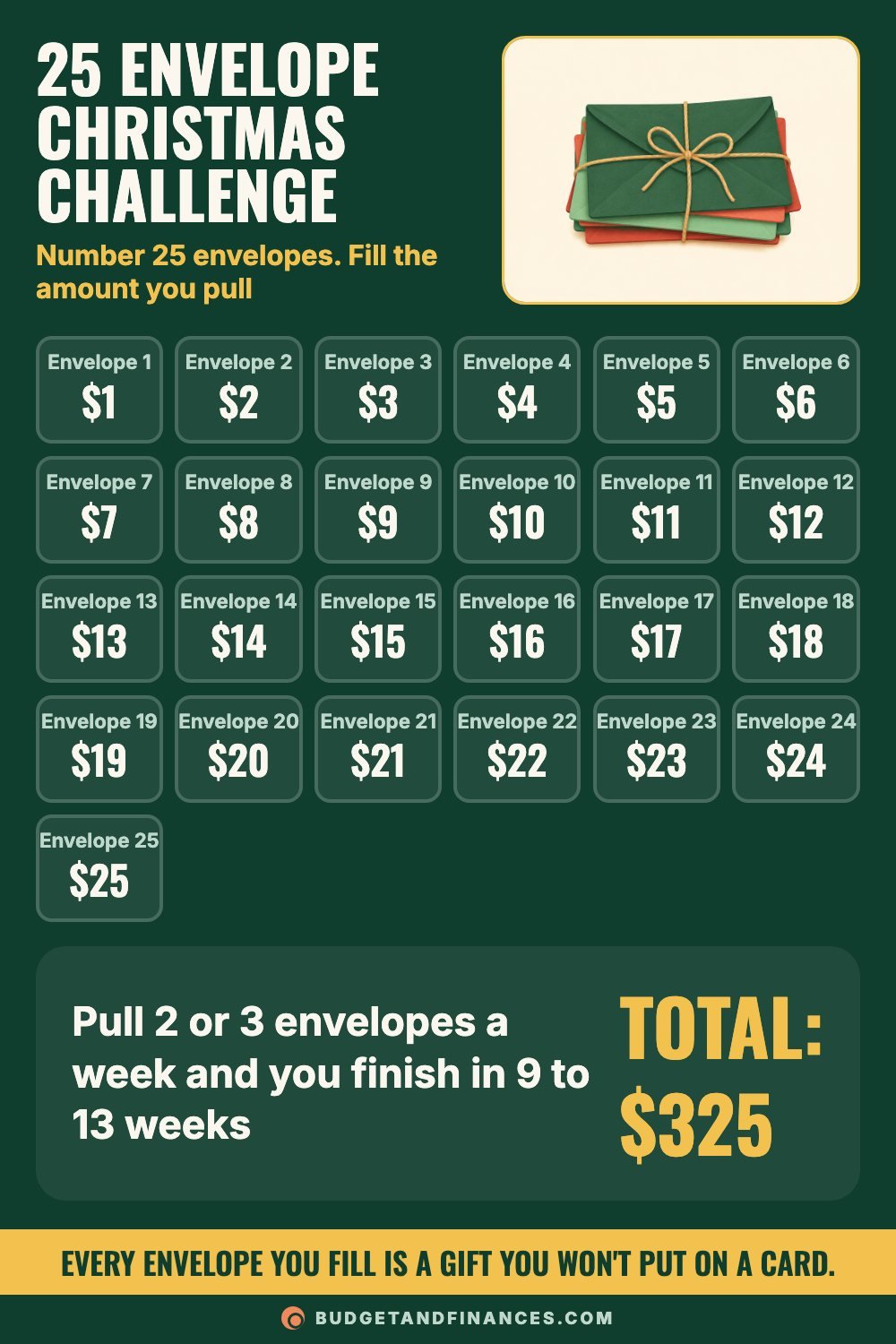
Challenge 1: The 25 envelope Christmas challenge
This is a smaller version of the 100 envelope challenge, sized for the holidays.
How it works
- Number 25 envelopes from 1 to 25.
- Shuffle them and keep them in a box.
- Each time you pull an envelope, put that many dollars inside. Envelope 7 gets $7. Envelope 22 gets $22.
- Fill all 25 and you have $325 for Christmas.
That total comes from adding 1 + 2 + 3 all the way to 25, which equals 325.
How long it takes
- Pull 3 envelopes a week and you finish in 9 weeks.
- Pull 2 envelopes a week and you finish in 13 weeks.
Start in October and you can finish before the holidays. On a tight week, pull a low number. On a good week, go for the twenties.
Challenge 2: Save $500 by Christmas chart
Some people prefer the same amount every time. This chart has 50 squares worth $10 each.
How it works
- Every time you set aside $10, color in one square.
- Fifty squares × $10 = $500.
How long it takes
- Color 5 squares a week ($50) and you’re done in 10 weeks.
- Color 4 squares a week ($40) and you’re done in 13 weeks, since 50 squares ÷ 4 is 12.5 weeks.
$10 at a time is how a cash Christmas happens.
Where to find Christmas money
Christmas money is usually hiding in everyday spending. Pick two of these to start this week.
- Sell unused items. Clothes, toys, decor, unused gear.
- Pause a subscription. Restart it in January if you miss it.
- Pack lunches. Move what you’d have spent eating out into the fund.
- No-spend weekends. Free plans at home, parks, or the library.
- Round-ups. Round purchases up and save the change. Some banking apps can do this for you, or you can do it by hand once a week.
- Extra shifts. Seasonal hours go straight to the fund. Remember that extra pay is taxed like the rest of your paycheck.
- Pantry week. Cook from what you have for a week and move the grocery savings over.
- Return it. Take back unused buys that still have receipts.
- Cash back. Move rewards and rebates into the fund instead of letting them disappear.
Worked example: a $500 Christmas in 12 weeks
Here’s how the pieces fit together for an example family starting in early October.
The goal: $500 in 12 weeks. The formula says $500 ÷ 12 = about $41.67 a week.
The chart: They use the save $500 chart. Four squares a week is $40, which is a little short. So they color 4 squares in 10 of the weeks and 5 squares in 2 of the weeks.
- 10 weeks × 4 squares = 40 squares
- 2 weeks × 5 squares = 10 squares
- Total: 50 squares × $10 = $500
Finding the money: In weeks 3-5, they sell a few things and pause a subscription. Those two weeks where they need 5 squares line up with the sales.
Spending it: Gifts come out of the fund in weeks 6-8, food and wrapping in weeks 9-10, and the last week’s $40 stays as a buffer.
Free printable: Christmas savings charts
The printable includes both challenges: the 25 envelope chart numbered 1 to 25, and the save $500 chart with 50 squares worth $10 each. Stick one on the fridge and color as you go.
Common mistakes
Mixing holiday money with everyday money. If it sits in checking, it gets spent on groceries. Give it its own spot.
Shopping before saving. Buying gifts in week 2 with money you plan to save in week 10 is how the January bill happens.
Picking a goal that’s too big. A goal you quit in week 4 saves less than a smaller goal you finish. Lower it early.
Forgetting food and wrapping. Save for the whole Christmas, not just the gifts.
Giving up after a missed week. Divide what’s left by the weeks remaining and keep going.
FAQ
How much should I save each week for Christmas?
Divide your total goal by the number of weeks left. A $300 Christmas over 12 weeks is $25 a week. A $600 Christmas is $50 a week.
When should I start saving for Christmas?
Early October gives you about 12 weeks. Starting sooner makes each weekly amount smaller.
How much does the 25 envelope challenge save?
$325, since the numbers 1 through 25 add up to 325.
What if I miss a week?
Take what you still need, divide it by the weeks left, and use that as your new weekly number. For example, if you need $200 more with 8 weeks left, that’s $25 a week.
Where should I keep my Christmas savings?
Somewhere separate from your everyday spending. A separate savings account or cash envelopes both work, as long as the money stays put until you shop.