

Gift shopping without a holiday gift budget list goes the same way every year. You buy something for the kids early, find a great deal for your sister, grab a few stocking stuffers, and in mid-December you add it up and feel sick.
The problem usually isn’t one expensive gift. It’s that nobody decided how much each person gets before the shopping started.
A gift budget list fixes that. Every name gets a limit, every purchase gets written down, and you can see your total at a glance. This guide shows you how to set one up, with an example $600 budget, low-cost gift ideas, and a free printable.
Step 1: Set one total gift budget
Start with the whole number, then split it. Pick a total you can pay in cash by the time you shop. If you’re also budgeting for holiday food, travel, and decorations, the gift number is just one piece of that.
Step 2: List every person
Write down everyone you plan to buy for. Then go back and add the ones people forget:
- Teachers, coaches, and bus drivers
- Babysitters and helpful neighbors
- Office, school, and friend gift swaps
- Hosts you’ll visit over the holidays
It’s much easier to decide someone gets a card and cookies now than to panic-buy the night before.
Step 3: Split the total by group
Deciding the split first makes the shopping easy. Here’s one way to split an example $600 holiday gift budget across everyone on your list.
| Group | Share | Amount | Examples |
|---|---|---|---|
| Kids | 40% | $240 | Your own kids’ main gifts |
| Partner | 15% | $90 | One thoughtful gift or a shared experience |
| Parents | 15% | $90 | Parents and in-laws, split evenly |
| Extended family | 10% | $60 | Siblings, nieces, nephews, or a family name draw |
| Friends and teachers | 10% | $60 | Close friends, teachers, coaches, neighbors |
| Stocking stuffers | 5% | $30 | Small treats, socks, practical extras |
| Wrapping and cards | 5% | $30 | Paper, bags, tape, tags, cards |
| Total | 100% | $600 |
Change the percentages to fit your family. A family without kids might give that 40% to extended family or giving. A family with a big name draw might need less for extended family.
Step 4: Write a limit next to each name
Now turn the group amounts into per-person limits.
Worked example: the $600 list
- Kids: 2 kids at $120 each = $240
- Partner: $90
- Parents: parents and in-laws at $45 per couple = $90
- Extended family: a family name draw with a $60 limit = $60
- Friends and teachers: 4 teachers and coaches at $10 each ($40) plus 2 close friends at $10 each ($20) = $60
- Stocking stuffers: 3 stockings at $10 each = $30
- Wrapping and cards: $30
That’s $600 exactly, with every name on the page before anything goes in a cart.
When the real price is different
Say the gift for one child costs $112 instead of $120. Write $112 next to their name and move the $8 left over to a buffer line. If the next gift runs $5 over, the buffer covers it. That’s how the list stays honest.
Gift budget rules before you shop
These rules keep the list in charge instead of the store.
Before you shop
- Set one total gift budget you can pay in cash.
- List every person, including teachers and gift swaps.
- Write a dollar limit next to each name.
While you shop
- Shop from the list, not the store displays.
- Compare prices in two places before buying.
- Keep receipts together in one envelope.
After each purchase
- Write the real price next to the name.
- Move leftover money to the buffer.
- Hide and label gifts so nothing gets bought twice.
The list decides what you buy. The store doesn’t.
Low-cost gifts people actually like
The gifts people keep are rarely the expensive ones. These go easy on your gift budget and work for family, friends, teachers, and neighbors.
- Baked treats. Cookies or bread in a reusable tin.
- Printed photos. A framed photo or a small photo book.
- Favor coupons. Babysitting, a car wash, or a cooked meal.
- Plant cutting. Rooted and potted in a thrifted pot.
- Movie night kit. Popcorn, cocoa, and a movie pick.
- Used books. Hand-picked with them in mind.
- Handwritten letter. What they mean to you, in writing.
- Something handmade. Knit, sewn, painted, or built.
- Mix in a jar. Dry soup or cookie mix, layered in a jar with the instructions attached.
Which one could you make this week? Homemade gifts still cost something for supplies, so give them a line on your list too.
Gifts for everyone vs a family name draw
Buying for every relative gets expensive fast. A name draw is the biggest single cut many families can make.
Gifts for everyone
Best for small families.
– Everyone gets something from everyone.
– Cost grows with every person you add.
– More shopping, wrapping, and shipping.
– Works best with a low per-person limit.
Family name draw
Best for big families.
– Each adult buys one gift for one person.
– One clear spending limit for the whole group.
– One better gift instead of many small ones.
– Kids can stay outside the draw.
The math on a big family
Say 8 adults each buy for the other 7 at $25 a gift. Each person spends 7 × $25 = $175, and the group spends $1,400 in total.
With a name draw and a $50 limit, each person spends $50 and the group spends $400. Everyone still gets a gift, and it’s a nicer one.
How to suggest a name draw to relatives
This is the part people dread. A few things make it easier.
- Bring it up early. Before anyone starts shopping, ideally by early fall. Late suggestions feel awkward for people who already bought.
- Keep the reason simple. Something like “We’re trying to keep Christmas simpler this year. Would anyone be up for drawing names for the adults?” You don’t owe anyone a detailed explanation of your finances.
- Suggest a clear limit. A shared number means nobody feels outdone.
- Keep the kids in. Many families still buy for the kids and draw names only for adults.
- Make the draw easy. Draw names at a family gathering, over a group text, or with a free online name-drawing tool.
- Expect a mix of reactions. Some relatives will be relieved. If someone wants to keep buying for everyone, that’s their call. You can still stick to your list.
Free printable: holiday gift budget list
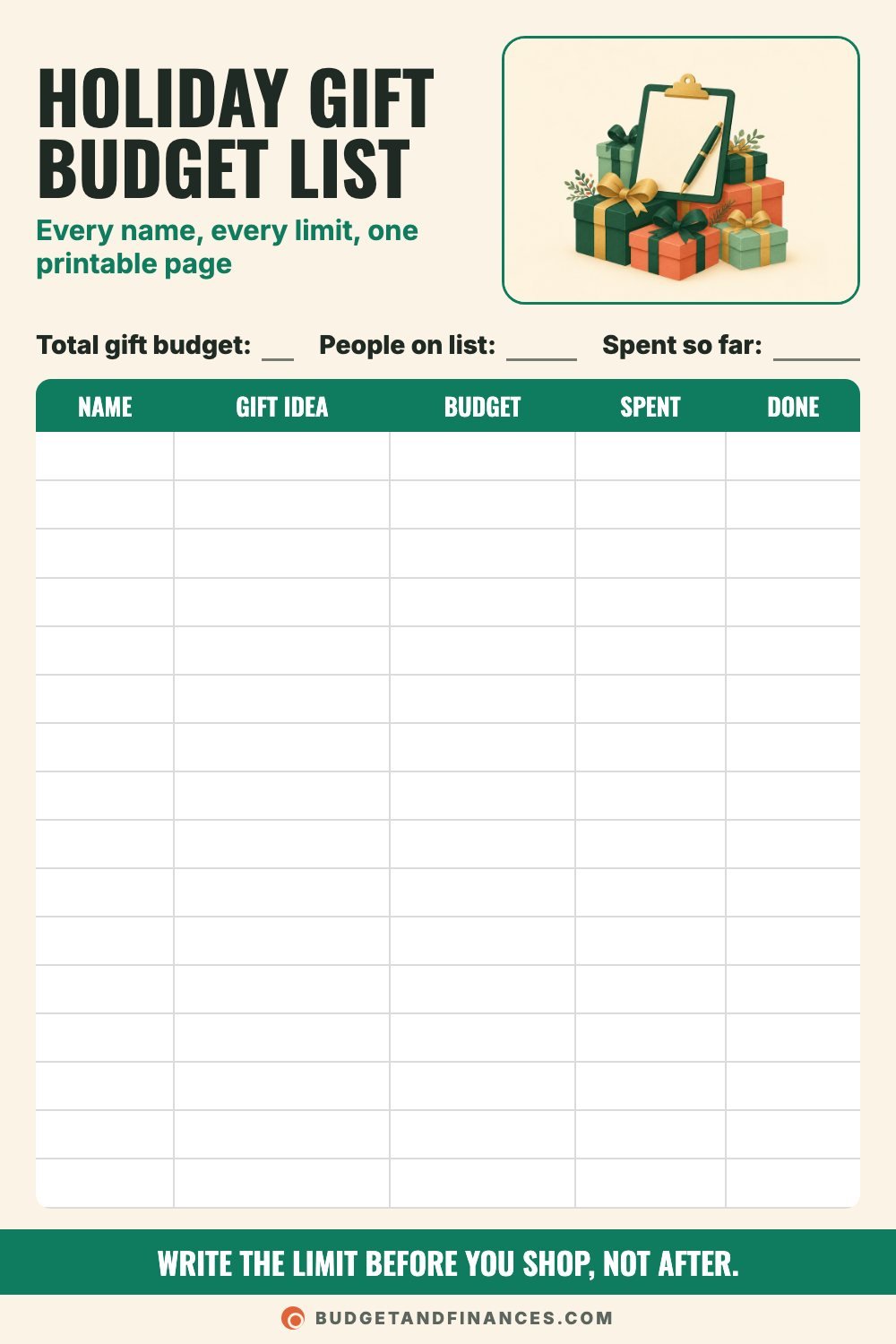
The printable has spaces at the top for your total gift budget, the number of people on your list, and what you’ve spent so far. Below, there are 16 rows with columns for Name, Gift idea, Budget, Spent, and Done.
Write the limit before you shop, not after.
Common mistakes
Setting a total but no per-person limits. A total alone won’t stop you from overspending on the first few names.
Forgetting the small names. Teachers, swaps, and hosts add up. Put them on the list from the start.
Not writing down real prices. If you only write the budget, you can’t see when you’ve gone over.
Buying the same gift twice. Label and hide gifts as you buy them, and tick the Done column.
Leaving wrapping off the list. Paper, tags, and cards are part of the gift budget.
FAQ
How much should I spend on Christmas gifts per person?
Start with a total you can pay in cash, then split it by group and divide by the number of people. The example gives $120 per child, $45 per set of parents, and $10 per teacher, but your numbers depend on your total.
How do I split a gift budget between kids?
Equal dollar limits are the simplest and feel fair. Some families match the number of gifts instead. Pick one approach and use it for every child.
Is it rude to suggest a gift exchange instead?
Suggested kindly and early, most people see it as practical. Many relatives are feeling the same pressure and are glad someone said it.
What should I do with money left over on the list?
Move it to a buffer line. If you finish with money still in the buffer, it can start next year’s gift fund.