

A Christmas budget rarely goes over because of one big gift. It goes over because of fifty small things nobody wrote down.
Wrapping paper. A teacher gift. Gas to see family. An extra grocery run when guests stay longer. Each one feels too small to plan for, and together they end up on a credit card.
The fix is a plan that covers every category, made early enough to save for it. This guide walks you through it, with an example $1,000 Christmas budget you can scale up or down to your own number.
- Step 1: Set your number
- Step 2: Split the total across every category
- Step 3: Add the costs people forget
- Step 4: Make your lists
- Step 5: Cut costs early
- Worked example: a $1,000 Christmas, start to finish
- Step 6: Stay on track while you shop
- Free printable: Christmas budget tracker
- Common mistakes
- FAQ
Step 1: Set your number
Everything starts with one total. Do this first, before any lists or shopping.
Pick a total you can pay in cash by December
Look at what you can realistically set aside between now and Christmas. Cash here means money you already have, not a card you’ll pay off later.
Check what’s already saved or coming in
Count any holiday savings you already have. If you expect extra money before December, like a work bonus that’s confirmed, you can include it. If it’s only a maybe, leave it out.
Divide by the weeks left
Subtract what’s already saved from your total. Divide what’s left by the number of weeks until you shop. That’s your weekly savings number.
Step 2: Split the total across every category
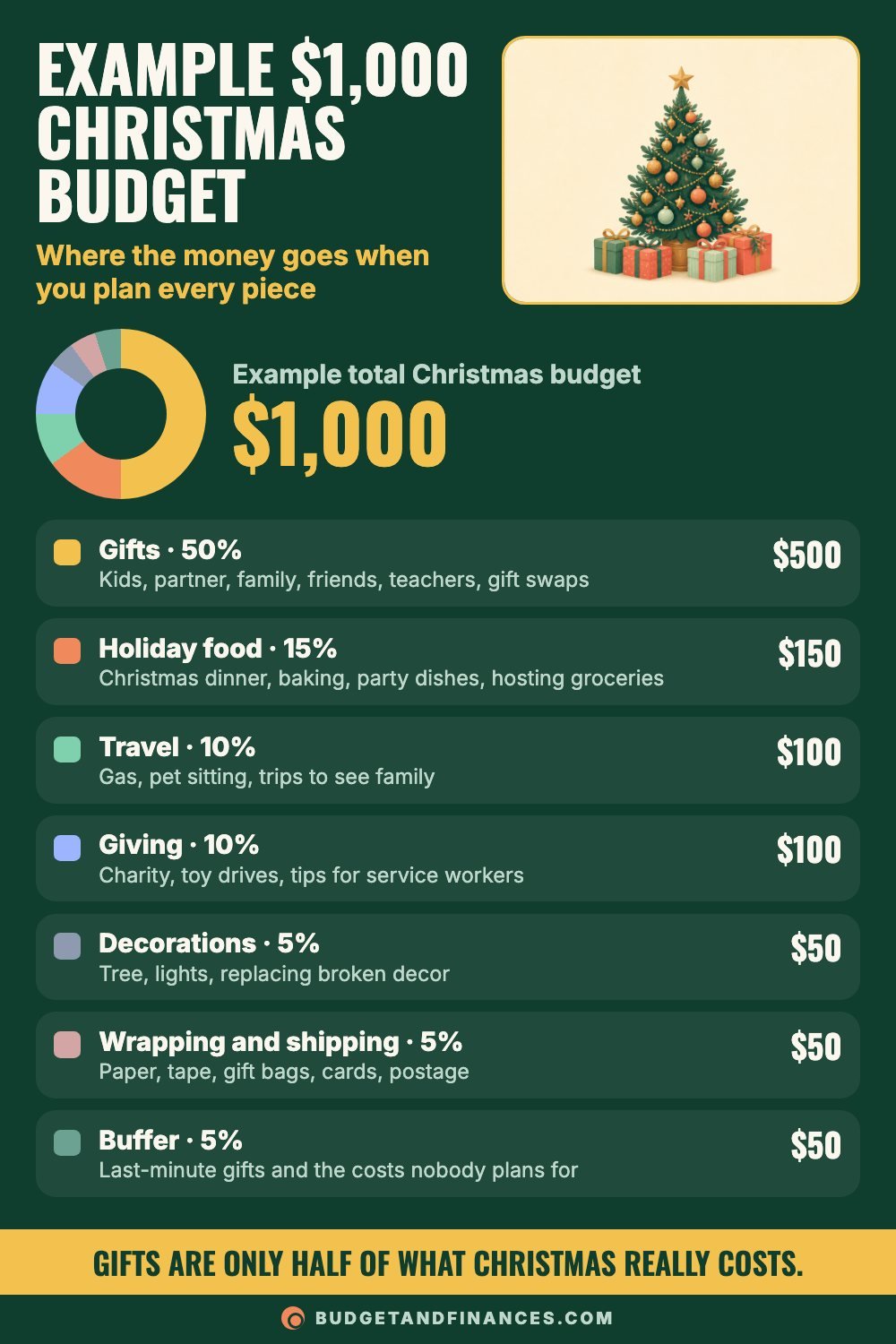
Gifts are only half of what Christmas really costs. Here’s an example $1,000 Christmas budget and where the money goes when you plan every piece.
| Category | Share | Amount | What it covers |
|---|---|---|---|
| Gifts | 50% | $500 | Kids, partner, family, friends, teachers, gift swaps |
| Holiday food | 15% | $150 | Christmas dinner, baking, party dishes, hosting groceries |
| Travel | 10% | $100 | Gas, pet sitting, trips to see family |
| Giving | 10% | $100 | Charity, toy drives, tips for service workers |
| Decorations | 5% | $50 | Tree, lights, replacing broken decor |
| Wrapping and shipping | 5% | $50 | Paper, tape, gift bags, cards, postage |
| Buffer | 5% | $50 | Last-minute gifts and the costs nobody plans for |
| Total | 100% | $1,000 |
If your budget is $500, halve each amount. If it’s $1,500, multiply each by 1.5. The percentages are a starting point. A family that hosts Christmas dinner might move money from travel to food.
Step 3: Add the costs people forget
Before you finalize the split, run through this list. These are the costs that quietly break a holiday budget.
- Wrapping: paper, tape, bags, tags, and bows
- Shipping gifts: postage for out-of-town family
- Teacher gifts: teachers, coaches, bus drivers, sitters
- Holiday outfits: photos, parties, church, school shows
- Travel gas: driving to see family adds up
- Hosting food: extra groceries when guests come
- Gift swaps: office, school, and friend exchanges
- Stocking stuffers: small items that quietly add up
- Batteries: for every toy that needs them
How many are already in your budget? Any that aren’t should get a line, even a small one. The surprise costs are the ones that end up on a credit card.
Step 4: Make your lists
List every person you plan to buy for
Include the people you forget until the week before: teachers, coaches, a neighbor who helps out, the office gift swap.
Write a dollar limit next to each name
Do this before you shop. A limit decided at home is much easier to keep than one decided in front of a store display.
Add food, travel, decor, and wrapping lines
Give each of these its own line with a number, just like the gift names.
Step 5: Cut costs early
Planning in October gives you room to spend less without feeling it in December.
Suggest a name draw for the adults
One gift per adult instead of gifts for everyone. Kids can still get gifts. Bring it up early, before anyone has started shopping.
Check your closet for gifts already bought
Many people pick up gifts during the year and forget them. Look before you shop.
Try the four-gift rule for kids
Something they want, something they need, something to wear, something to read. It keeps the pile reasonable and the list easy.
Give experiences
A day out, a baking afternoon, or a movie night at home can mean more than another toy.
Bake instead of buy
Cookie tins and homemade treats cover coworkers, neighbors, and teachers for much less than store-bought gifts.
Plan the holiday menu around cheap staples
Potatoes, rice, bread, and a big pot of something go a long way when you’re feeding a crowd.
Order early
Shopping ahead means you don’t pay extra for rush shipping.
Worked example: a $1,000 Christmas, start to finish
Here’s how the plan looks for an example family.
Setting the number. They pick $1,000. They already have $200 saved and 10 weeks until they shop. That leaves $800 to save, and $800 ÷ 10 = $80 a week.
Splitting the $500 gift line:
- Two kids at $120 each: $240
- Partner: $80
- Two sets of parents at $40 each: $80
- Three teachers at $10 each: $30
- Sibling name draw: $30
- Office gift swap: $20
- Stocking stuffers: $20
That adds up to exactly $500. Every name has a number before a single gift is bought.
The other $500 follows the table above: $150 food, $100 travel, $100 giving, $50 decorations, $50 wrapping and shipping, and $50 buffer.
When something runs over. Say the kids’ gifts come in at $255 instead of $240. That’s $15 over. They move $15 from the buffer, which drops to $35, and write it down the same day.
Step 6: Stay on track while you shop
Log every purchase the day you make it
Waiting until the weekend means forgetting a few. Log it that day.
Keep all receipts in one envelope
It makes returns easy and keeps your tracker honest.
Shop with cash envelopes if that helps
Put each category’s money in an envelope. When it’s empty, that category is done.
When a category hits zero, stop or move money over
Moving money is fine. Just take it from another category, usually the buffer, and write down the change.
Free printable: Christmas budget tracker
The tracker keeps all your holiday spending on one page. At the top, write your total budget, what you’ve saved so far, and your weekly savings number. Below, track each category’s budget, what you’ve spent, and what’s left.
Track it as you go and December has no surprises.
Common mistakes
Budgeting for gifts only. Food, travel, wrapping, and giving can add up to as much as the gifts. Plan for all of it.
Starting in December. With a few weeks left, the weekly savings number gets painful. October gives you room.
No buffer. Something always comes up. A small buffer keeps it off a credit card.
Setting limits after shopping. A limit written after the purchase can’t stop the purchase.
Counting money you don’t have yet. A possible bonus isn’t Christmas money until it’s in your account.
FAQ
How much should I budget for Christmas?
Pick a total you can pay in cash by December based on what you can save each week. There’s no right amount. The right number is the one that doesn’t follow you into January.
When should I start saving for Christmas?
October works well for many families. Starting earlier makes each weekly amount smaller.
What percentage of a Christmas budget should go to gifts?
The example uses 50%, which leaves room for food, travel, giving, decorations, wrapping, and a buffer. Adjust it to how your family celebrates.
How do I tell family we’re spending less this year?
Keep it simple and early. Suggest a name draw or a per-person limit before anyone starts shopping, and frame it as a way for everyone to enjoy the season with less stress.
What if I’ve already overspent?
Stop and total what you’ve spent so far. Return anything you don’t need, move money from other categories, and use the buffer. Then write every purchase down from here on.