

You’d like a real chunk of savings, not a few hundred dollars. But a plain goal like “save $5,000” is hard to start and even harder to stick with, at least without a 100 envelope challenge to break it up.
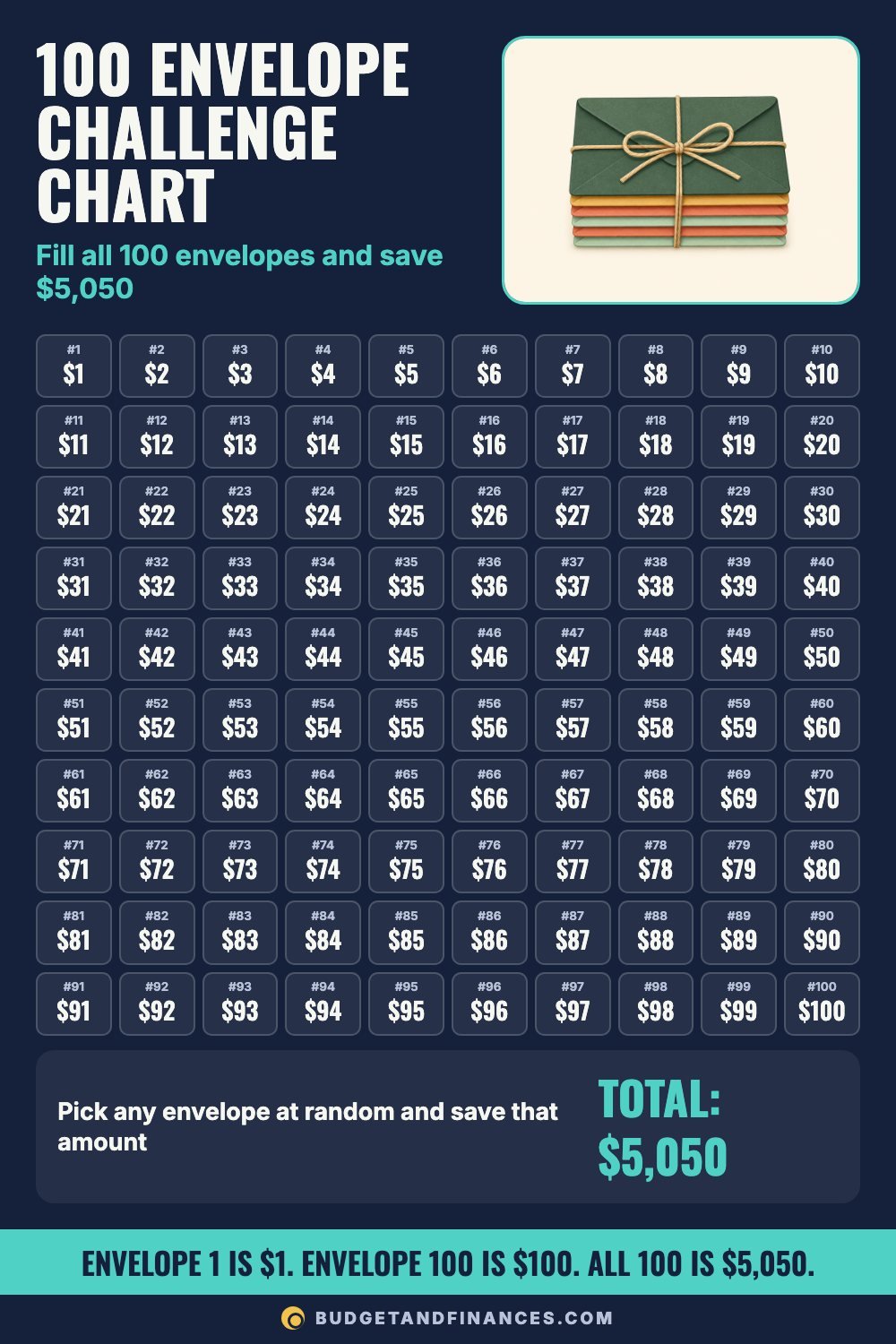
The 100 envelope challenge turns that big goal into 100 small draws. You number envelopes from 1 to 100, pull one at random, and save that many dollars. Envelope 1 is $1. Envelope 100 is $100. Fill all 100 and you have $5,050.
The random draw makes it feel a bit like a game. And you get to choose how fast you go, which matters a lot when you draw envelope 97 on a tight week.
- How much money is the 100 envelope challenge?
- How the 100 envelope challenge works
- Step 1: Gather your supplies
- Step 2: Make three decisions
- Step 3: Draw, save, cross it off
- Tips for real budgets
- Worked example: the 50-week pace
- Start smaller: the 50 envelope challenge
- Get the free printable chart
- Common mistakes
- FAQ
How much money is the 100 envelope challenge?
The full 100 envelope challenge saves $5,050. Each envelope is worth its own number in dollars, so the total is 1 + 2 + 3 and so on up to 100. Pair the envelopes from the outside in (1 + 100, 2 + 99, 3 + 98) and you get 50 pairs of $101, which is $5,050. The smaller 50 envelope challenge comes to $1,275.
How the 100 envelope challenge works
- Number 100 envelopes (or slips of paper) from 1 to 100.
- Put them in a box and mix them up.
- On each draw day, pull one out.
- Save that exact number of dollars.
- Cross the number off your chart.
Add up 1 + 2 + 3 all the way to 100 and you get $5,050. That’s the total no matter what order you draw them in.
You can save cash in the actual envelopes or skip the cash entirely. Plenty of people just cross off the number and transfer that amount to a savings account.
Step 1: Gather your supplies
- 100 envelopes or 100 slips of paper
- A marker to number them 1 to 100
- A box or bin to hold them
- The printable tracking chart
Slips of paper are cheaper and take up less space. Envelopes are nice if you plan to save cash inside them.
Step 2: Make three decisions
Your pace
The original version is one envelope a day for 100 days. That’s a lot of money in a short time. You can spread it out as long as you need to.
| Pace | Draws | Average saved |
|---|---|---|
| 100 days | 1 envelope a day | $50.50 a day |
| 20 weeks | 5 a week | $252.50 a week |
| 25 weeks | 4 a week | $202 a week |
| 50 weeks | 2 a week | $101 a week |
| 100 weeks | 1 a week | $50.50 a week |
| Your own pace | Any order, any timeline | $5,050 total |
These are averages. $5,050 divided by 100 envelopes is $50.50 per envelope, so your actual amount each week depends on which numbers you draw. Some weeks will be well above the average and some well below.
Cash or transfers
Cash in envelopes is satisfying and visual. Transfers to savings are safer and easier. You can also mix them: draw the envelope, then transfer the amount.
What the $5,050 is for
Write it on your chart. An emergency fund, a car, a move. A named goal is harder to walk away from.
Step 3: Draw, save, cross it off
Every draw follows the same three steps: pull an envelope, save that exact amount, cross the number off your chart. Repeat 100 times.
Check your total once a month. Seeing $1,000 or $2,000 already saved is what keeps you drawing when the numbers get big.
Tips for real budgets
Draw on payday. Pick your envelopes the day money comes in, not days later when it’s already spent.
Allow a redraw. Big number on a lean week? Put it back once and draw again. Set this rule before you start so it doesn’t turn into drawing until you get a small one.
Save digitally. Skip the cash. Cross off the number and transfer that amount to savings.
Don’t keep $5,050 at home. If you use cash, deposit it often. A big pile of cash at home is a risk.
Stretch the timeline. Choose a pace your budget can carry. Finishing late beats quitting.
Keep a few small ones back. Set aside a few low numbers to draw on weeks when money is tight.
Worked example: the 50-week pace
Say you get paid every week and $101 a week sounds doable. You choose the 50-week pace: two envelopes each payday.
Week 1. You draw envelopes 34 and 8. You transfer $42 to savings and cross both numbers off.
Week 2. You draw 91 and 77. That’s $168, which is well above the $101 average. You planned for this: you use your one redraw, put 91 back, and pull 22. That week costs $99.
Week 3. You draw 5 and 60 and save $65.
After three weeks you’ve saved $42 + $99 + $65 = $206 and crossed off 6 of 100 envelopes. Remember that 91 is still in the box. The high numbers don’t disappear when you redraw them, so the average evens out over the whole challenge.
At two envelopes a week, you draw your 100th envelope in week 50 and finish with $5,050.
Start smaller: the 50 envelope challenge
If $5,050 feels like too much right now, start with half.
Number envelopes 1 to 50 instead. Draw them the same way. Envelopes 1 to 50 add up to $1,275. That’s a strong first goal, and it’s enough to cover a $1,000 starter emergency fund with some left over.
When you finish, you’re not starting over. Envelopes 51 to 100 add up to $3,775 more. Do those next and you’ve completed the full challenge: $1,275 plus $3,775 is $5,050.
Get the free printable chart
The chart lists all 100 envelope numbers so you can cross each one off as you draw it, whether you save cash or transfer to savings. There’s room at the top to write your pace and your goal.
Common mistakes
Choosing a pace that’s too fast. 100 days averages $50.50 a day. Unless that fits your income easily, pick a longer timeline from the start.
Keeping all the cash at home. By the halfway point you could have thousands of dollars in a box. Deposit cash in a savings account often.
Redrawing every big number. One redraw is a safety valve. Redrawing until you get something small just leaves all the big envelopes for the end.
Drawing after the money’s gone. If you draw on a Thursday and got paid on Monday, the money may already be spent. Draw on payday.
Not tracking. Envelopes get lost and numbers get forgotten. Cross every number off the chart.
FAQ
How much do you save with the 100 envelope challenge?
$5,050. That’s every number from 1 to 100 added together. The half-size 50 envelope version saves $1,275.
How long does the 100 envelope challenge take?
As long as you want. One envelope a day takes 100 days and averages $50.50 a day. Two a week takes 50 weeks and averages $101 a week. One a week takes 100 weeks.
Do I have to use real envelopes and cash?
No. You can use slips of paper and transfer each amount to a savings account instead. Many people find that safer and easier.
What if I draw a big number on a tight week?
Decide on a redraw rule before you start, like one redraw per week. Put the big envelope back and pull again. You can also keep a few small numbers aside for tight weeks.
Can I do the 100 envelope challenge with a partner?
Yes. You can split each draw or take turns drawing. Just agree on the pace and where the money goes before you start.