Cards make spending feel weightless. You tap, the screen says approved, and the total disappears into an app, and by the end of the month the grocery and takeout lines are twice what you meant them to be, the exact problem a cash envelope system fixes.
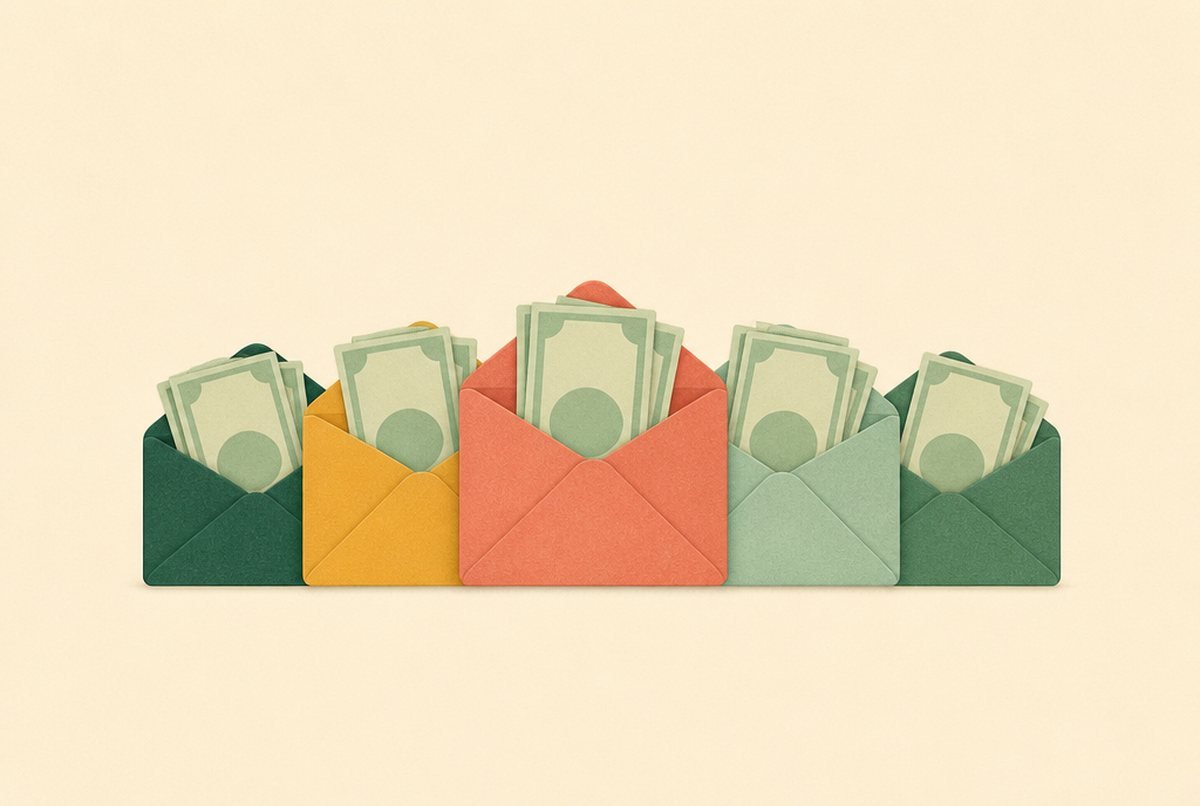
The cash envelope system fixes that by making spending physical again. You put a set amount of cash for each category into its own envelope. When the envelope is empty, that category is done until next payday.
Your bills stay on autopay. Cash only covers the everyday spending that’s easy to overdo.
How the cash envelope system works
You pick a handful of spending categories, decide how much each one gets for the month, withdraw that cash on payday, and divide it into labeled envelopes.
Then you follow a few rules:
- An empty envelope means that spending stops.
- If you really need more, borrow from another envelope, never from a card.
- Leftover cash rolls over to next month or goes to savings.
That’s it. The system works because you can see and feel exactly how much is left.
Step 1: Pick your envelopes
Choose 4-8 categories where you tend to overspend. Groceries, gas and dining out are good starters. If you’re brand new, start with just three envelopes, like groceries, gas and fun money, and add more once those feel easy. To plan every category, including the ones you pay by card, start with a monthly budget template.
Leave rent and bills on autopay. Envelopes are for spending, not fixed bills.
Here are nine category ideas. Pick the ones where money slips away:
- Groceries: food and household basics.
- Gas: fill-ups and parking.
- Eating out: takeout, coffee, drive-thru.
- Personal care: haircuts, toiletries, makeup.
- Fun money: movies, hobbies, nights out.
- Gifts: birthdays and holiday presents.
- Kids: activities, school extras, allowance.
- Pets: food, treats, grooming.
- Clothing: seasonal basics and shoes.
A good first move is to choose your top four.
Step 2: Set your amounts
For each envelope, average what you spent in that category over the last 3 months. That gives you a realistic starting number instead of a hopeful one.
Round to amounts that are easy to withdraw. If you’re paid biweekly, split each monthly amount in half so you fill the envelopes a little at a time on each payday.
Step 3: Fill the envelopes
Withdraw the cash once, on payday. Then:
- Label each envelope with its category and amount.
- Keep them together in one wallet or zip pouch.
- Ask for small bills. Tens and fives make it easier to pay close to exact and see what’s left.
Step 4: Follow the rules
The system only works if an empty envelope actually means stop. If you top up envelopes with a card or an extra ATM trip mid-month, they turn back into a regular checking account.
A cash envelope budget example
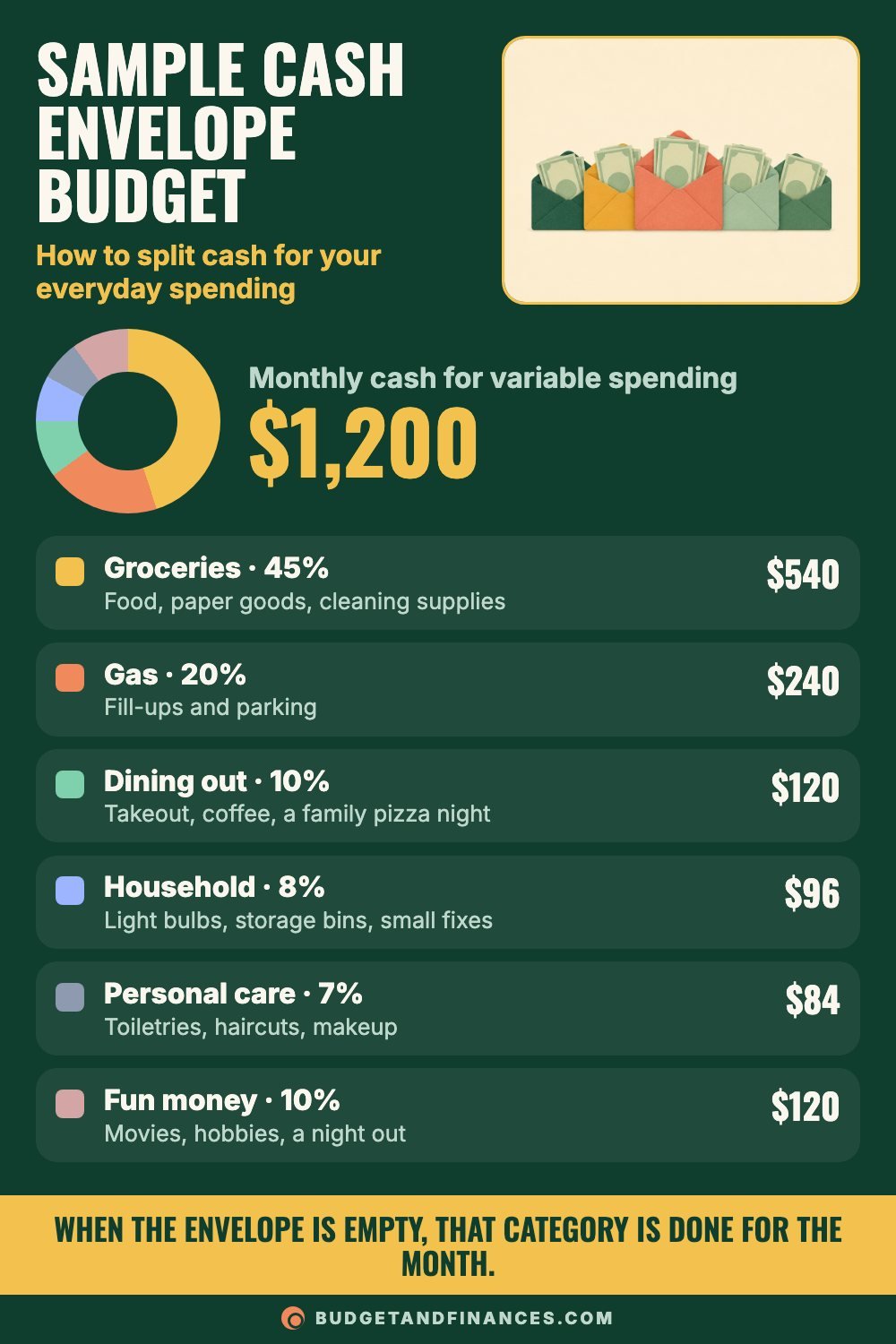
Say you set aside $1,200 a month in cash for variable spending. Bills like rent, utilities and insurance are paid separately. Here’s one way to split it:
| Envelope | Share | Monthly cash | What it covers |
|---|---|---|---|
| Groceries | 45% | $540 | Food, paper goods, cleaning supplies |
| Gas | 20% | $240 | Fill-ups and parking |
| Dining out | 10% | $120 | Takeout, coffee, a family pizza night |
| Household | 8% | $96 | Light bulbs, storage bins, small fixes |
| Personal care | 7% | $84 | Toiletries, haircuts, makeup |
| Fun money | 10% | $120 | Movies, hobbies, a night out |
| Total | 100% | $1,200 |
If you’re paid every two weeks, you’d withdraw $600 per paycheck and fill each envelope with half its amount: $270 for groceries, $120 for gas, $60 for dining out, $48 for household, $42 for personal care and $60 for fun money.
To keep week one from eating the whole grocery budget, divide the $540 into four weekly amounts of $135. Put each week’s cash in its own small envelope inside the grocery envelope.
If $96 and $84 are awkward to withdraw, round them to $95 and $85. They still add up to $180, so the total stays at $1,200.
Cash vs digital envelopes
You can run the same method without paper envelopes. Both versions have tradeoffs.
Cash envelopes
Best if cards trip you up.
- You feel every bill leave your hand.
- You can’t overdraft a paper envelope.
- It needs a trip to withdraw cash.
- It doesn’t work for online orders.
- Cash can be lost or stolen.
Digital envelopes
Best for online shoppers.
- Uses separate accounts or a budgeting app.
- Works for online bills and orders.
- Easier to track and adjust.
- Card swipes feel less real.
- Takes discipline to stop at zero.
You don’t have to choose just one. A mix works well for a lot of people: cash for groceries, digital for everything you buy online. A good rule is to try cash for the categories where cards get you in trouble.
Tips that keep the system running
Start with three envelopes. Groceries, gas and fun money. Add more once those feel easy.
Ask for small bills. Tens and fives make it easier to see what’s left.
Split groceries by week. Weekly amounts stop the first week from eating the month.
Keep receipts inside. Tuck each receipt into its envelope. The month-end review then takes about five minutes.
Refill only on payday. Topping up mid-month defeats the purpose.
Save the leftovers. Move unspent cash to savings, or let it roll over into next month’s envelope.
Drop coins in a jar. Collect loose change from envelope purchases and deposit it when the jar fills.
Get the free envelope labels
The printable labels have a spot for the category name, the monthly amount, and the per-paycheck amount if you’re paid biweekly. Print them, cut them out, and stick them on plain envelopes.
Common mistakes
Putting bills in envelopes. Rent and utilities are usually paid online and don’t need cash. Keep envelopes for spending you control day to day.
Starting with too many envelopes. Ten envelopes on day one is a lot to manage. Start with three or four.
Setting amounts too low. An envelope based on wishful thinking runs out in a week. Use your three-month average, then trim a little at a time.
Grabbing a card when an envelope runs out. That quietly undoes the whole system. Borrow from another envelope instead, and adjust the amounts next month.
Carrying all the cash everywhere. Take only the envelopes you need for the trip you’re making. The rest can stay home.
FAQ
Is it safe to keep that much cash at home?
Keep only your spending envelopes at home, store them somewhere secure, and consider withdrawing per paycheck instead of monthly so less cash is on hand at once. If that still feels risky, digital envelopes might suit you better.
What happens to money left in an envelope at the end of the month?
You choose. Roll it into the same envelope next month, which helps with uneven costs like clothing, or move it to savings.
Can I use cash envelopes if I’m paid biweekly?
Yes. Split each monthly amount in half and fill the envelopes a little on each payday.
What if I have to buy groceries online?
Use a digital envelope for that category, or set aside the cash and deposit it back into checking to cover the online order. The key is that the spending still comes out of the envelope’s amount.
How long should I try it before deciding if it works?
Give it at least two or three months. The first month usually shows you which amounts need adjusting.