

Black Friday is built to make you spend more than you planned. Countdown timers, doorbuster limits, and “was” prices all push the same button: buy now or miss out.
You can still use the sales. You just need to make the decisions before the ads do.
This guide gives you a week-by-week prep checklist, seven rules to stay on budget, a way to tell a real deal from a fake one, and a tracker to log every purchase. It’s only a deal if it was already in the budget.
One week before: plan it
Set a total spending limit for the weekend
Pick one number for the whole sale weekend. It should come out of money you already have, usually your holiday gift budget. If you haven’t set one yet, do that first.
List each item and who it’s for
Write down what you need and who it’s for. Decide this before the ad previews come out, so the ads don’t decide for you.
Write a max price next to each item
This is the most you’ll pay. Above that number, you walk away, no matter how big the discount looks.
Night before: do the homework
Compare prices at 2 or 3 stores
Look up each item at a few retailers. Some stores match prices. Many don’t.
Check the price history
Look up what the item sold for in past months. Many online stores and browser price trackers show price history. Some Black Friday prices aren’t lower than a normal sale earlier in the year.
Unsubscribe from sale emails you don’t need
Every email is another invitation to add something that isn’t on your list.
Remove saved cards from shopping sites
One extra step at checkout is a small pause, and a small pause is often enough.
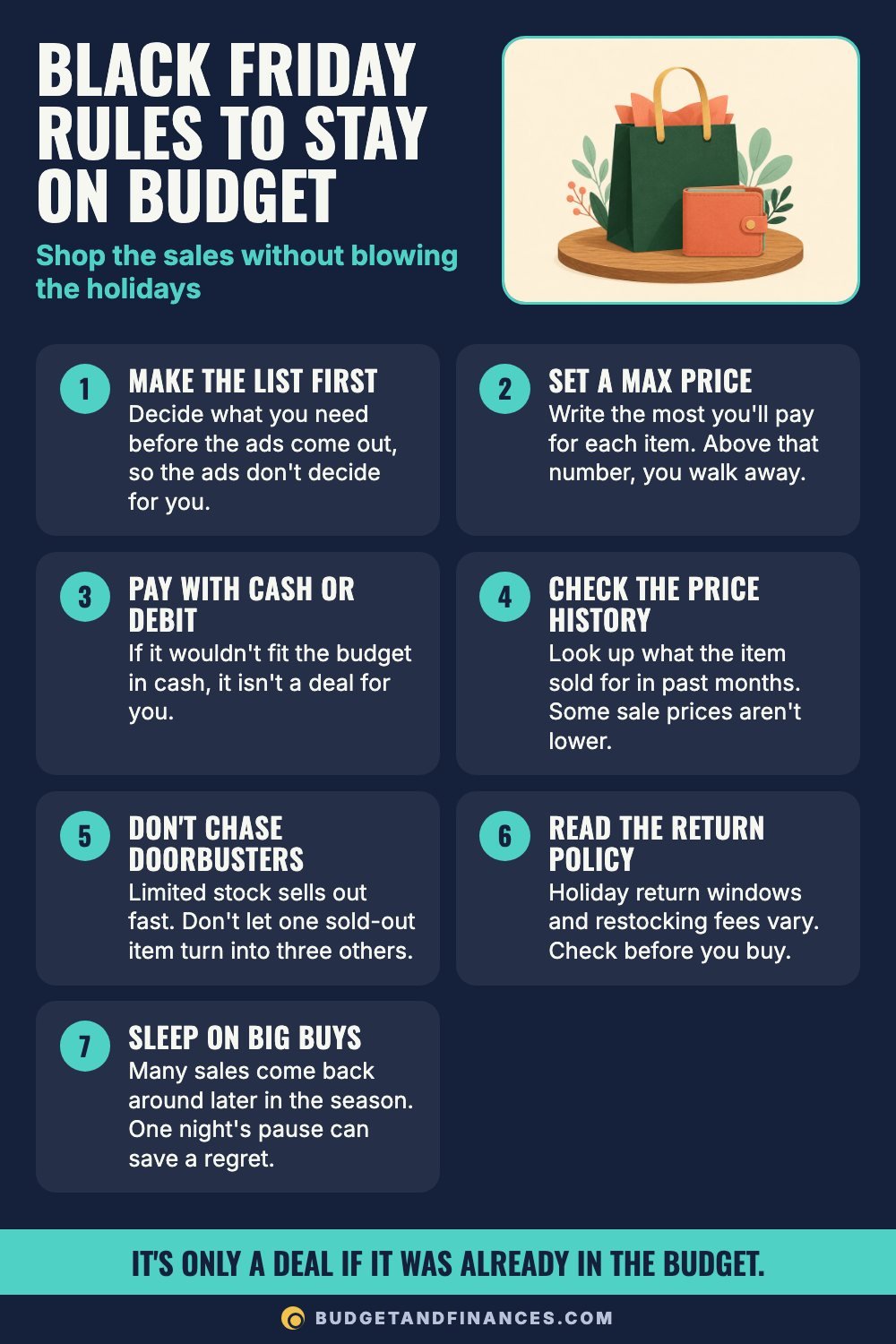
While shopping: 7 rules to stay on budget
1. Make the list first
You already did this. Now shop only from it.
2. Set a max price and keep it
Above your max price, you walk away. The item often comes back around later.
3. Pay with cash or debit
If it wouldn’t fit the budget in cash, it isn’t a deal for you. Financing and buy now, pay later plans make a price feel smaller than it is.
4. Check the price history
A big percentage off a price the item never actually sold for isn’t a discount.
5. Don’t chase doorbusters
Limited stock sells out fast. Don’t let one sold-out item turn into three other purchases you didn’t plan.
6. Read the return policy
Holiday return windows and restocking fees vary by store. Check before you buy, especially for electronics.
7. Sleep on big buys
Many sales come back around later in the season. One night’s pause can save a regret.
At the register or checkout: check the cart total before you pay, and skip store credit card offers. A one-time discount can cost far more if you carry a balance at the card’s interest rate.
Real deal vs fake deal
Here’s how to tell before you pay.
A real deal
- It was already on your list.
- It’s lower than its recent price history.
- You’d buy it at this price any week.
- It fits your max price and your total limit.
A fake deal
- You found it while scrolling the sale.
- The “was” price is one you never saw.
- The discount nudges you toward a pricier model.
- It needs a store card or extra spending to get it, like “spend $100, get $20 off.”
A discount on something you didn’t need is still money spent.
Six questions to ask before you buy
Run through these for anything that goes in your cart. Six yeses, then buy it.
- Is it on my list? If not, it waits a week.
- Can I pay cash? No financing, no carrying a balance.
- Is it really lower? Check the price history first.
- Where will it go? No spot at home often means no real need.
- Can I return it? Know the window before you buy.
- Will I want it tomorrow? Sleep on anything over your limit.
A 10-second pause beats a 30-day return.
After: log it and protect your savings
Log every purchase against your limit
Write it down the same day. The weekend blurs together fast.
Save receipts and note return deadlines
Put receipts in one envelope and write the last return date on each one, or on your tracker.
Ask about price adjustments if prices drop
Some stores refund the difference if the price falls within a set window after you buy. Policies vary, so ask or check the store’s policy page.
Worked example: a $400 Black Friday weekend
Here’s how the tracker looks for an example family with a $400 weekend limit. “Saved” here means the item’s usual recent price minus what they paid, and it only counts because each item was already on the list.
| Item | For | Usual price | Max price | Paid | Saved |
|---|---|---|---|---|---|
| Winter boots | Oldest child | $60 | $45 | $42 | $18 |
| Blender | Parents | $80 | $55 | $50 | $30 |
| Board game | Whole family | $30 | $20 | $18 | $12 |
| Tablet case | Teen | $25 | $15 | $15 | $10 |
Totals:
– Paid: $42 + $50 + $18 + $15 = $125
– Saved against usual prices: $18 + $30 + $12 + $10 = $70
– Left under the weekend limit: $400 − $125 = $275
Notice the family didn’t spend the other $275 just because the limit allowed it. A limit is a ceiling, and nobody has to reach it. The unspent money stays in the gift budget for the rest of the list.
Also notice what’s not on the table. The TV they saw at 40% off didn’t make it, because it wasn’t on the list.
Free printable: Black Friday spending tracker
The tracker has spaces at the top for your weekend limit and what you’ve spent so far. Below, there are 12 rows with columns for Item, For, Max price, Paid, and Saved. The printable also includes the prep checklist from this post, so you can tick off each step during the week before.
Only what’s on this page goes in the cart.
Common mistakes
Shopping without a limit. Without a number, every deal looks affordable on its own.
Counting “savings” as money earned. Saving $30 on a blender you didn’t need means you spent $50.
Opening a store card for a one-time discount. If you carry a balance, the interest can wipe out the savings.
Letting a sold-out doorbuster turn into other purchases. Walk away and check back later.
Ignoring return windows. A gift that doesn’t fit and can’t be returned is money gone.
FAQ
How much should I spend on Black Friday?
Only what’s already in your holiday or gift budget. Set a weekend limit from that money before the sales start.
Are Black Friday deals really the best prices of the year?
Sometimes, but not always. Some items are cheaper at other sales during the year. Checking price history is the best way to know.
Is it better to shop online or in stores on Black Friday?
Either can work. Online makes price comparisons easier and avoids impulse buys at the register. Stores let you see the item and skip shipping. The list and the limit matter more than where you shop.
What if an item I bought drops in price later?
Ask the store about a price adjustment. Some offer one within a set period. If they don’t and the item is still returnable, you may be able to return it and buy it again at the lower price.
Should I use buy now, pay later for Black Friday?
It can make an item feel cheaper than it is and makes it easy to stack several payments at once. If you can’t pay cash for it, it’s safer to leave it.