
You look at your bank statement and can’t remember buying half of it. A coffee here, a takeout order there, a few things in an online cart at 11pm. None of it felt like much at the time.
A no-spend challenge is a 30-day break from that kind of spending. You still pay your bills and buy groceries. You just stop spending on non-essentials for a month and see what happens to your bank balance.
Nobody is asking you to live this way forever. A month is enough to break the autopilot habits, find out what you actually miss, and move the money you didn’t spend toward something that matters to you.
Step 1: Write your rules before day one
A no-spend challenge falls apart when you’re making up the rules in the checkout line. Decide what counts before temptation shows up, write it down and post it somewhere you’ll see it.
Still allowed (needs)
- Rent, mortgage and bills
- Groceries from your list
- Gas to get to work
- Medicine and planned health costs
Off limits (wants)
- Takeout and coffee runs
- Clothes, decor and makeup
- Online shopping carts
- New subscriptions
Your list might look a little different. Maybe you allow one planned gift for a birthday, or you count a work lunch as a need. That’s fine. What matters is that you decide once, in writing, and then follow what you wrote.
Before you start
- Write your allowed list and post it on the fridge
- Plan meals for the first week
- Unsubscribe from store emails
- Tell your household the plan so nobody is caught off guard
If you slip
- Write down what you bought and why
- Don’t restart the month
- Pick up again tomorrow
That last rule matters most. One slip on day 12 doesn’t cancel the 11 good days before it.
Step 2: Follow the month week by week
Each week of a no-spend month has its own challenge. Knowing what’s coming makes it easier.
Prep (day 0): Set it up
Write your rules and your savings goal. Stock up on basics you use every week and plan your meals. Going into day one with a full pantry takes a lot of pressure off.
Week 1 (days 1-7): Break autopilot
Notice when you usually spend. The drive home, the lunch break, the Sunday scroll. Swap coffee runs for coffee at home. This week is mostly about catching the habit in the moment.
Week 2 (days 8-14): Handle the cravings
The novelty wears off and you start wanting things. Use a 48-hour wish list (more on that below). Cook from the pantry and freezer.
Week 3 (days 15-21): Push past boredom
This is when boredom spending creeps in. Plan free outings ahead of time. Declutter a closet and list things to sell.
Week 4 (days 22-30): Finish and review
Move what you saved to your goal. Look back at the month and keep the habits that felt easy. Maybe coffee at home stays. Maybe the store emails stay unsubscribed.
Step 3: Have free plans ready
Boredom spends money. If Saturday comes and you have nothing planned, a trip to the store starts to sound like entertainment. Keep a list of free things to do:
- Library day. Books, movies and free events.
- Park or trail walk. Pack a snack from home.
- Potluck with friends. Everyone brings a dish they already have.
- Home movie night. Use what you already stream.
- Declutter a closet. List items to sell later.
- Pantry baking. Use up what’s in the cupboard.
- Game night. Dig out the board games.
- Free museum days. Check your local museums for free admission days.
- Plan next month. Set up your next budget while your spending habits are fresh in your mind.
How to get through the hard days
Every no-spend month has a Friday night or a bad day where you want to give up. These make spending harder and not spending easier.
Use a 48-hour list. Write down anything you want to buy. Most of it won’t matter two days later. If it still matters after the month ends, you can plan for it.
Delete saved cards. Remove card details from shopping sites so buying takes extra steps.
Have a backup dinner. Keep one easy freezer or pantry meal for nights you’d normally order takeout.
Mute the triggers. Unfollow shops on social media and turn off shopping app notifications for the month.
Leave cards at home. Going for a walk or to a friend’s house? You don’t need your wallet.
Move the savings. Transfer what you’d normally spend each week so you can see it pile up in savings.
Worked example: what a no-spend month could free up
Here’s an example of how to figure out what your own month could save. The numbers below are made up for illustration. Use your last month’s bank statement to fill in your real ones.
Say last month’s non-essential spending looked like this:
- Coffee runs: 12 at $5 each = $60
- Takeout: 4 orders at $35 each = $140
- Online orders: $90
- Clothes and decor: $60
That adds up to $350 in one month.
During the no-spend month, you move money to savings every week. Dividing $350 by 4 gives $87.50 a week to transfer.
Now say you slip once and buy a $40 shirt on day 19. You write it down, don’t restart, and keep going. Your month still frees up $350 minus $40, which is $310.
You write “$310 to the emergency fund” on your tracker, color in 29 of the 30 days, and decide the coffee-at-home habit is staying.
Your numbers will be different. The method is the same: add up last month’s wants, divide by four, and move that amount each week.
Get the free no-spend tracker
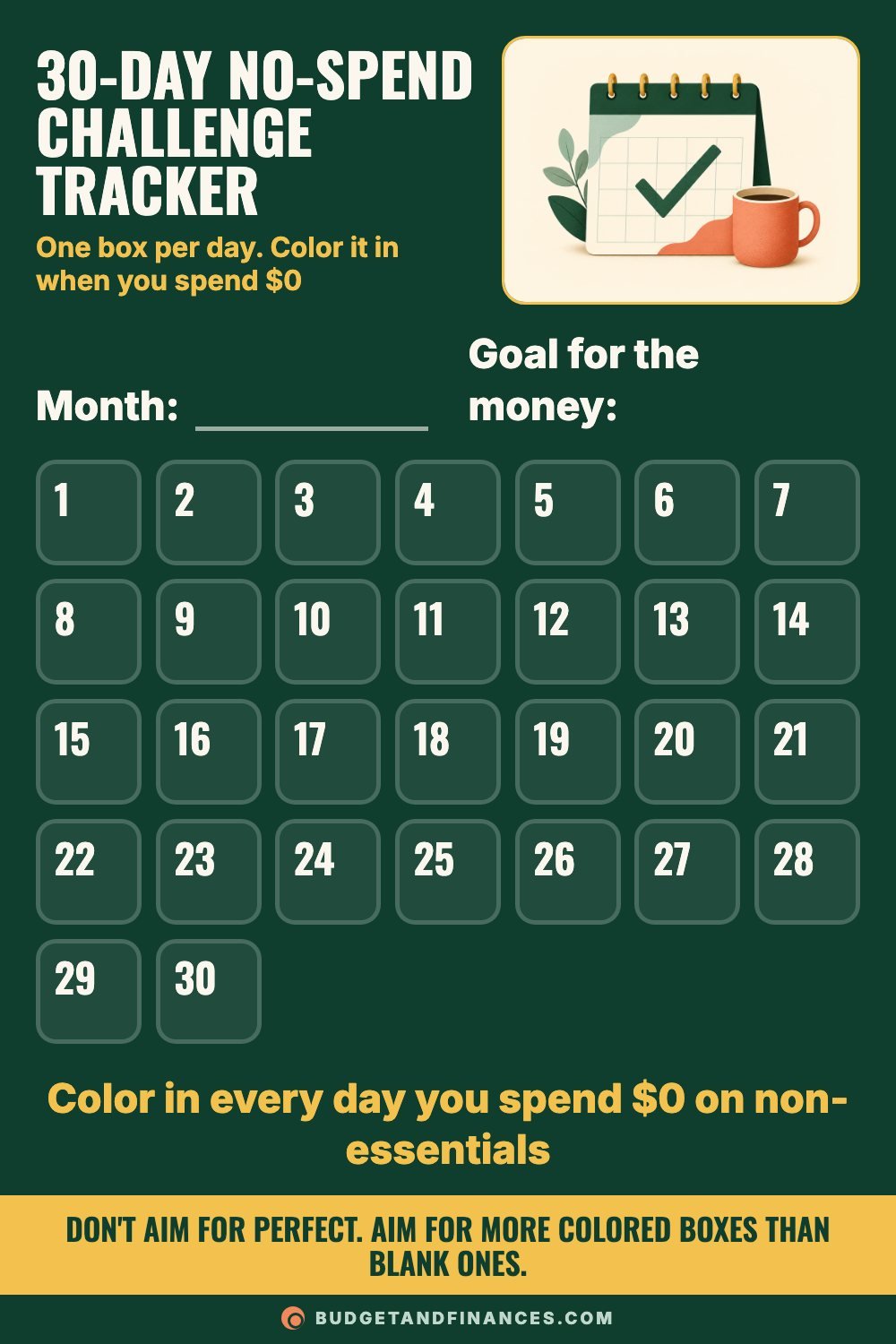
The tracker has 30 boxes, one per day, plus space to write the month and your goal for the money. Color in every day you spend $0 on non-essentials.
Don’t aim for perfect. Aim for more colored boxes than blank ones.
Common mistakes
Skipping the rules. Without a written list, every purchase turns into a debate. Decide your needs and wants on day 0.
Cutting groceries too hard. A no-spend month still includes food. If you under-buy groceries, takeout wins by day 5.
Restarting after a slip. Starting over from day one makes the challenge feel endless. Note it and keep going.
Leaving the money in checking. Money you didn’t spend has a way of getting spent later. Move it to savings every week.
Stocking up right before. Buying a month of “treats” before day one just moves the spending earlier.
No plan for weekends. Friday and Saturday are the hardest days. Have a free plan and a backup dinner ready.
FAQ
What counts as spending in a no-spend challenge?
You decide, but the usual rule is that needs are allowed and wants are not. Bills, groceries from your list, gas for work and medicine are allowed. Takeout, coffee runs, shopping and new subscriptions are off limits.
Can I buy groceries during a no-spend month?
Yes. Groceries from a planned list are a need. Try to cook from your pantry and freezer first so you buy less.
What happens if I break the no-spend challenge?
Write down what you bought and why, then pick up again the next day. Don’t restart the month. The goal is more colored boxes than blank ones.
How long should a no-spend challenge be?
Thirty days is long enough to break autopilot habits and short enough to feel doable. If a month feels like too much, try a no-spend weekend or a no-spend week first.
What should I do with the money I save?
Pick a goal before you start and write it on your tracker. Common choices are a starter emergency fund, a debt payment or a planned purchase. Move the money every week so it doesn’t sit in checking.