
You need $1,000, and you need it soon. Maybe it’s a starter emergency fund. Maybe the car is making a noise you don’t like. Either way, “save a little each month” is too slow when you need to save $1,000 in 30 days.
Thirty days is a short, focused push. It won’t come from one place. It comes from selling a few things, eating from home, pausing shopping, earning a little extra and trimming a bill or two.
This guide breaks $1,000 into pieces small enough to actually do, with a plan for each week and a daily chart to track it.
Ground rules for a $1,000 month
Set these before day one. They keep a short-term push from causing a long-term mess.
Cover bills first. Rent, utilities and minimum debt payments come before the challenge. Never skip a bill to hit a savings number.
Save it the same day. Money from a sale or a skipped purchase goes to savings before it can be spent.
Use a separate account. Keep the $1,000 somewhere you can’t spend it with a debit card swipe.
Track daily. Write your running total down every night. Seeing $400 on day 12 keeps you going.
Tell your household. Everyone knows it’s a 30-day push, so nobody is surprised when there’s no takeout.
Plan one free treat. Pick something free to enjoy each week so the month doesn’t feel harsh.
Step 1: Split $1,000 into buckets
Here’s one example of where $1,000 in 30 days can come from. Adjust the mix to fit your life.
| Bucket | Share | Amount | Examples |
|---|---|---|---|
| Sell unused stuff | 30% | $300 | Clothes, furniture, baby gear, electronics you no longer use |
| Cut food spending | 25% | $250 | Pantry meals, no takeout, bring lunch to work |
| Pause shopping and fun | 20% | $200 | No new clothes, decor or paid entertainment this month |
| Extra income | 15% | $150 | Extra shifts, babysitting, pet sitting, odd jobs |
| Trim bills | 10% | $100 | Cancel or pause subscriptions, call for a lower bill |
$300 + $250 + $200 + $150 + $100 = $1,000.
If you have nothing to sell, move that 30% into extra income or food. If you can’t pick up extra work this month, lean harder on selling. Treat the buckets as a starting point.
Step 2: Check 9 places to find money
Before you decide there’s nothing left to cut, go through each of these.
- Closet. Sell clothes you haven’t worn in a year.
- Returns. Unworn items still in the return window.
- Subscriptions. Pause anything you forgot you had.
- Pantry. Cook from it before buying groceries.
- Gift cards. Use them for things you’d buy anyway, and move the cash you would have spent to savings.
- Car. Combine errands and carpool where you can.
- Phone plan. Ask about a cheaper plan.
- Kids’ outgrown stuff. Sell toys, gear and clothes.
- Your time. An extra shift or a weekend side job.
Money is usually hiding in stuff, subscriptions and habits.
Step 3: Follow the weekly plan
Break $1,000 into four chunks of $250 so the goal stays doable.
Days 1-7: Quick wins ($250 saved)
- List 5 things to sell today.
- Cancel or pause subscriptions you don’t use.
Selling takes time to pay off, so start on day one. The sooner items are listed, the sooner they sell.
Days 8-14: Eat from home ($500 saved)
- Plan meals from what’s already in the pantry.
- Skip takeout and coffee runs.
Food is one of the most flexible parts of most budgets. Move the grocery money you didn’t spend to savings at the end of each week.
Days 15-21: Earn a little extra ($750 saved)
- Pick up a shift or a side job.
- Return unworn purchases still in the return window.
Days 22-30: Close the gap ($1,000 saved)
- Check your total and see what’s left.
- Hold a no-spend weekend to finish.
If you’re short, go back to the list of 9 places. There’s usually one more thing to sell or one more bill to call about.
Worked example: filling in the buckets
Here’s how the example plan could look in practice. These are illustrations of the method. Your actual items and amounts will be different.
Sell unused stuff: $300. A dresser you’ve been meaning to get rid of, a stroller the kids outgrew, and a bag of clothes. Each sale goes to savings the same day. When your sales total $300, this bucket is done.
Cut food spending: $250. Look at what you normally spend on groceries and eating out in a month. Plan pantry meals, pack lunch and skip takeout. Whatever you spend less than normal gets transferred to savings each week until this bucket reaches $250.
Pause shopping and fun: $200. No new clothes, decor or paid entertainment. Whatever you’d normally spend on those in a month goes to savings instead, up to $200.
Extra income: $150. Two extra shifts, a weekend of pet sitting, or a few babysitting nights. All of it goes to savings.
Trim bills: $100. Cancel two subscriptions you forgot about and call about a lower phone or internet bill. Anything you save on this month’s bills goes to savings, until this bucket reaches $100.
Add the five buckets together and you hit $1,000.
Use the daily chart to stay on track
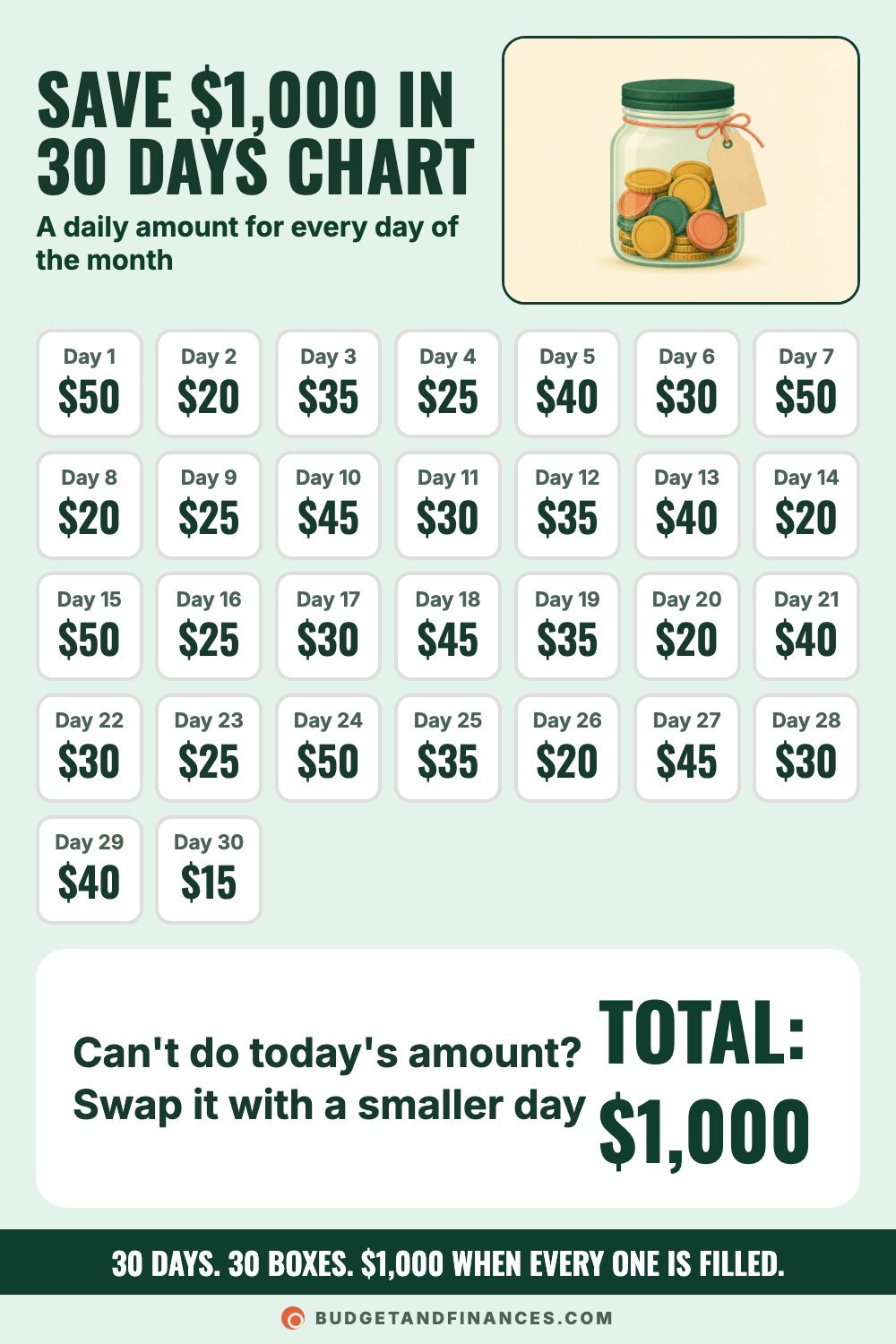
The printable chart gives you a set amount to save each of the 30 days, from $15 to $50. Every box, filled in, adds up to exactly $1,000.
The first seven days add up to $250, which matches the first checkpoint on the weekly plan. After that, some days ask for more than others, so don’t expect every week to land on exactly $250.
Can’t do today’s amount? Swap it with a smaller day later in the month. You still finish at $1,000 as long as every box gets filled.
Get the free printable chart
The chart has 30 boxes, one per day, each with a dollar amount. Check off each day as you move that money to savings.
Common mistakes
Skipping bills to hit the goal. A late fee or missed payment can cost you more than the challenge saves. Bills first, savings second, everything else waits 30 days.
Leaving the money in checking. If found money sits in your spending account, it gets spent. Move it the same day.
Starting to sell on day 20. Selling takes time. List items in the first week.
Cutting groceries to nothing. You still need to eat. Cook from the pantry and buy what’s on your list.
Going all or nothing. If you end the month at $820, that’s $820 you didn’t have before. Keep it and keep going.
FAQ
Is it realistic to save $1,000 in 30 days?
For a lot of people it’s a stretch, but it’s possible when you combine several sources: selling things, cutting food spending, pausing shopping, earning a little extra and trimming bills. The exact mix depends on your income and what you have to sell.
What’s the fastest way to save $1,000?
Selling items you don’t use is often the quickest, because one or two larger items can cover a big share. Combine it with cutting food spending and pausing shopping for the month.
Where should I keep the $1,000?
In a separate savings account, away from your debit card. A high-yield savings account is a common choice for emergency savings.
What if I don’t make it to $1,000?
Keep what you saved and continue into the next month. Even a partial month builds a cushion you didn’t have before.
Should I save $1,000 or pay off debt first?
Many people build a $1,000 starter emergency fund before paying extra on debt, so a surprise expense doesn’t go on a credit card. Keep making every minimum payment either way.