You want to save, but your budget is tight and every dollar already has somewhere to go. Big savings challenges feel out of reach, but a coin jar doesn’t ask for much.
A coin jar is a gentle place to start. Loose change and a few dollar bills barely register when they leave your wallet. Put them somewhere they can’t be spent and they quietly add up.
This guide gives you a 30-day coin jar challenge that saves $90, habits that keep the change coming, what every coin roll is worth, and how to turn a heavy jar into money in savings without losing some of it to fees.
The 30-day coin jar challenge
The plan is small on purpose. Each day, drop a set amount in the jar and check off the box.
- Day 1: $1
- Day 2: $2
- Day 3: $3
- Day 4: $4
- Day 5: $5
- Day 6: back to $1, and repeat
That five-day pattern runs six times over 30 days. Each round of five days adds up to $15 ($1 + $2 + $3 + $4 + $5). Six rounds is $90.
You can use coins, bills or a transfer to savings. What counts is that the amount goes in every day and the box gets checked.
Repeat it all year
Finish one 30-day chart and start another. Twelve rounds of the challenge is 360 days and $1,080 ($90 × 12). Not bad for a jar on the counter.
Habits that fill your coin jar faster
The challenge gives you a daily target. These habits make sure there’s change to put in.
Empty your pockets nightly. Every coin in your wallet, pocket or bag goes in the jar before bed.
Pay small buys in cash. Use bills for small purchases and save all the change you get back.
Round up in your head. Spent $6.40? Drop the 60 cents it takes to reach $7 into the jar.
Save every quarter. If you only save one coin, make it quarters. They add up fastest.
Add a $1 bill on Fridays. One extra dollar a week keeps the jar growing on slow weeks.
Check the usual spots. Car cupholders, couch cushions, coat pockets and the laundry room.
Coins you save tonight are coins you won’t spend tomorrow.
How much is a roll of coins?
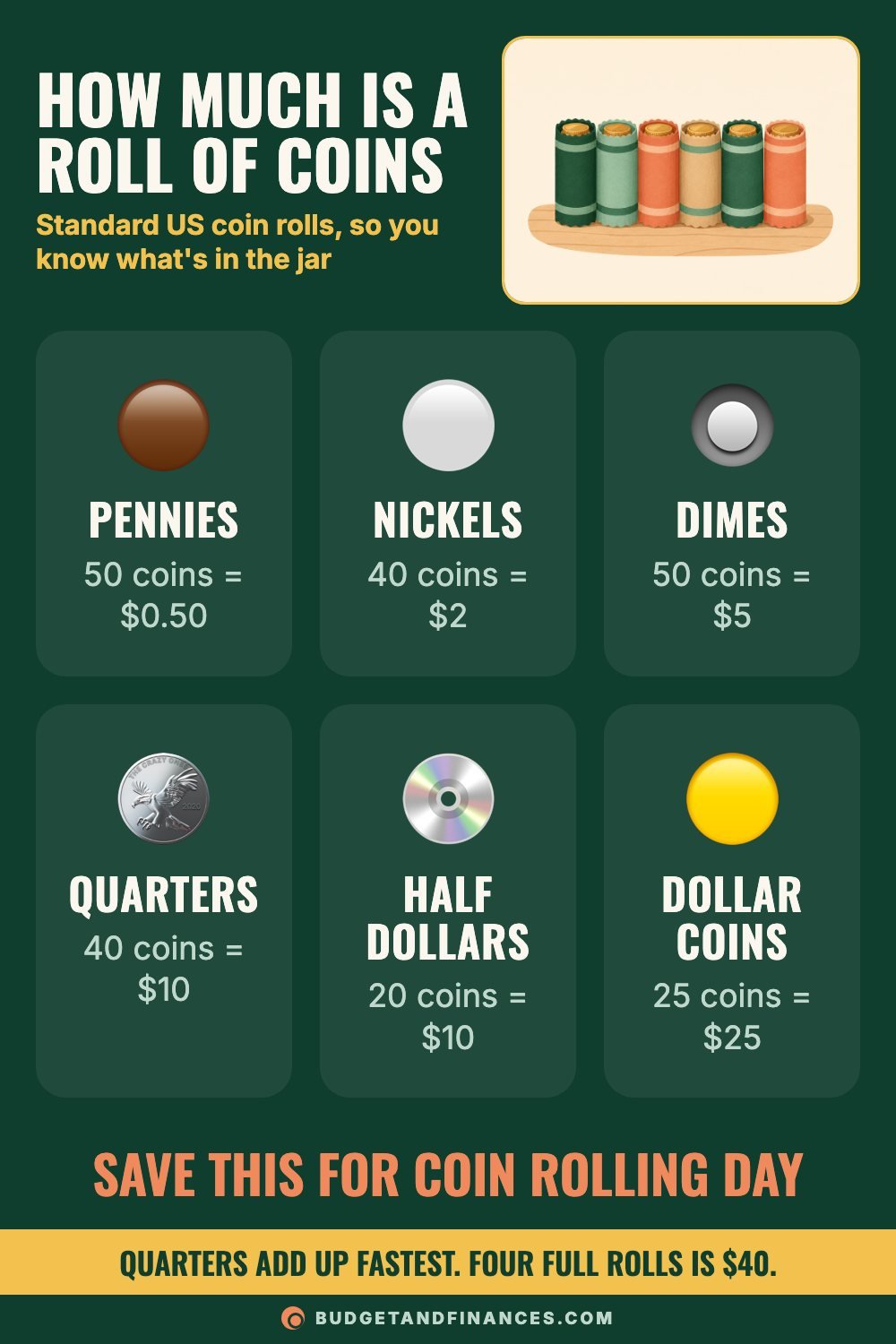
When it’s time to cash in, it helps to know what a full roll is worth. Here are standard US coin rolls:
| Coin | Coins per roll | Roll value |
|---|---|---|
| Pennies | 50 | $0.50 |
| Nickels | 40 | $2 |
| Dimes | 50 | $5 |
| Quarters | 40 | $10 |
| Half dollars | 20 | $10 |
| Dollar coins | 25 | $25 |
Quarters add up fastest for everyday change. Four full rolls of quarters is $40, and that’s only 160 coins.
Worked example: one month of the challenge
Here’s how a month could go.
Days 1-5. You drop in $1, $2, $3, $4 and $5. The jar holds $15. Some days you use coins from your pocket. On day 5 you put in a $5 bill.
Days 6-15. Two more rounds of the pattern add $30. Your total is $45, and you’re halfway through the chart.
Days 16-30. Three more rounds add $45. You check off the last box on day 30 with $90 in the jar.
Extra change. Your pocket-emptying and round-up habits drop in more coins alongside the daily amounts. Count those separately on cash-in day, or just enjoy the bonus.
Cash-in day. You sort the jar. Say you have 3 full rolls of quarters ($30), 4 rolls of dimes ($20), 5 rolls of nickels ($10) and 60 $1 bills ($60). That’s $30 + $20 + $10 + $60 = $120 total. The daily challenge accounts for $90, and the other $30 came from your change habits. All of it goes into savings.
How to cash in a coin jar without losing money to fees
Coin counting kiosks are convenient, but many charge a percentage of what you pour in. Before you pay a fee to count your own savings, work through this checklist.
Sort
- Pour the coins onto a towel so they don’t roll away.
- Separate them by type.
- Pull out foreign coins, tokens and anything that isn’t money.
Roll
- Get free or cheap paper coin wrappers. Some banks hand them out.
- Fill each roll to the right count (see the table above).
- Write your name on each roll.
Deposit
- Call your bank or credit union and ask how they handle coin deposits.
- Ask if coin counting is free for customers.
- Compare against kiosk fees before using one.
Save it
- Put the money straight into savings.
- Write your total on your chart.
- Start the jar again the same day.
Coin jar vs digital round-ups
If you rarely carry cash, a physical jar won’t fill up. Digital round-ups are the card-user version of the same idea.
A coin jar is best for cash users. You save physical coins and small bills, you can see and hear it grow, and it’s great for kids to join in. The downsides: it needs sorting and a bank trip, and the money sits at home until you deposit it.
Round-ups are best for card users. Purchases are rounded up to the next dollar and the difference moves to savings for you. There are no coins to count or roll. The downsides: it’s easy to forget it’s happening, and some round-up services charge a monthly fee, so check before you sign up.
Use the one that matches how you actually pay for things. Spare change adds up either way.
Get the free printable chart
The chart has 30 boxes with the daily amount in each one, $1 to $5 on repeat. Check off each day as the money goes in.
Common mistakes
Letting the jar sit for years. Money in a jar earns nothing and is easy to raid. Cash it in when it gets heavy.
Paying a big counting fee. Call your bank first. Rolling coins yourself takes an evening and can save you the fee.
Spending the cash-in money. Deposit it directly into savings so it doesn’t disappear into your checking account.
Only saving pennies. Pennies are fine, but a full roll is only 50 cents. Quarters build your jar much faster.
Skipping days on the chart. If you miss a day, add it the next day and check both boxes.
FAQ
How much can you save with a coin jar challenge?
The 30-day challenge on this chart saves $90. Repeat it twelve times and that’s $1,080 over 360 days. Any extra change you add on top is a bonus.
How many quarters are in a roll?
A standard roll of quarters has 40 coins and is worth $10. Dimes come 50 to a roll ($5), nickels 40 ($2) and pennies 50 ($0.50).
Where can I cash in coins for free?
Start by calling your own bank or credit union. Some count coins for customers at no cost, while others ask you to bring rolled coins. Compare that against any kiosk fee before you pour your jar in.
Is a coin jar or round-up savings better?
It depends on how you pay. If you use cash, a jar is simple and visible. If you mostly use cards, round-ups do the saving for you. Check for monthly fees on any round-up service.
Can kids do the coin jar challenge?
Yes. A clear jar is a great way for kids to see savings grow. They can help sort and roll the coins on cash-in day, too.