
A lot of people avoid frugal living because they picture a sad, beige life. No dinners out, no fun, arguing over the tip.
Frugal living works differently. You decide what actually matters to you, spend on those things without guilt, and cut hard on everything else.
This guide covers tips that don’t feel like sacrifice, a four-stage plan for beginners, the difference between frugal and cheap, and a 30-day challenge that turns small choices into real savings.
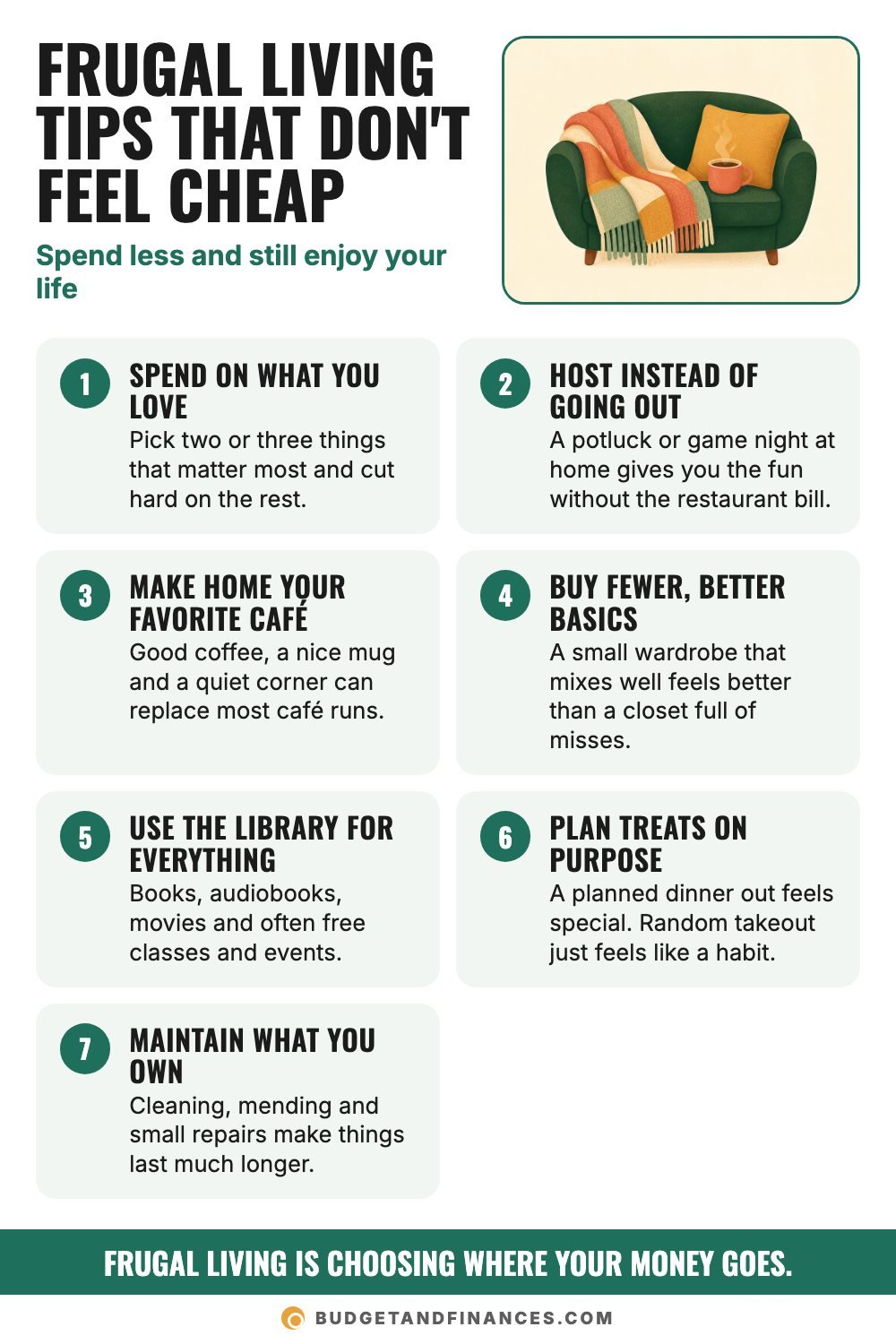
Seven frugal living tips that don’t feel cheap
1. Spend on what you love
Pick two or three things that matter most to you. Maybe it’s good coffee, travel, or your kids’ sports. Protect those, and cut hard on the rest.
2. Host instead of going out
A potluck or game night at home gives you the fun without the restaurant bill. Everyone brings a dish, and nobody has to split a check.
3. Make home your favorite café
Good coffee, a nice mug and a quiet corner can replace most café runs. Keep the café for a planned treat.
4. Buy fewer, better basics
A small wardrobe that mixes well feels better than a closet full of misses. The same goes for kitchen tools and furniture.
5. Use the library for everything
Books, audiobooks and movies, plus classes and events at many branches. Check what yours offers. It’s often more than people expect.
6. Plan treats on purpose
A planned dinner out feels special. Random takeout just feels like a habit. Put the treat on the calendar and look forward to it.
7. Maintain what you own
Cleaning, mending and small repairs make things last much longer. A loose button doesn’t mean a new shirt.
Make your spend-on list
Tip 1 is the one the rest hang on, so give it five minutes with a pen.
Write down the three things you’d protect if money got tight. Be honest. It might be a weekly coffee with a friend, a hobby, or good groceries.
Then write down three things you spend on that you’d barely miss. If you can’t think of any, wait until you’ve tracked your spending for a month in Stage 1 below. The circled regrets usually fill this column fast.
Now you have a rule for every purchase. If it’s on the first list, spend without guilt. If it’s on the second, that’s where the cuts come from. You’ll never have to wonder whether frugal living means giving up the things you care about.
Frugal vs cheap: know the difference
Frugal and cheap both involve spending less. They get very different results.
Frugal (values-based spending):
- Looks at the cost over time.
- Spends more on what gets used daily.
- Tips fairly and pays their share.
- Repairs things before replacing them.
- Saves so emergencies aren’t a crisis.
Cheap (lowest price every time):
- Looks only at today’s price.
- Buys the cheapest option and replaces it often.
- Skimps on tips or splitting the bill.
- Lets things break from neglect.
- Saves money at other people’s expense.
The short version: be careful with money and generous with people. Frugal protects your money and your relationships.
Frugal living for beginners: a four-stage plan
Trying to change everything in one month is how people quit. This plan spreads it out so each habit has time to stick.
Stage 1: Notice your spending (month 1)
- Track every purchase for 30 days. A notebook or a notes app works fine.
- At the end of the month, circle anything you regret buying.
Don’t cut anything yet. Just look. The circled items tell you where to start.
Stage 2: Plug the easy leaks (month 2)
- Cancel unused subscriptions.
- Plan meals and shop with a list.
- Unsubscribe from store emails.
These take a little effort once, then keep saving without any willpower.
Stage 3: Swap your habits (months 3-4)
- Make coffee and lunch at home most days.
- Borrow, thrift or wait before buying new.
- Call providers to ask for lower rates on bills.
Stage 4: Give savings a job (month 5 on)
- Automate a transfer to savings each payday.
- Build a $1,000 starter emergency fund.
- Plan fun money so the budget doesn’t feel strict.
How to tell it’s working
Count how many of these sound like you. You’re probably more frugal than you give yourself credit for.
- You shop with a list, and mostly stick to it.
- Leftovers get eaten, not forgotten in the back of the fridge.
- You fix things. A loose button doesn’t mean a new shirt.
- You use the library for books, movies and events.
- You wait on wants, and most of them pass.
- You have savings, even if it’s small.
- You buy secondhand for furniture, kids’ stuff and tools.
- You know your bills: the amounts and the due dates.
- You still have fun. It’s just planned and budgeted.
What’s your score out of 9? Pick one you didn’t check and make it next month’s focus.
Worked example: the 30-Day Frugal Wins Jar
Here’s a simple challenge to pair with Stages 2 and 3.
Every day you choose the frugal option, like packing lunch or skipping takeout, move $5 to savings and color in that day on the chart.
Fill all 30 days: $5 × 30 = $150 set aside.
Miss a few days: if you color in 22 days, that’s $5 × 22 = $110. Still real money.
Connect it to Stage 4: the starter emergency fund is $1,000. At $150 a month, $1,000 ÷ $150 = about 6.7, so seven full months of the challenge gets you there. After six full months you’d have $150 × 6 = $900, and one more month finishes it.
The $5 is a transfer you make, not a number you guess. That keeps the total honest. If $5 a day doesn’t fit your budget, use $2 or $3. Thirty days at $2 is $60.
Get the free 30-Day Frugal Wins Jar chart
The chart has 30 day boxes at $5 each. Packed lunch? Skipped takeout? Color a day and move $5 to savings. Print it and keep it where you’ll see it every evening.
Common mistakes
Cutting the things you love. If you cut your favorite thing first, you’ll resent the whole plan. Cut what you don’t care about.
Doing every stage at once. The stages are spread over five months for a reason. One set of habits at a time.
Being cheap with other people. Skimping on tips or your share of the bill costs you more in relationships than it saves.
Buying the cheapest thing every time. If you replace it three times, it wasn’t cheap. Look at cost over time.
Having no fun money. A budget with zero room for fun is one you’ll abandon. Plan the treats.
FAQ
How do I start frugal living?
Track every purchase for 30 days without changing anything. Then circle what you regret and start with those. That’s Stage 1 of the plan above.
What’s the difference between frugal and cheap?
Frugal looks at cost over time and spends on what matters. Cheap chases the lowest price today and often costs more later, sometimes at other people’s expense.
Can I live frugally and still have fun?
Yes. Plan fun money into your budget, host at home, use the library and schedule treats on purpose. Planned fun tends to feel better than random spending anyway.
How much can I save with the 30-day challenge?
It depends on how many days you color in. Every day is $5, so all 30 days is $150. The math is always $5 times the days you checked off.
How long does it take to build frugal habits?
The beginner plan runs about five months across four stages. Some habits will stick right away and others will take longer, and that’s fine.