
“Three to six months of expenses” is the advice you hear everywhere. It’s a good guideline. But it leaves two questions open: which expenses, and is it three months or six for your emergency fund?
The answers change your goal by thousands of dollars. On $3,000 a month of essential costs, three months is $9,000 and six months is $18,000.
This guide walks through both questions. You’ll add up your essential monthly costs from real statements, pick the number of months that fits your situation, and check whether the fund you have now is too small, about right or bigger than it needs to be.
The formula
Essential costs x months of cover = your goal.
That’s it. The work is in getting each half right.
Part 1: Find your essential monthly costs
Start with essential monthly costs, not income. Your emergency fund needs to cover what you’d still have to pay if your paycheck stopped, and in a real emergency you’d cut the extras.
How to calculate it in six steps
- Pull 3 months of statements. Bank and credit card statements show what you really spend, not what you guess.
- Circle the essentials. Housing, food, utilities, insurance, transportation, minimum debt payments and childcare.
- Leave out the extras. Eating out, streaming and shopping can be paused if your income stops.
- Average the months. Add up the essentials for all three months and divide by 3 for a monthly number.
- Multiply by your months. 3 to 6 is the common range. For example, $2,500 x 4 months = $10,000.
- Recheck once a year. Rent, insurance and family size change. Update your number when they do.
What counts as essential
- Housing: rent or mortgage and renters or home insurance.
- Groceries: basic food and household supplies. No takeout.
- Utilities and phone: electric, water, heat, internet and one phone plan.
- Transportation: car payment, gas and car insurance.
- Health insurance and meds: premiums, prescriptions and regular copays.
- Minimum debt payments: credit card and loan minimums only, not extra payments.
- Childcare and must-haves: childcare, diapers and other costs you can’t skip.
Worked example: $3,000 a month of essentials
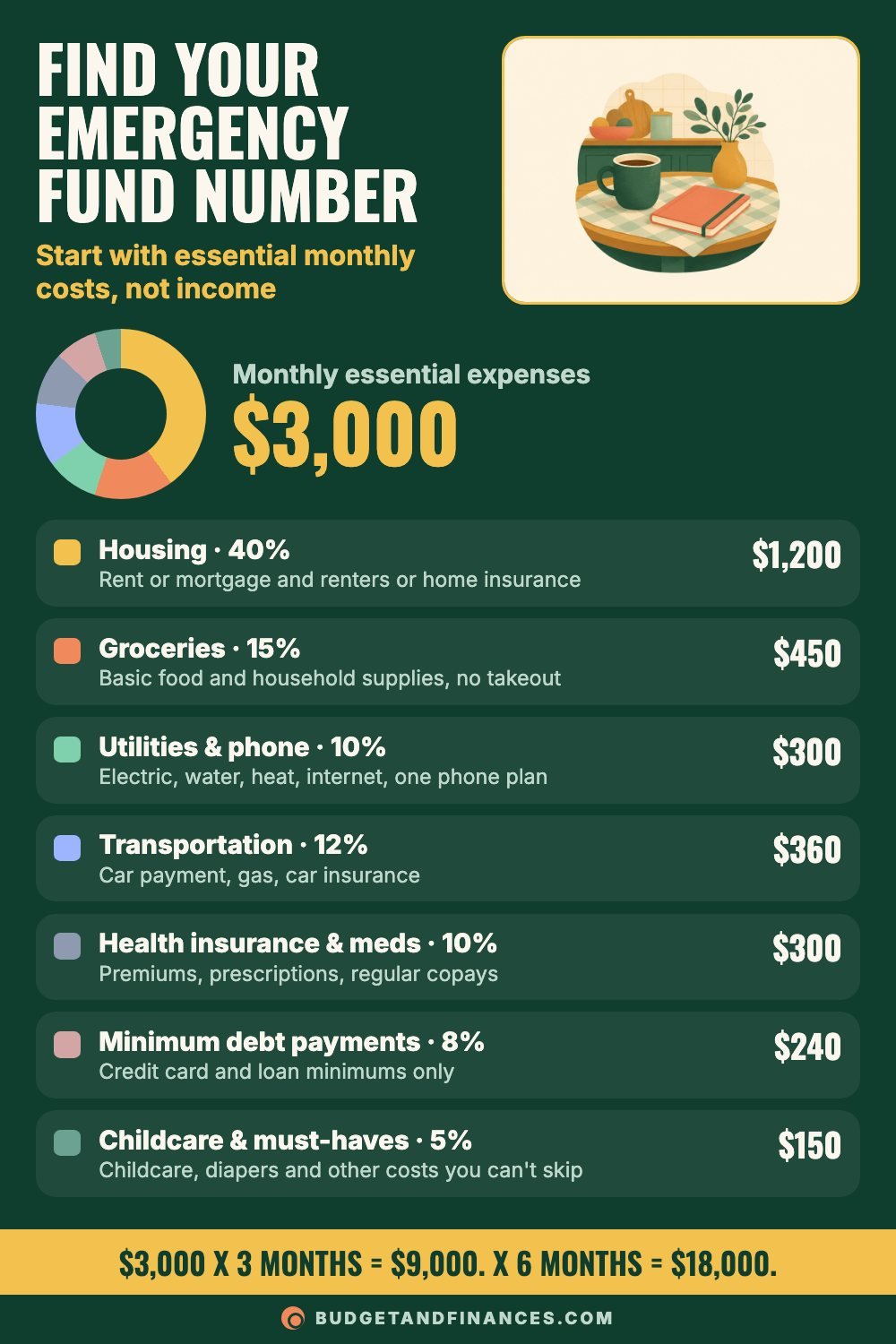
Say you pull three months of statements and circle only the essentials. The totals come to $2,900, $3,150 and $2,950. Added together, that’s $9,000. Divided by 3, your essential monthly cost is $3,000.
Here’s how that $3,000 breaks down:
| Essential cost | Share | Monthly |
|---|---|---|
| Housing | 40% | $1,200 |
| Groceries | 15% | $450 |
| Utilities & phone | 10% | $300 |
| Transportation | 12% | $360 |
| Health insurance & meds | 10% | $300 |
| Minimum debt payments | 8% | $240 |
| Childcare & must-haves | 5% | $150 |
| Total | 100% | $3,000 |
Now the second half of the formula:
- 3 months: $3,000 x 3 = $9,000
- 6 months: $3,000 x 6 = $18,000
Which one is yours depends on Part 2.
Part 2: Choose how many months you need
More risk in your life means more months in your fund. Here’s how to think about it.
3 months may be enough if
- Your household has two steady incomes.
- Your job is in steady demand.
- You rent and don’t handle big home repairs.
- Your car is reliable and paid off.
- Few people depend on your income.
Aim for 6 months or more if
- You’re the only income in your home.
- You’re self-employed or paid on commission.
- You own a home or drive an older car.
- You have kids or others who rely on you.
- Jobs in your field take longer to find.
Start with 3 months. Keep going if the second list sounds like you.
Emergency fund size by situation
Use these as starting points. Your essential costs set the dollars.
| Situation | Starting point |
|---|---|
| Two stable incomes | About 3 months of expenses |
| Single income | About 6 months of expenses |
| Self-employed | 6-12 months of expenses |
| Commission or tips | 6-12 months of expenses |
| Seasonal work | Enough to cover the slow season |
| Kids at home | Lean toward 6 months |
| Homeowner | Lean toward 6 months |
| Ongoing health needs | Lean toward 6 months or more |
| Still paying off debt | $1,000 starter fund first |
If more than one applies, go with the larger number. A self-employed homeowner with kids should look at the higher end.
Back to the example
Say the person with $3,000 of essential costs is a single income earner. The table points to about 6 months, so the goal is $18,000.
If they were self-employed, 6-12 months would put the goal between $18,000 and $36,000.
Part 3: Close the gap
Say they already have $4,000 saved.
- The gap to 3 months ($9,000) is $5,000. At $500 a month, that takes 10 months.
- The gap to 6 months ($18,000) is $14,000. At $500 a month, that takes 28 months.
A big gap is normal. Reaching 3 months first gives you a solid milestone, and you keep going from there. Set an automatic transfer on payday so the gap closes without you having to remember.
Is your emergency fund big enough?
Check which list sounds most like you.
Save more if
- One surprise bill would empty it.
- You’d need a card to cover a month off work.
- Your income dropped or became irregular.
- Your family or expenses grew this year.
Likely on track if
- It covers 3-6 months of essential costs.
- It’s in a separate savings account.
- You refill it soon after you use it.
Maybe too much if
- It’s well past 12 months of expenses.
- It’s full, but you save nothing for retirement.
- It’s full, but you carry high-interest debt.
A fund can be too big when cash sits there that could be paying down high-interest debt or growing for retirement. Right-sized means covered for emergencies, with the rest put to work.
Next steps
- Add up your essential monthly costs.
- Pick a number of months that fits your risk.
- Set an automatic transfer to close the gap.
Common mistakes
Using your income instead of essential costs. Your take-home pay includes eating out, savings and extras you’d cut in an emergency. Using it makes the goal higher than it needs to be.
Guessing instead of checking statements. Guesses usually miss things like insurance paid every six months. Averaging three months of statements catches more.
Forgetting minimum debt payments. Those still come due if your income stops.
Setting the number once and never updating it. A move, a new baby or a new car payment changes your essential costs.
Stopping at 3 months when your situation calls for more. If you’re a single income or self-employed, 3 months is a milestone. Keep going after you reach it.
FAQ
Should my emergency fund be based on income or expenses?
Expenses. Specifically, essential monthly expenses: the costs you’d still need to pay if your income stopped. That’s usually lower than your take-home pay.
Is 3 months or 6 months better?
Neither is better for everyone. Three months may be enough with two steady incomes and few dependents. Six months or more makes sense for single incomes, self-employment, commission pay, homeowners and families with kids.
Can an emergency fund be too big?
It can. If it’s well past 12 months of expenses while you carry high-interest debt or save nothing for retirement, some of that cash may do more work elsewhere.
What if I’m still paying off debt?
A common approach is to save a $1,000 starter fund first, pay off debt, and then build to your full 3-6 month number.
How often should I recalculate?
Once a year, and any time your rent, insurance, family size or income changes in a big way.
This is general education, not personal financial advice.