Some savings plans ask you to sit down with a budget, pick a number and move it every week. If that’s never stuck for you, the $5 bill challenge might.
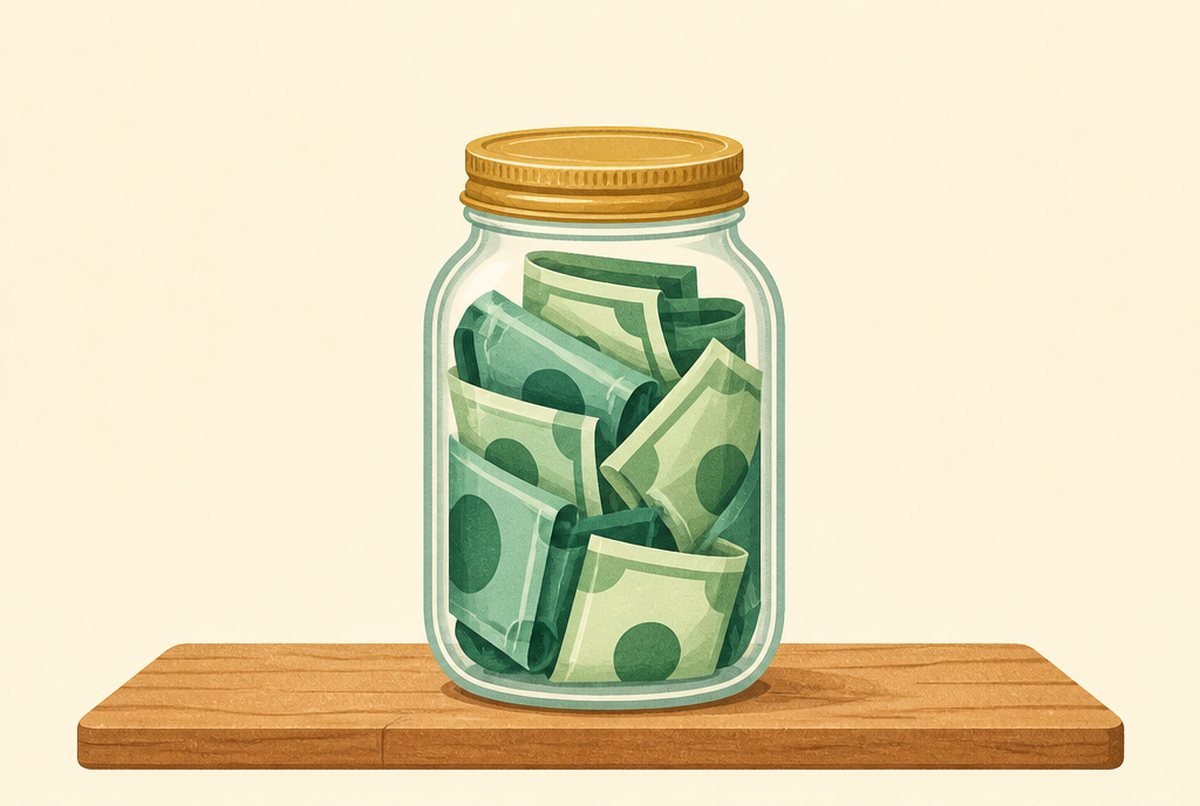
There’s one rule. Every time a $5 bill lands in your wallet, it goes in the jar. You don’t plan it. You don’t decide each time. The five just gets saved.
It feels a lot like saving money you never planned on spending. And 100 of those fives is $500.
The rules of the $5 bill challenge
Keep the rules short so there’s nothing to argue with yourself about.
- Every $5 bill you receive gets saved. Change from a purchase, cash back, money from a friend. If it’s a five, it’s the jar’s.
- No taking fives back out. The jar is a one-way door.
- Other bills stay in your wallet. Ones, tens and twenties are for spending as usual. Only fives count.
That’s the whole challenge. The rest of this guide is about making it easy to follow and keeping the money safe.
How to set it up in one evening
Pick your jar
Choose a jar or box you can’t easily open. A sealed tin, a jar with a lid you tape shut, or a box with a slot works well. The harder it is to get into, the less tempting it is on a short week.
Print the 100-box chart
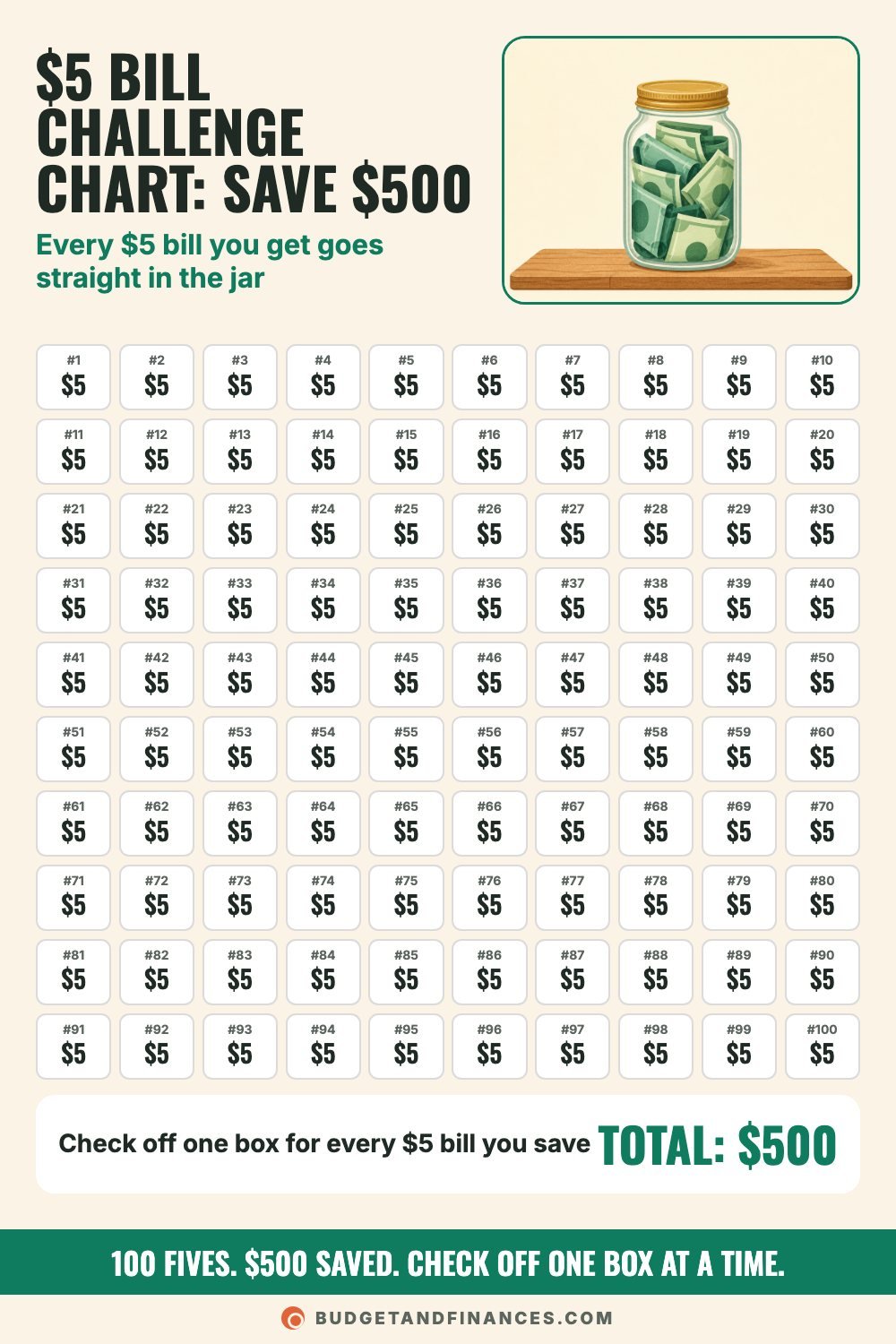
Each box stands for one $5 bill. Check one off every time a five goes in. With 100 boxes, a full chart is $500.
Write your goal and deadline
Write what the money is for and a rough finish date at the top of the chart. “Car repair fund by summer” gives the jar a job.
Plan your deposits
Deposit the cash each time you hit $100, which is 20 bills. Move it into a savings account. That way the jar stays light, and you’re never keeping hundreds of dollars in cash at home.
Your $5 bill milestones
Here’s how many fives it takes to reach each goal. The math is simple: every 20 bills is another $100.
| Bills saved | Total | What to do |
|---|---|---|
| 20 | $100 | Deposit it. Proof the habit is working. |
| 50 | $250 | Enough for a surprise copay or small car fix. Keep it in savings, not your wallet. |
| 100 | $500 | A full chart. Halfway to a $1,000 starter emergency fund. Print a fresh chart. |
| 200 | $1,000 | Two full charts. A full starter emergency fund. Decide what the next 200 are for. |
A $1,000 starter emergency fund is a common first savings goal. It’s enough to cover a lot of the small emergencies that would otherwise end up on a credit card.
How to get more $5 bills
The jar only grows if fives pass through your hands. If you mostly pay by card, you won’t see many. These habits help.
Pay cash for small buys. Use a $10 or $20 for coffee or gas and you’ll often get a five back in change.
Ask for fives. When you get cash back or withdraw money, ask for part of it in $5 bills.
Break bigger bills. Swap a $20 for four fives at the bank and save one of them.
Cash out small wins. Sold something for $15? Keep a five for the jar.
Pay cash for a week. Using cash instead of a card gives you more chances to get fives back as change.
Empty your wallet nightly. Pull out any fives before bed so they don’t get spent tomorrow.
Worked example: from first five to $1,000
Here’s how the milestones play out if you follow the setup above.
Bills 1 to 20. You check off 20 boxes and the jar holds $100. You deposit the $100 into savings. The jar is empty again, but the chart shows 20 boxes done.
Bills 21 to 50. Thirty more fives, another $150. Your total is $250. You deposit again at 40 bills ($200) and keep the other $50 in the jar until you reach 60.
Bills 51 to 100. Fifty more fives, another $250. The chart is full and you’ve saved $500. You print a fresh chart.
Bills 101 to 200. One more full chart, another $500. Your total is $1,000, a full starter emergency fund built one five at a time.
How long this takes depends on how many fives you get. There’s no set weekly amount, and that’s the tradeoff with this challenge. If you get one five a day, you’d fill a chart in 100 days. If you get a few a week, it’ll take longer. Either way, every box you check is $5 you didn’t spend. If you would rather save on a set schedule, the 100 envelope challenge uses random draws from $1 to $100 instead.
$5 bill challenge vs the 52-week challenge
These are two of the most popular savings challenges, and they suit different people.
The $5 bill challenge is best if you use cash. You save every five you receive, there’s no set weekly amount, and the total depends on how many fives you get. It works with a jar at home and feels like saving money you didn’t plan on.
The 52-week challenge is best if you mostly pay by card. You save $1 more each week, so it’s a fixed schedule you can plan for. Deposits climb to $52 by the end, it adds up to $1,378 in a year, and it’s easy to automate with a bank transfer.
Mostly cash? Go with fives. Mostly cards? Try the 52-week chart.
You can also run both at once. Fives go in a jar, weekly boxes go in the bank.
Get the free printable chart
The chart has 100 boxes, one for each $5 bill, with space at the top for your goal and deadline. Check off one box for every five you save.
Common mistakes
Keeping all the cash at home. A jar with $500 in it is a risk if it gets lost, stolen or “borrowed.” Deposit every $100.
Making exceptions. “Just this once” turns into every other five. The challenge works because there’s no decision to make.
Never using cash. If every purchase goes on a card, you won’t get fives. Pay cash for small things so change comes back to you.
Forgetting to check off boxes. When you deposit the cash, the jar looks empty. The chart is how you see your real progress.
Not naming the goal. $500 with no purpose is easy to spend on something random. Decide what it’s for before you start.
FAQ
How much can you save with the $5 bill challenge?
It depends on how many fives you get. 20 bills is $100, 50 bills is $250, 100 bills is $500 and 200 bills is $1,000. The printable chart tracks 100 bills for $500.
How long does the $5 bill challenge take?
There’s no set timeline. The more you pay with cash, the faster it goes. If you’d like a deadline, write one on your chart and use the tips above to get more fives.
Should I keep the $5 bills in a jar or put them in the bank?
Both. Use the jar to collect them, then deposit the cash into a savings account every time you reach $100. You get the fun of the jar without keeping a lot of cash at home.
What if I don’t use cash much?
The $5 bill challenge works best for cash users. If you mostly use cards, try the 52-week challenge instead, or ask for some $5 bills when you withdraw cash for the week.
Can I spend other bills while doing the challenge?
Yes. Only $5 bills get saved. Ones, tens and twenties stay in your wallet for spending as usual.