

January has a way of arriving with a pile of receipts and a vague sense that money needs sorting out. Most people know they should “get on top of it” and have no idea where to start without a money reset checklist to follow.
Start small. You don’t need a whole weekend or a perfect spreadsheet. You need a clear picture, a simple budget, and one goal.
This guide gives you a reset checklist, a week-by-week plan for January, the nine money numbers worth knowing, and a way to set goals that last past February. There’s a free no-spend January calendar at the end.
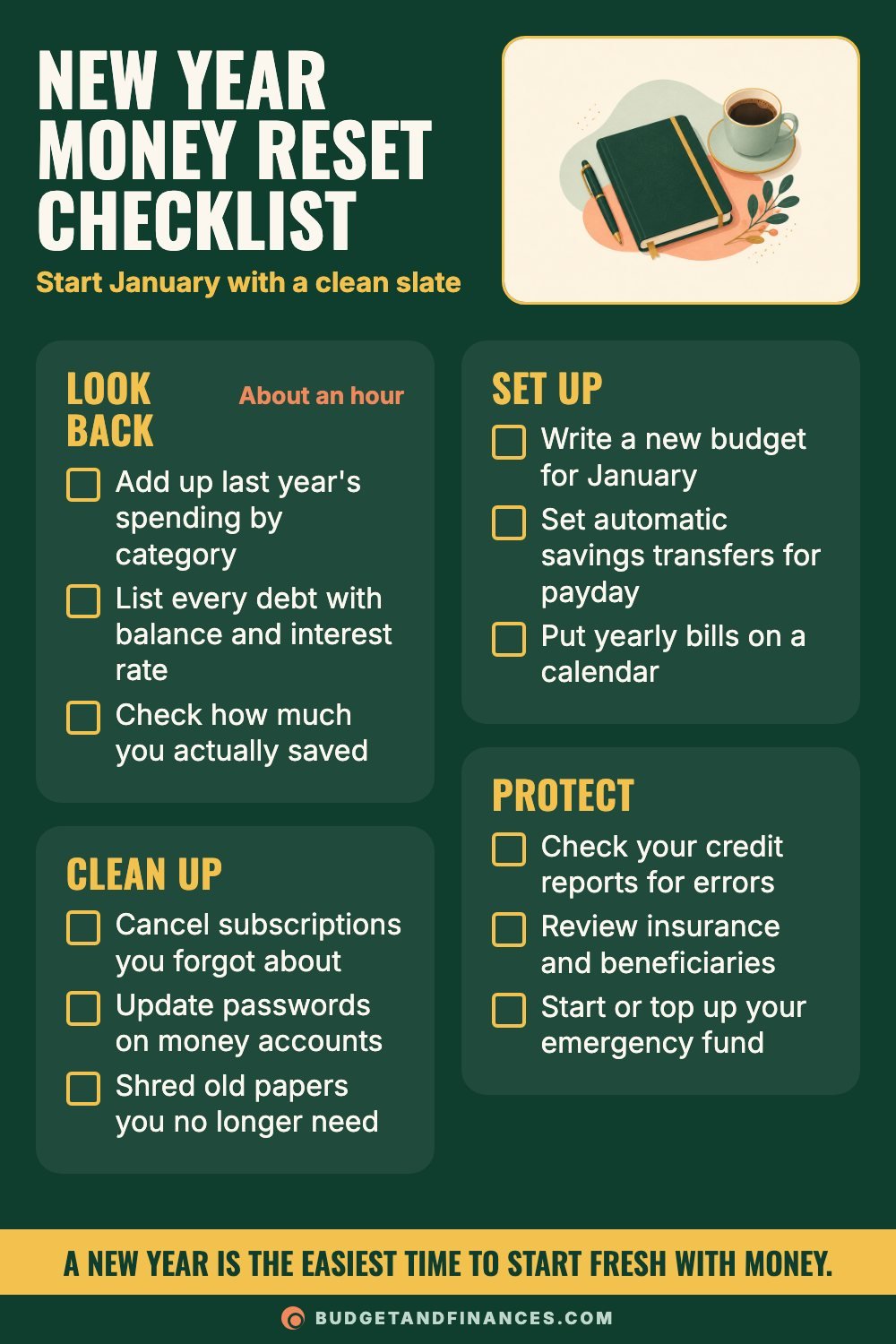
The New Year money reset checklist
Work through these in order. The look back takes about an hour. The rest can be spread over the month.
Look back
- Add up last year’s spending by category. Your bank and card statements will have most of it.
- List every debt with its balance and interest rate.
- Check how much you actually saved.
Clean up
- Cancel subscriptions you forgot about.
- Update passwords on money accounts, and turn on two-step login where it’s offered.
- Shred old papers you no longer need. Before you shred tax documents, check current IRS guidance on how long to keep them.
Set up
- Write a new budget for January.
- Set automatic savings transfers for payday.
- Put yearly bills on a calendar, like car registration, insurance premiums, and memberships.
Protect
- Check your credit reports for errors. You can get free copies from the three nationwide credit bureaus through the official free credit report site set up under federal law.
- Review insurance and the beneficiaries on your accounts.
- Start or top up your emergency fund.
January money reset, week by week
If the checklist feels like a lot, spread it over four weeks. One small job a week for the whole month.
Week 1: Get the full picture
- List your income, bills, debts, and savings in one place.
- Pull last month’s bank statements and see where the money actually went.
Week 2: Build the budget
- Give every dollar of January pay a job. That’s zero-based budgeting: income minus everything you plan to spend, save, and pay equals zero.
- Add sinking funds for yearly costs. Divide each yearly bill by 12 and save that amount monthly.
Week 3: Automate it
- Schedule bill payments and savings transfers for right after payday.
- Set a weekly 10-minute money check-in on your calendar.
Week 4: Pick one goal
- Choose one focus: debt, savings, or spending.
- Break it into a monthly number.
Four weeks, four small jobs, one calmer year.
9 money numbers to know in January
You can’t fix a number you’ve never looked at. Here’s how to find each one.
1. Take-home pay
What lands in your account each month after taxes and deductions. Check your pay stubs or bank deposits. If your pay varies, average the last few months.
2. Fixed bills
Rent or mortgage, utilities, insurance, phone. Add up the bills that come every month at roughly the same amount.
3. Total debt
Every balance added together: credit cards, car loan, student loans, medical bills, personal loans. Log in to each account or check the latest statement.
4. Interest rates
The rate on each debt you owe. It’s on your statement. This is the number the debt avalanche method uses, since it pays off the highest rate first.
5. Emergency fund
How many months of expenses your savings cover. Divide your emergency savings by your essential monthly expenses. A common goal is 3 to 6 months, often after a $1,000 starter fund.
6. Subscriptions
The monthly cost of all of them together. Scroll through a couple of months of bank and card statements to catch the ones you forgot.
7. Savings rate
Savings divided by take-home pay. If you save $200 of $4,000 take-home pay, your savings rate is 5%.
8. Credit score
Many banks and card issuers show it for free, so there’s no need to pay. Checking your own score doesn’t lower it.
9. Net worth
What you own minus what you owe. Add up savings, retirement accounts, and the value of things like your car or home, then subtract all your debts.
How many can you answer today? Write them down in January and you can see your progress by December.
Worked example: filling in the numbers
Here’s how a few of those numbers look for an example household.
Savings rate. They save $200 a month from $4,000 of take-home pay. $200 ÷ $4,000 = 5%.
Emergency fund. They have $3,000 saved and essential expenses of $2,500 a month. $3,000 ÷ $2,500 = 1.2 months.
Subscriptions. Five subscriptions at $12, $15, $10, $8, and $5 add up to $50 a month. Over a year, that’s $50 × 12 = $600.
Net worth. They own a car worth about $12,000 and have $6,000 in savings, so they own $18,000. They owe $25,000 in loans. $18,000 − $25,000 = −$7,000.
A negative net worth is common when you’re paying off loans. Think of it as a starting line. The number to watch is whether it moves up over the year.
Their one goal. They pick savings: $1,200 more in the emergency fund this year. That’s $1,200 ÷ 12 = $100 a month, or about $23 a week, since $1,200 ÷ 52 is $23.08.
Money goals that actually stick
New Year money resolutions often fade by February. These habits help yours last.
Pick one goal at a time
One clear goal gets more of your attention than five vague ones.
Put a number on it
“Save more” is a wish. “Save $1,000 by June” is a goal you can track. Starting in January, that’s six months, or about $166.67 a month.
Break it into months
$1,200 in a year is $100 a month, or about $23 a week.
Automate the first step
Set the transfer for payday so the money moves before you can spend it.
Keep it where you’ll see it
A chart on the fridge or a note on your phone keeps the goal in front of you.
Plan for a slip
Missed a month? Restart next payday. One bad month doesn’t cancel the goal.
Check in monthly
Ten minutes on the first of each month to see progress and adjust.
Small, specific, automatic. That’s a goal that lasts.
The no-spend January challenge
A no-spend month is a quick way to reset spending habits after the holidays.
The rules
- Bills still get paid. Rent, utilities, debt payments, insurance, and other regular bills are outside the challenge.
- Plan the essentials like bills. Decide ahead of time what counts, such as one planned weekly grocery shop, gas for work, and medicine. Write the list down and treat those like bills.
- Everything else waits. Takeout, coffee runs, clothes, home decor, and impulse buys are paused for the month.
- Color in every day you spend $0 outside your bills.
- Move the savings. At the end of the month, move what you didn’t spend toward your one goal.
- A slip doesn’t end it. Leave that day blank and keep going the next day.
Free printable: no-spend January calendar and reset checklist
The printable includes a 31-day calendar with spaces for your goal and the money you saved, plus the full reset checklist from this post. Every colored square is proof you’re in charge of your money.
Common mistakes
Trying to fix everything in week one. Spread the jobs over the month so you actually finish them.
Setting five goals. Pick one. Add another when the first is on autopilot.
Skipping the look back. A budget built on guesses breaks by the second week.
Forgetting yearly bills. Put them on the calendar and save for them monthly.
Quitting after a slip. Restart next payday.
FAQ
How do I start a financial reset in January?
Begin with the full picture: income, bills, debts, and savings in one list. Then build a simple budget, automate savings, and pick one goal.
What should I cancel in January?
Subscriptions you don’t use, free trials that turned into paid plans, and memberships you’ve outgrown. Check two months of statements to find them all.
How often should I check my credit reports?
At least once a year, and any time you’re about to apply for a loan. Look for accounts you don’t recognize and balances that look wrong.
Does a no-spend month include groceries?
A simple approach is to plan one grocery shop a week and treat it like a bill. The point of the challenge is to pause extras while everyone still eats.
This is general education, not personal financial advice.