
You’ve got several debts, a little extra money each month, and one question: which debt do you pay first?
The two most popular answers are the debt snowball and the debt avalanche. Both have you pay the minimum on everything and throw your extra money at one debt at a time. They only disagree on the order.
That one difference changes how soon you get your first win and how much interest you pay overall. Below, you’ll see both methods run on the same set of debts, month by month, so you can see the tradeoff in real dollars.
The short version
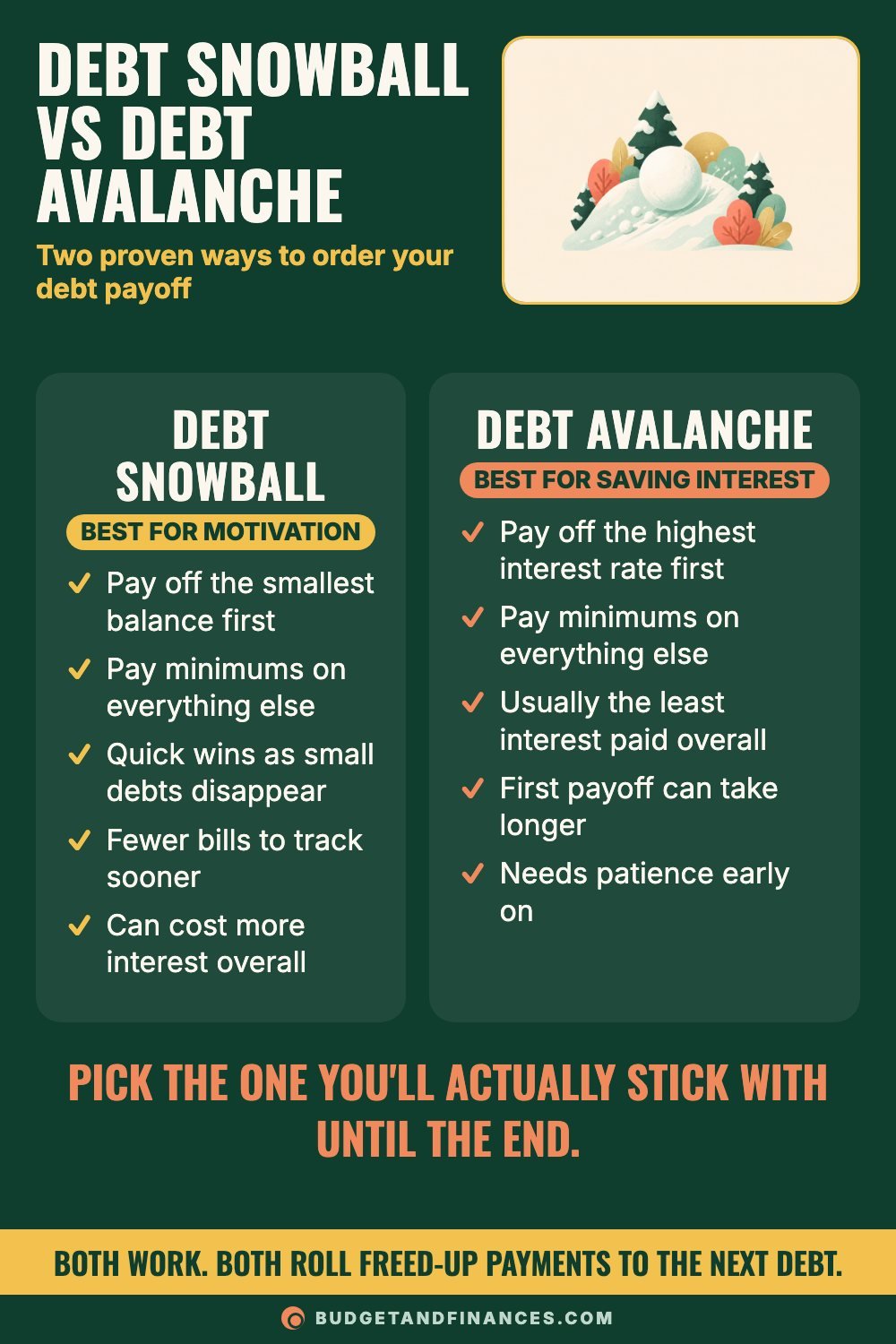
Debt snowball: smallest balance first. You pay minimums on everything else and put every extra dollar on the smallest balance. Small debts disappear quickly, so you get quick wins and have fewer bills to track sooner. It can cost more interest overall.
Debt avalanche: highest interest rate first. You pay minimums on everything else and put every extra dollar on the debt with the highest rate. It usually costs the least interest overall. Your first payoff can take longer, so it needs patience early on.
Both roll freed-up payments to the next debt. Both work. The best one is the one you’ll stick with until the end.
How both methods work, step by step
The steps are the same for both methods. Only step 2 changes.
Step 1: List every debt
Write down the balance, interest rate and minimum payment for each one. Leave out your mortgage if you have one. It is usually handled separately from this kind of plan.
Step 2: Put them in order
- Snowball: smallest balance to largest.
- Avalanche: highest interest rate to lowest.
Step 3: Pay every minimum
Set autopay so nothing is missed. Late fees and penalty rates can undo your progress.
Step 4: Attack the top debt
Send every extra dollar to debt number one on your list. Even $25 extra a month helps.
Step 5: Roll the payment
When a debt is paid off, add its full payment to the next debt on the list. The payment grows with every debt you clear. This is the part that makes both methods work.
Worked example: same debts, two methods
Here’s a sample set of debts. The numbers are made up for illustration, but the math is real. Every result below comes from a month-by-month calculation.
| Debt | Balance | Interest rate (APR) | Minimum payment |
|---|---|---|---|
| Medical bill | $900 | 0% | $50 |
| Store card | $1,600 | 26% | $50 |
| Credit card | $5,400 | 23% | $135 |
| Car loan | $8,000 | 6.5% | $250 |
Total debt: $15,900. Minimums add up to $485 a month.
Say you can put $800 a month toward debt. That’s $485 in minimums plus $315 extra.
How we ran the numbers: each month, interest is added at the yearly rate divided by 12. Then every minimum is paid, and whatever is left of the $800 goes to the target debt. The payment amounts stay the same even as balances fall, and paid-off payments roll to the next debt.
The snowball order
Medical bill ($900), store card ($1,600), credit card ($5,400), car loan ($8,000).
| Debt | Paid off in month |
|---|---|
| Medical bill | 3 |
| Store card | 7 |
| Credit card | 17 |
| Car loan | 23 |
Total interest paid: $2,068.97. Debt-free in 23 months.
The avalanche order
Store card (26%), credit card (23%), car loan (6.5%), medical bill (0%).
| Debt | Paid off in month |
|---|---|
| Store card | 5 |
| Credit card | 17 |
| Medical bill | 18 (by its $50 minimum) |
| Car loan | 23 |
Total interest paid: $1,895.08. Debt-free in 23 months.
What the difference looks like
In this example, the avalanche saved $173.89 in interest ($2,068.97 minus $1,895.08). Both plans finished in the same month.
The snowball gave you your first win in month 3 instead of month 5, and two debts were gone by month 7.
That’s the real tradeoff. The avalanche costs less. The snowball feels better sooner. How big the gap is depends on your debts. It grows when your highest-rate debt also has a large balance, and shrinks when your smallest debt also has the highest rate.
Why the extra payment matters more than the order
For comparison, if you paid only the minimums on these same debts and never rolled anything forward, it would take 77 months and cost $6,915.07 in interest.
Picking a method and sticking with it is what saves you the big money. Snowball versus avalanche is a smaller decision on top.
Which one fits you?
Match the method to how you think about money.
- Need quick wins? Snowball.
- Love the math? Avalanche.
- Too many bills to keep track of? Snowball clears accounts faster.
- One card with a very high rate? Avalanche targets it first.
- Quit payoff plans before? Snowball keeps motivation up.
- Patient and steady? Avalanche saves more interest.
If you’re torn, look at your own list. When your smallest balance also has one of the highest rates, the two orders are nearly the same and the choice barely matters.
Get ready before you start
Know every balance, rate and minimum before you pick a method.
Gather. Latest statement for every debt, the current balance, interest rate, minimum payment and due date.
Decide. Snowball or avalanche, your extra monthly payment amount, and where that money comes from in your budget.
Protect. Save a small emergency buffer first. Stop adding new charges to cards. Set autopay for every minimum.
Track. Write balances down once a month. Cross off each debt as it’s paid. Roll each freed payment forward.
Common mistakes
Skipping minimums. Pay every minimum on time. Late fees and penalties can wipe out your extra payment.
Forgetting to roll payments. When a debt is gone, add its full payment to the next one. If it just gets absorbed into spending, your plan slows way down.
No emergency buffer. Without a little savings, a flat tire goes right back on the card.
Adding new debt. Paying down one card while charging another keeps you in place.
Switching methods often. Pick snowball or avalanche and stay with it long enough to see results.
Not tracking progress. Update balances monthly. Seeing the total drop keeps you going.
FAQ
Is the debt snowball or avalanche faster?
It depends on your debts. The avalanche usually costs less interest, which can finish a little sooner. In the example above, both finished in 23 months, but the avalanche paid $173.89 less in interest.
Which debt payoff method saves the most money?
The debt avalanche usually saves the most interest, because it pays down your most expensive debt first. The size of the savings depends on your balances and rates.
Can I switch from snowball to avalanche partway through?
You can, but switching back and forth slows progress. If you want both, a common approach is to knock out one or two tiny balances first for a quick win, then switch to highest-rate order and stay there.
Should I include my car loan or student loans?
Include any debt you want to pay off early. Many people leave out a mortgage and handle it separately. Low-rate debts tend to land at the bottom of the avalanche order anyway.
Do I need an emergency fund before starting?
A small buffer helps so a surprise expense doesn’t go back on a credit card. Many people aim for a $1,000 starter emergency fund before sending extra money to debt.
This is general education, not personal financial advice.