
Holiday travel can cost more than the gifts. And the plane ticket or the tank of gas is only the start.
There are bag fees, airport parking, a pet sitter, snacks on the road, a thank-you for the family you stay with, and a movie or light show once you’re there. None of those feel big on their own. Together they’re the reason the trip shows up on a credit card in January.
This guide shows you how to budget a holiday trip from your front door and back, with an example $1,200 plan, a way to compare driving and flying honestly, and a simple tracker to use on the road.
Step 1: Set one total for the whole trip
Start with a single number that covers everything, from the day you leave to the day you unpack. Then break it into categories.
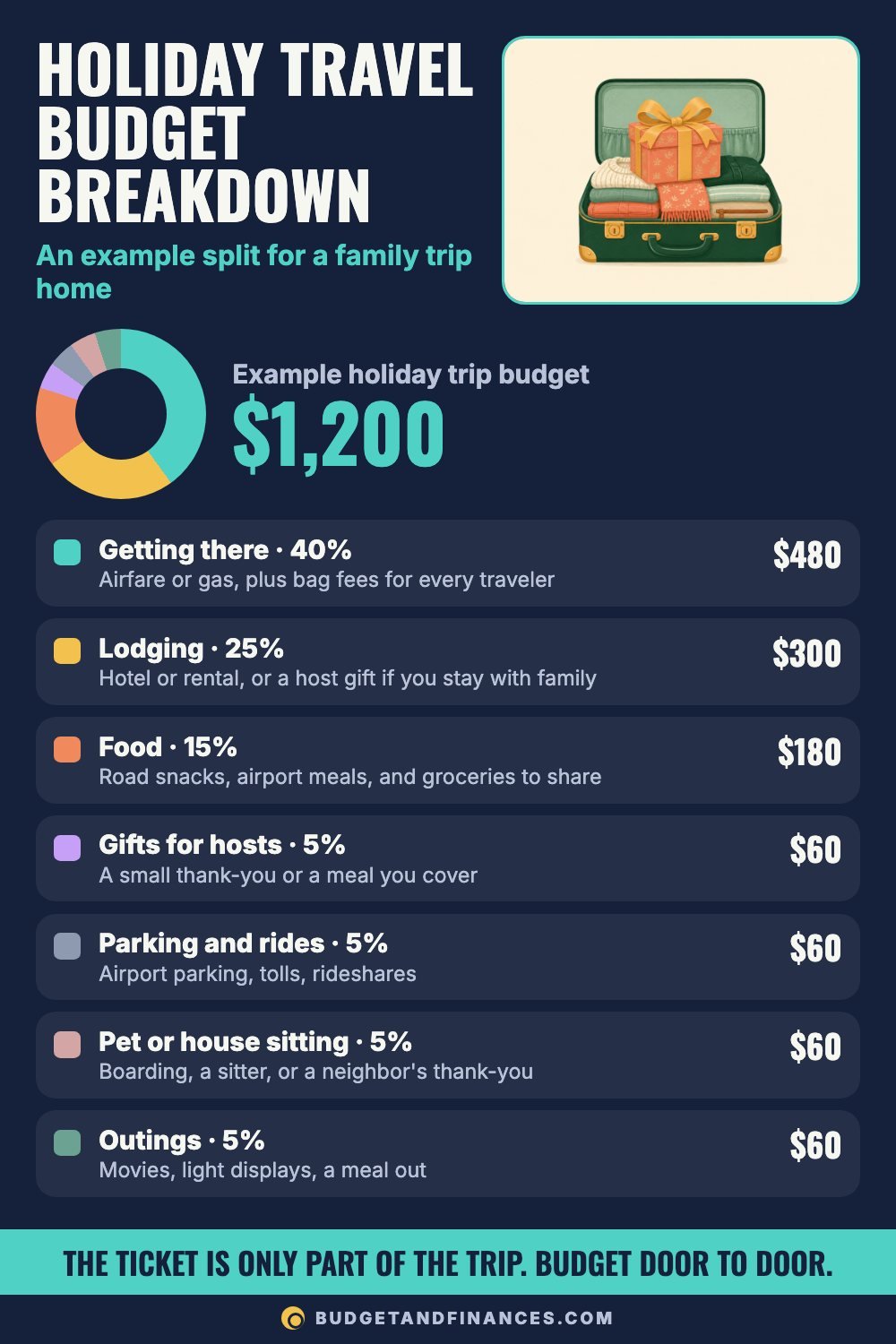
Setting one total first keeps you from budgeting the ticket and guessing at the rest. Here’s an example $1,200 holiday trip budget for a family trip home.
| Category | Share | Amount | What it covers |
|---|---|---|---|
| Getting there | 40% | $480 | Airfare or gas, plus bag fees for every traveler |
| Lodging | 25% | $300 | Hotel or rental, or a host gift if you stay with family |
| Food | 15% | $180 | Road snacks, airport meals, and groceries to share |
| Gifts for hosts | 5% | $60 | A small thank-you or a meal you cover |
| Parking and rides | 5% | $60 | Airport parking, tolls, rideshares |
| Pet or house sitting | 5% | $60 | Boarding, a sitter, or a neighbor’s thank-you |
| Outings | 5% | $60 | Movies, light displays, a meal out |
| Total | 100% | $1,200 |
Your split will depend on distance and how many people are going. A family driving two hours will spend far less on getting there. A family flying across the country may need more than 40% for it. The categories matter more than the percentages.
Step 2: Compare driving and flying on the full cost
The cheapest ticket isn’t always the cheapest trip. To compare fairly, add up the full door-to-door cost of each option.
What driving really costs
- Gas for the whole round trip
- Tolls and parking at your destination
- Wear on your car and an oil change after a long drive
- A hotel night if the drive is too long for one day
- Food stops along the way
The upside: gifts and luggage ride along for free.
What flying really costs
- A fare for every traveler, including kids with their own seats
- Checked and carry-on bag fees, each way
- Airport parking or rides to and from the airport
- A rental car if you need one at your destination
- Airport meals and snacks
- Shipping gifts ahead of time
The upside: flying is faster over long distances, and time off work has value too.
Do the gas math
Here’s how to price the gas for a drive. Divide the round-trip miles by your car’s miles per gallon, then multiply by your local gas price.
A 600-mile round trip in a car that gets 25 miles per gallon uses 24 gallons. If gas costs $3.50 a gallon where you are, that’s 24 × $3.50 = $84. Use your own local price, since it varies a lot by area and season.
Step 3: Work through the checklist from booking to back home
Every trip costs something. Plan it so it costs what you chose.
Before you book
- Set one total budget for the whole trip.
- Compare a few different travel dates.
- Price the full cost of driving and of flying, using the lists above.
- Check bag fees before comparing fares. A cheap fare with high bag fees can end up costing more.
Before you leave
- Pack snacks and refillable water bottles.
- Book pet care early. Sitters and boarding fill up around the holidays.
- Ship bulky gifts or order them online and send them straight to your destination.
- Pay any bills that come due while you’re away, so a trip doesn’t cause a late fee.
On the trip
- Carry a set daily spending amount.
- Offer to cook a meal instead of eating out.
- Track every purchase as you go.
Back home
- Add up what you actually spent.
- Note what you’d change next year.
- Start a travel fund for next season.
Ways to save on holiday travel
Be flexible on dates. Leaving a day earlier or later can change the price. Check a few options side by side before you book.
Set price alerts. Turn on fare alerts early so you see when prices drop, instead of checking every day.
Pack light. A carry-on only trip can skip checked bag fees on both legs, though some fares charge for carry-ons too. Read the fare rules.
Split the driving costs. Carpool with relatives heading the same way and share gas and tolls.
Bring your own food. Pack sandwiches and snacks for travel days. Airport and road food adds up fast, especially for a family.
Stay with family kindly. Skip the hotel, then say thanks by cooking a meal or buying groceries. It’s a real saving for you and a real help for your hosts.
Worked example: a family of four, 600 miles round trip
Say a family of four is visiting relatives who live 300 miles away. They start with the $1,200 example budget and compare their options.
Driving. Their car gets 25 miles per gallon, so the 600-mile round trip uses 24 gallons. At $3.50 a gallon, gas is $84. They set aside $50 toward an oil change after the drive and $20 for tolls. The full cost of driving is $84 + $50 + $20 = $154.
Flying. For flying to cost less, all four round-trip fares plus bag fees and airport parking would have to come in under $154. That’s $38.50 per person, with bags and parking included. They check fares and decide to drive.
Gas and the oil change go in the getting-there line, which comes to $134. The $20 in tolls goes in parking and rides.
Lodging. They stay with family, so the $300 hotel line drops to $0. To say thanks, they add $40 to the food line and buy groceries for a big family dinner.
Here’s what the trip actually costs:
| Category | Budget | Actual |
|---|---|---|
| Getting there | $480 | $134 |
| Lodging | $300 | $0 |
| Food | $180 | $220 |
| Gifts for hosts | $60 | $60 |
| Parking and rides | $60 | $20 |
| Pet or house sitting | $60 | $60 |
| Outings | $60 | $60 |
| Total | $1,200 | $554 |
They spend $554 and have $646 left from the $1,200 they set aside. That money can start next year’s travel fund, so the next trip home is already partly paid for.
Your numbers will be different. A longer drive may need a hotel night, and a cross-country trip may make flying the only real choice. The method is what carries over: price everything door to door, then decide.
Free printable: holiday trip expense tracker
Write it down the day you spend it. The tracker has space for the trip name, travel dates and your trip budget at the top. Below are 16 rows for the date, the expense, its category, the amount and a running total.
A running total means you always know where you stand, not only at the end.
Common mistakes
Comparing ticket prices only. Bags, parking and a rental car can change which option is cheaper.
Forgetting the pet sitter. Boarding and sitters are easy to leave out and hard to book at the last minute.
Staying with family and spending nothing on them. Free lodging is a gift. A cooked meal or a grocery run is a kind way to return it and belongs in the budget.
Not tracking on the road. Travel days are full and it’s easy to lose count. Log each purchase the same day.
Booking late. Waiting until the last few weeks usually leaves fewer choices on dates, fares and pet care.
FAQ
How much should I budget for holiday travel?
Add up the full door-to-door cost for your trip: getting there, lodging, food, parking, pet care, host gifts and outings. The example here is $1,200, but a short drive could cost much less and a long flight for a family could cost more.
Is it cheaper to drive or fly for the holidays?
It depends on distance, how many people are going and what fares look like for your dates. Price both on the full cost. Driving often gets cheaper per person as more people ride in one car, since the gas cost doesn’t grow with each passenger.
How do I calculate gas for a road trip?
Divide the round-trip miles by your car’s miles per gallon to get gallons. Multiply by your local gas price. A 600-mile round trip at 25 mpg uses 24 gallons.
What’s a good thank-you when staying with family?
Cook a meal, buy groceries for a dinner, bring a small gift, or take over a chore while you’re there. It doesn’t need to be expensive to be appreciated.
When should I start saving for holiday travel?
As early as you can. Divide your trip total by the months left before you travel. Once you’re home, start a small travel fund for next year so it’s partly saved before you book.