

Money is tight this year, and Christmas is coming anyway, which means finding a way to do Christmas on a budget whether you planned to or not. Maybe it’s a job change, a new baby, higher bills or debt you’re working to pay down.
You can still have a Christmas your family loves. The feeling of Christmas was never about the amount spent. What people remember are the traditions, the food, the time together and a few gifts chosen with care.
What changes on a tight budget is how much planning it takes. This guide gives you an example $600 plan for the whole season, nine rules that make the small decisions for you, and ideas for keeping the magic when money is short.
Step 1: Pick the total first
Every other choice gets easier once you have one number for the season. Without it, each purchase is its own small debate. With it, the answer is either “that fits” or “that doesn’t.”
Choose a number you can pay in cash. That means money you have or can save before you shop, not a card you’ll deal with later.
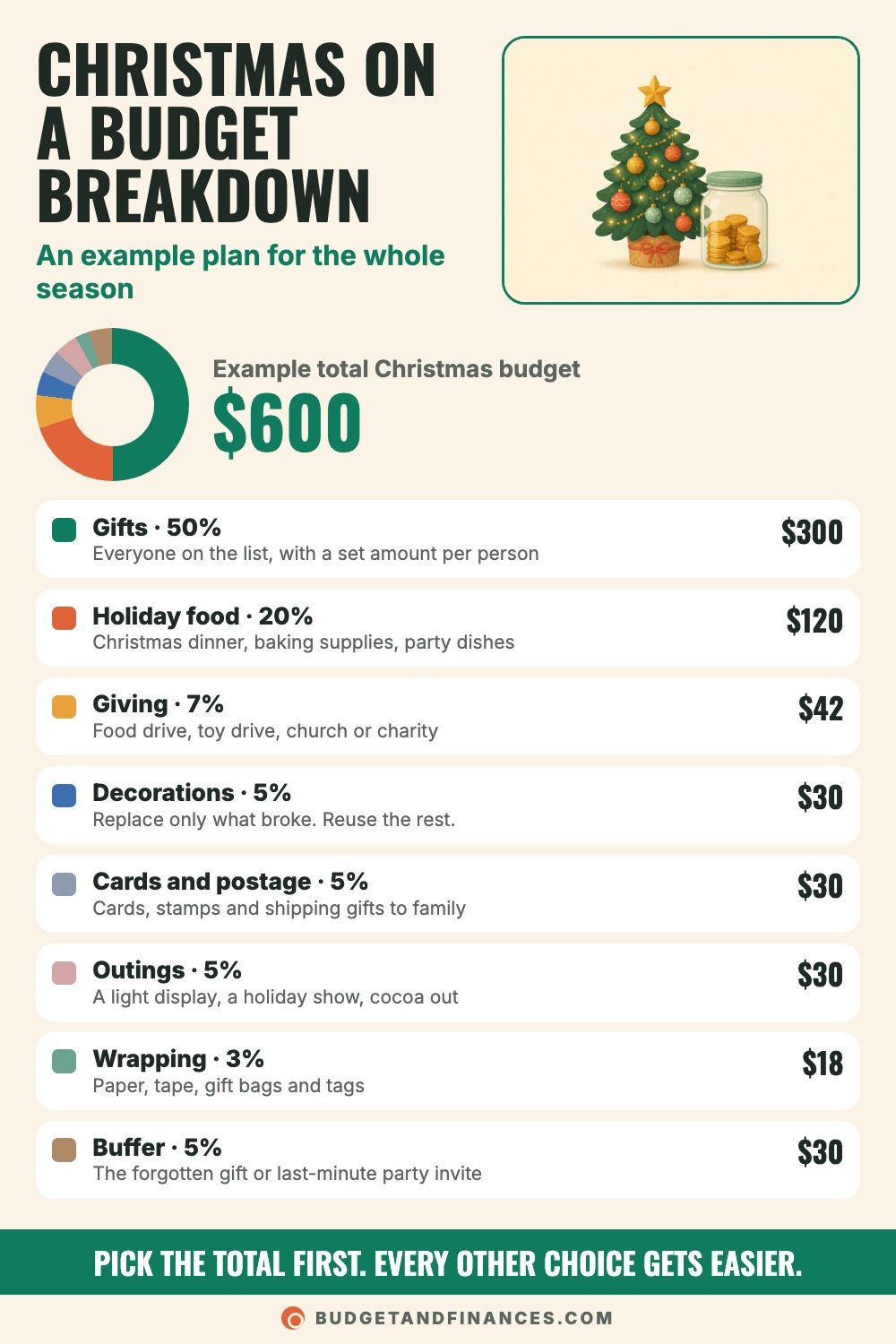
Here’s an example $600 Christmas budget covering the whole season.
| Category | Share | Amount | What it covers |
|---|---|---|---|
| Gifts | 50% | $300 | Everyone on the list, with a set amount per person |
| Holiday food | 20% | $120 | Christmas dinner, baking supplies, party dishes |
| Giving | 7% | $42 | Food drive, toy drive, church or charity |
| Decorations | 5% | $30 | Replace only what broke. Reuse the rest. |
| Cards and postage | 5% | $30 | Cards, stamps and shipping gifts to family |
| Outings | 5% | $30 | A light display, a holiday show, cocoa out |
| Wrapping | 3% | $18 | Paper, tape, gift bags and tags |
| Buffer | 5% | $30 | The forgotten gift or last-minute party invite |
| Total | 100% | $600 |
If your number is $300, halve each line. The shares are a starting point. If your family skips cards, move that money to food or gifts.
Step 2: Spread it out month by month
December feels scary when it’s one giant bill. Spread the planning and saving across the fall and it turns into a few smaller steps.
September: pick your total
Choose one number for the whole season. Subtract anything already saved, then divide what’s left by the months you have to save.
October: make the lists
Write every name with a gift amount next to it. Plan food, travel and decoration costs as their own lines.
November: shop with the list
Buy gifts only from the list. Track every purchase as you go, so you always know what’s left.
Early December: wrap up the shopping
Ship anything going by mail so you don’t pay for rush shipping. Buy baking and dinner supplies.
Christmas week: enjoy it and add it up
Stop shopping and spend time together. After the day, total what you spent against the plan. That number makes next year’s plan better.
Step 3: Set a few firm rules
A few firm rules make a lot of small decisions for you. Here are nine that work well on a tight budget. Pick the ones that fit your family.
- Four-gift rule. Each child gets something they want, something they need, something to wear and something to read.
- Draw names. Adults draw names and buy one gift each instead of gifts for everyone.
- Cash envelopes. Put each category’s money in an envelope. When the envelope is empty, you’re done.
- List before you shop. No list, no purchase.
- Shop your home. Decorate with what you already own.
- Bake, don’t buy. Homemade treats cover parties, neighbors and coworkers.
- 24-hour pause. Wait a day on anything that isn’t on the list.
- Ship early. Mail gifts in time to avoid paying for rush shipping.
- No new debt. If it can’t be paid in cash, skip it.
The last rule is the one that protects January. Everything else supports it.
Ideas that keep the magic when money is short
Talk to family early. Other relatives may feel the same pressure. Suggest spending less, like a name draw or a gift limit, before anyone starts shopping.
Focus on one big moment. Pick the tradition your family loves most and put your effort there. Maybe it’s Christmas Eve dinner, a cookie baking day or opening one gift by the tree. You don’t need to do everything.
Stretch the stockings. Fill them with small useful things: socks, a toothbrush, a favorite snack. Stockings feel full without costing much.
Cook a simpler dinner. A ham or a big pasta bake can feed a crowd for less than a full roast spread with many sides.
Borrow instead of buy. Ask a friend for a serving platter, extra chairs or a party outfit.
Give your kids a job. Let them help wrap, bake and deliver treats. Kids love to feel part of it, and it turns work into a tradition.
Keep receipts together. Put every receipt in one envelope in case a gift needs returning. A return is money back in the budget.
Try a December no-spend challenge
A no-spend challenge gives December a simple daily goal. From December 1 to December 25, color in each day you buy nothing beyond bills and planned groceries.
It doesn’t mean skipping Christmas. If most planned gifts are bought in November, December’s job is to avoid the extras: the impulse ornament, the drive-through coffee on a shopping trip, the “while I’m here” add-on.
Some tips for making it work:
- Finish gift shopping in November so December days can be no-spend days.
- Plan groceries for the week so a no-spend day doesn’t break over a missing ingredient.
- Write down what you didn’t spend. If you usually grab a $6 lunch and bring one from home instead, note it in the “Money saved” box.
Every no-spend day is money that stays yours.
Worked example: a $600 Christmas
Here’s how one example family puts the plan together.
September. They pick $600 for the season. They already have $150 set aside, so $450 is left to save. With three months to save (September, October and November), that’s $450 ÷ 3 = $150 a month.
October. They split the $300 gift line:
- Two kids, using the four-gift rule, $60 each: $120
- Parents: $50
- Partner: $40
- Adult name draw with siblings: $25
- Two stockings, $15 each: $30
- Three teachers, $5 each: $15
- Neighbors, a baking day’s worth of supplies: $20
That’s $120 + $50 + $40 + $25 + $30 + $15 + $20 = exactly $300.
November. They shop from the list and log each purchase. The kids’ gifts come in at $130 instead of $120. They move $10 from the buffer, which drops from $30 to $20, and write it down.
December. They mail the parents’ gift in the first week and buy dinner and baking supplies from the $120 food line with their planned groceries. Every other day, they aim for a box on the no-spend calendar.
Christmas week. They add it all up against the plan. Anything left in the buffer goes toward next year.
Free printable: December no-spend challenge
The calendar has 25 boxes, one for each day from December 1 to Christmas. At the top, write the month and track the money you saved. Color in each day you buy nothing beyond bills and planned groceries.
Common mistakes
Planning gifts only. Food, cards, wrapping and outings add up. Give each one a line.
Waiting until December. Saving $450 in three weeks is much harder than $150 a month over three months.
Keeping the plan to yourself. If family doesn’t know you’re cutting back, you may end up matching gifts you can’t afford. Talk early.
Replacing decorations that still work. Replace only what broke. Reuse the rest.
Covering the gap with a card. A gift bought on credit costs more if the balance isn’t paid in full. If it doesn’t fit in cash, skip it or swap it for something smaller.
FAQ
How can I make Christmas special with little money?
Put your effort into one or two traditions your family loves, keep gifts simple with a rule like the four-gift rule, and involve the kids in baking, wrapping and giving. Time together carries more of the holiday than the gift pile.
How much should I spend on Christmas on a tight budget?
Only what you can pay in cash. The example here is $600 for the season, but your number might be $200 or $1,000. The right number is the one that doesn’t follow you into January.
What is the four-gift rule?
Each child gets four gifts: something they want, something they need, something to wear and something to read. It keeps the pile reasonable and makes the list easy to write.
How do I tell my kids Christmas will be smaller?
Keep it simple and age-appropriate. Focus on what’s staying the same, like traditions, food and time together, and give them a role in making the holiday happen.
Does a no-spend challenge include Christmas gifts?
In this version, bills and planned groceries don’t count, and most gifts are bought from your list in November. If you still have a planned gift or shipping to pay for in December, those days just don’t get colored in. The challenge is about cutting the unplanned extras in December.