
You made the last payment. The balance says $0. And now there’s a strange question sitting in your debt-free budget: what do you do with the money that used to go to lenders every month?
If you don’t answer it on purpose, the answer tends to be “a little more of everything.” A few more takeout nights, a nicer phone, a bigger cart at the store. Six months later the money is gone and you can’t say where.
This guide gives that money a plan. You’ll see a sample debt-free budget on $4,500 a month, a six-step order for where your old payment should go, and a checklist for the first 90 days so the debt stays gone.
How a budget changes once the debt is gone
Same paycheck, very different month. That’s the simplest way to put it.
With debt, a chunk of your money is already spoken for before the month starts. Minimum payments come out first. Interest adds cost to things you bought months or years ago. When a surprise bill shows up, it often goes back on a card because there’s no cushion, and raises tend to disappear into balances.
Once the debt is gone, those same dollars are yours to assign. Old payments can turn into monthly savings. Surprise bills come out of an emergency fund. Retirement savings finally get room to grow. Big purchases get saved for and paid in cash, and raises go toward goals you pick.
The income didn’t change. The number of choices did.
What to do after you pay off debt, step by step
Keep the payment going. Just send it somewhere new. Here’s the order that works for a lot of households.
Step 1: Close the loop (first month)
Log in to every account you paid off and confirm each one shows a $0 balance. Final interest can post after your “last” payment, so check the next statement too.
Then celebrate with something small, paid in cash. You earned it, and paying cash keeps the win clean.
Step 2: Finish the emergency fund (3-6 months)
If you paid off debt with only a small starter fund in place, this comes next. Aim for 3-6 months of essential expenses, meaning the bills you’d still have to pay if your income stopped.
Keep it in a separate high-yield savings account, away from your everyday checking.
Step 3: Boost retirement savings (ongoing)
If your employer offers a match on retirement contributions, make sure you contribute enough to get the full match. Then raise your contribution a little each year, for example whenever you get a raise.
Step 4: Start sinking funds
A sinking fund is money you save each month for a cost you know is coming: car repairs, gifts, trips, yearly insurance bills. When you save for these ahead of time, yearly costs stop landing on a credit card, which is how a lot of people end up back in debt.
Step 5: Save for bigger goals
With the basics covered, pick the bigger things. A home down payment, your kids’ education, or paying cash for the next car instead of financing it.
Step 6: Build wealth and give
Invest steadily for the long term and give more to the people and causes you care about. This is the part debt used to crowd out.
A sample debt-free budget on $4,500 a month
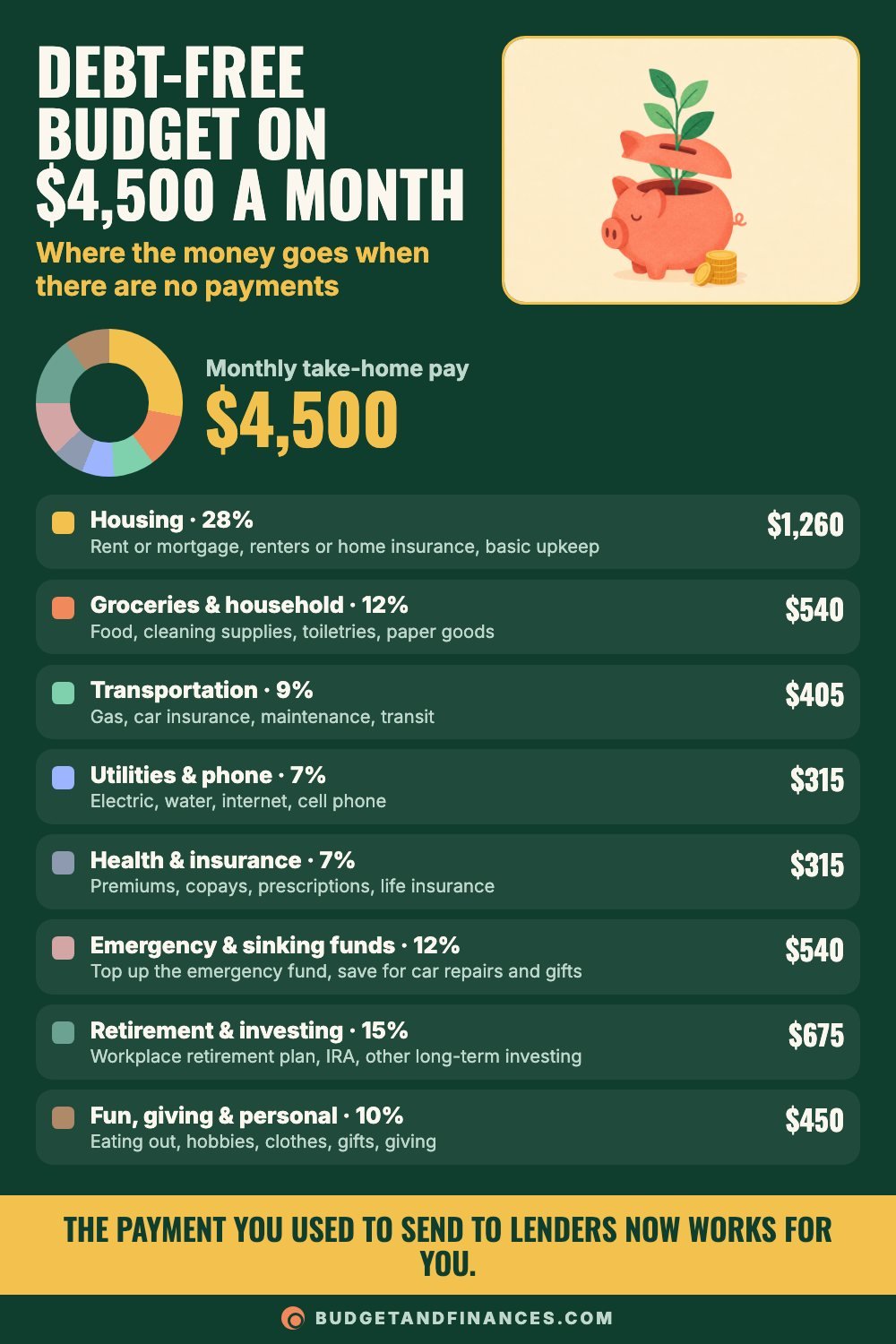
Here’s one way to split $4,500 of monthly take-home pay once there are no debt payments. Your numbers will look different. Use it as a starting point, then adjust.
| Category | Share | Monthly amount | What it covers |
|---|---|---|---|
| Housing | 28% | $1,260 | Rent or mortgage, renters or home insurance, basic upkeep |
| Groceries & household | 12% | $540 | Food, cleaning supplies, toiletries, paper goods |
| Transportation | 9% | $405 | Gas, car insurance, maintenance, transit |
| Utilities & phone | 7% | $315 | Electric, water, internet, cell phone |
| Health & insurance | 7% | $315 | Premiums, copays, prescriptions, life insurance |
| Emergency & sinking funds | 12% | $540 | Top up the emergency fund, save for car repairs and gifts |
| Retirement & investing | 15% | $675 | Workplace retirement plan, IRA, other long-term investing |
| Fun, giving & personal | 10% | $450 | Eating out, hobbies, clothes, gifts, giving |
| Total | 100% | $4,500 |
Notice what’s missing: a debt line. Notice what’s there instead.
The emergency and sinking funds line ($540) and the retirement line ($675) add up to $1,215 a month going toward your future. Over a year, that’s $14,580.
How to adjust it for your income
Start with your own take-home pay and your real fixed costs. Housing is usually the line that moves the rest. If your rent takes 35% instead of 28%, those 7 points have to come from somewhere, often the fun line or the savings split, until your income grows.
Then fill the lines in this order: essentials first, then emergency fund until it’s full, then retirement, then sinking funds, then fun. When the emergency fund reaches your 3-6 month target, move that part of the $540 over to sinking funds or bigger goals.
Write it out before the month starts so every dollar has a job before payday.
Worked example: giving the old payment a new job
Say you paid off a car loan and a credit card that together took $540 a month. That $540 is the exact size of the emergency and sinking funds line in the sample budget above.
Instead of letting it blend into spending, you set an automatic transfer for $540 on payday. For the first stretch, all of it goes to the emergency fund. Once that fund covers 3-6 months of essentials, you split it between sinking funds, like car repairs and gifts, and bigger goals.
Your lifestyle didn’t change. You were already living without that $540. It just stopped leaving for a lender.
Your first 90 days debt-free
Payoff took effort. Ninety days of new habits keeps it that way.
Print the checklist and work through one month at a time.
Month 1: Lock in the win
– Confirm each account shows a $0 balance.
– Keep the paid-in-full letters in a folder. If a lender doesn’t send one, ask for it.
– Remove saved cards from shopping sites so buying something takes more than one click.
– Redirect the old payment amount on payday with an automatic transfer.
Month 2: Build the cushion
– Send the old payment to your emergency fund.
– Set up sinking funds for car repairs and gifts.
– Rewrite your budget without the debt lines.
Month 3: Plan ahead
– Check your credit reports for errors. You can get free copies from each of the three major credit bureaus.
– Raise your retirement contributions.
– Pick one big goal to save toward.
– Decide which cards to keep open. Closing an old card can lower your available credit, so think it through before you close anything.
Every month after
– Give every dollar a job before the month starts.
– Pay any card you use in full.
– Review your spending once a week.
Signs your debt-free budget is working
Check these once a quarter. How many are true for you right now?
- Emergency fund ready. A surprise bill doesn’t go on a card.
- Cards paid in full. Any card balance is cleared monthly.
- Bills on autopilot. No late fees, no missed due dates.
- Gifts paid in cash. Holidays come from a sinking fund.
- Retirement growing. You add to it every paycheck.
- Car fund building. Your next car gets bought with savings.
- Raises go to goals. Pay bumps don’t vanish into spending.
- Budget before payday. Every dollar has a plan ahead of time.
- Money feels calm. Checking your balance isn’t scary.
If you can only check a few, that’s fine. Pick the next one on the list and work on it this quarter.
Common mistakes after paying off debt
Letting the old payment blend into spending. If you don’t move it on payday, it gets spent. Automate the transfer in month one.
Skipping sinking funds. Car repairs, holidays and yearly bills are the most common way debt comes back. They aren’t surprises, so save for them.
Using the emergency fund for expected costs. Christmas and new tires belong in sinking funds. Keep the emergency fund for real emergencies.
Closing every card in a rush. Decide card by card. Keeping an old no-fee card open and paid in full can help your credit history.
Going all in on one goal. Putting everything into investing while the emergency fund is thin leaves you exposed if something breaks.
FAQ
Should I invest or build my emergency fund first after paying off debt?
A common order is to finish the emergency fund to 3-6 months of essential expenses while still getting any employer retirement match, then raise investing after that. The emergency fund keeps a surprise bill from turning into new debt.
How much of my budget should go to savings once I’m debt-free?
There isn’t one right number. In the sample $4,500 budget, 27% goes to emergency, sinking funds and retirement combined, which is $1,215 a month. Start with whatever your old debt payments were, since you were already living without that money.
Should I close my credit cards after paying them off?
Not automatically. Closing a card can lower your total available credit and, for an older card, shorten your credit history. If a card has an annual fee or tempts you to overspend, closing it can still make sense. Decide one card at a time.
What if I get a raise after I’m debt-free?
Decide where it goes before the first bigger paycheck lands. Raising your retirement contribution or adding to a savings goal right away keeps the raise from disappearing into everyday spending.
Do I still need a budget if I have no debt?
Yes. A budget is how you decide where money goes on purpose. Without one, the room you created by paying off debt tends to fill up with spending you didn’t plan.
This is general education, not personal financial advice.