
You make a payment every month, but the credit card debt barely moves. Then you look at the statement and see why: a big chunk of what you paid went to interest.
Credit card debt is expensive because the interest rates are usually high and interest is charged on whatever balance you carry. The good news is that small changes, like paying a bit more each month or getting a lower rate, can cut both the time and the total cost.
This guide covers the practical moves, shows the real math on a $5,000 balance, and walks through balance transfers, consolidation loans and the habits that keep the balance from creeping back.
Step 1: Stop adding new charges
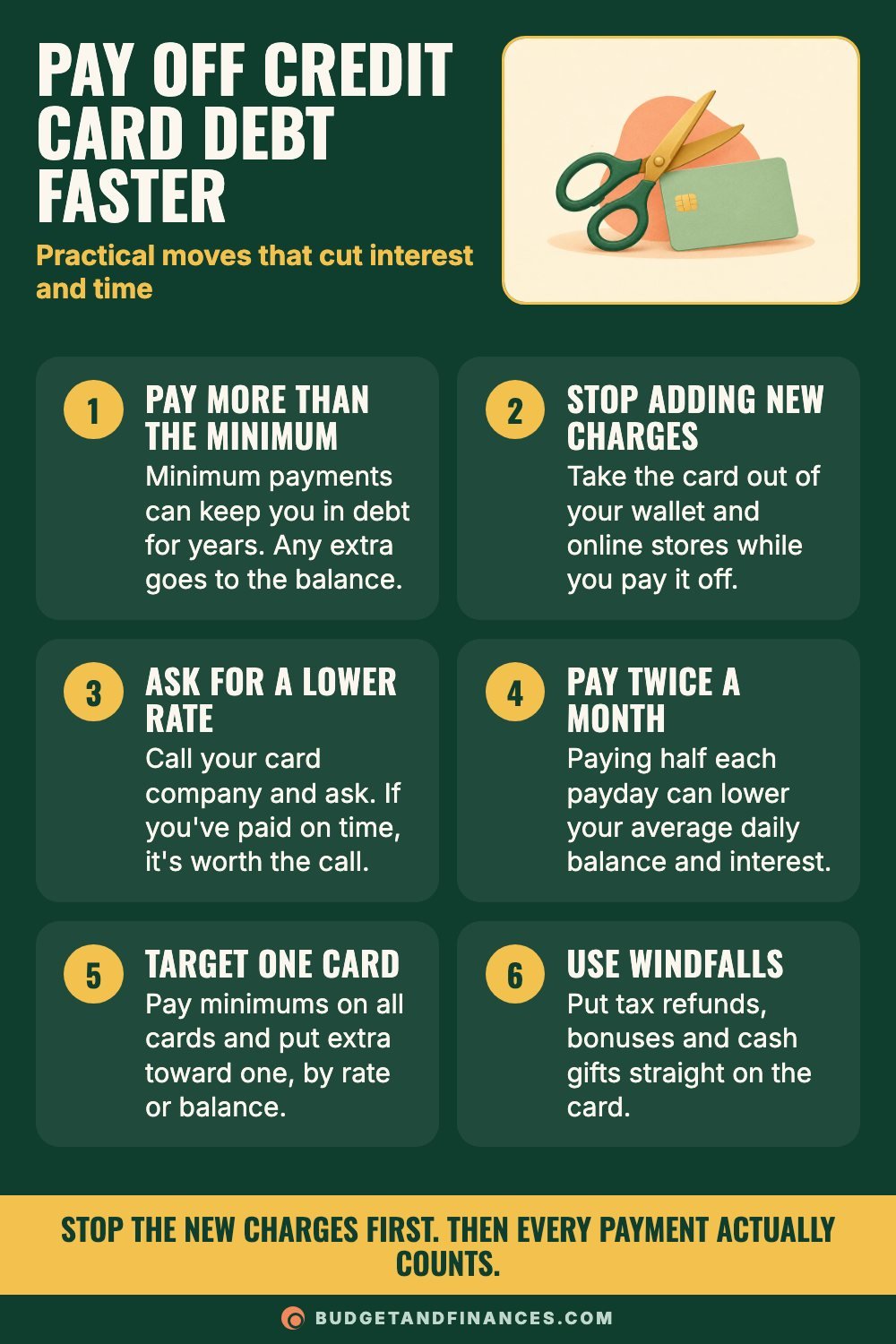
Stop the new charges first. Then every payment actually counts.
If you keep using the card while you pay it down, you’re filling the bucket while you bail it out. Take the card out of your wallet and remove it from online stores while you pay it off.
Step 2: Pay more than the minimum
Minimum payments can keep you in debt for years. A large share of a small payment can go to interest, while every dollar above that goes to your balance.
Here’s what that looks like on real numbers.
Worked example: $5,000 at 24% APR
Say you owe $5,000 on a card with a 24% APR, and you stop adding charges. Each month, interest is 24% divided by 12, or 2% of your balance. In the first month, that’s $100 in interest.
If you pay $150, only $50 of that first payment goes to the balance. Pay more and the balance falls much faster. We ran each option month by month, paying the same fixed amount every month until the balance is gone:
| Monthly payment | Months to pay off | Total interest | Total paid |
|---|---|---|---|
| $150 | 56 | $3,322.15 | $8,322.15 |
| $250 | 26 | $1,449.37 | $6,449.37 |
| $350 | 17 | $946.99 | $5,946.99 |
Going from $150 to $250 a month saves $1,872.78 in interest and finishes 30 months sooner. Going to $350 saves $2,375.16 compared with $150.
Your card’s actual minimum payment may be calculated differently and usually shrinks as your balance falls. Paying a fixed amount that doesn’t shrink is one of the simplest ways to get out faster.
Step 3: Ask for a lower rate
A lower APR means more of each payment goes to the balance. It takes one phone call, and if you’ve paid on time, it’s worth making.
Before you call
- Find your current APR on your statement.
- Note how long you’ve had the card.
- Note your on-time payment history.
On the call
- Ask directly for a lower interest rate.
- Mention you’re working to pay the balance down.
- Ask if there’s a hardship program.
- Stay polite, and ask twice if needed.
Before you hang up
- Confirm the new rate.
- Ask when it takes effect.
- Ask if it’s permanent or temporary.
After the call
- Write down the date and the representative’s name.
- Check your next statement for the new rate.
- Put any savings toward the balance.
The worst they can say is no. If they do, try again in a few months.
Step 4: Pay twice a month
Many cards charge interest based on your average daily balance. Paying half your payment each payday, instead of the full amount once a month, brings the balance down earlier in the cycle. That can lower your average daily balance and the interest you’re charged.
Just make sure the total you pay by the due date is at least the minimum.
Step 5: Target one card at a time
If you have more than one card, pay the minimum on every card and put all your extra money toward one. You can choose that card two ways:
- By rate (debt avalanche): highest interest rate first. Usually the least interest overall.
- By balance (debt snowball): smallest balance first. Quicker wins.
When the target card is paid off, add its full payment to the next card.
Step 6: Use windfalls
Put tax refunds, bonuses and cash gifts straight on the card. A one-time payment goes entirely to the balance and cuts the interest charged every month after.
Balance transfer vs consolidation loan
Two tools can lower the interest you pay. Either one only helps if you stop adding new card charges.
Balance transfer card
Best for a fast payoff.
- A low or 0% intro rate for a set time.
- Usually charges a transfer fee.
- The rate goes up when the intro period ends.
- Often needs good credit to qualify.
- Works if you can pay it off before the intro period ends.
To see how that plays out, say a card offered 0% for 15 months with a 3% transfer fee. These terms are only for illustration, so check the real ones on any offer. The fee on $5,000 would be $150, making the new balance $5,150. Dividing $5,150 by 15 months gives about $343.33 a month to clear it before the intro rate ends. Compare that with the table above, where $350 a month at 24% still costs $946.99 in interest.
Debt consolidation loan
Best for a fixed plan.
- One fixed monthly payment.
- A set payoff date from day one.
- The rate depends on your credit.
- May charge an origination fee.
- Paid-off cards can tempt you to spend again.
Read the fees and the end date before you sign anything.
Habits that keep the balance going down
Paying off the card only works if it stays paid off.
- Freeze the card. Literally, in a block of ice, or lock it in the card’s app.
- Delete saved cards. Remove them from shopping sites.
- Use a 24-hour rule. Wait a day before any non-essential buy.
- Use cash for fun money. When it’s gone, it’s gone.
- Autopay minimums. Never miss a due date.
- Keep a small buffer. So emergencies don’t go on the card.
- Check your balance weekly. Watch it go down.
- Unfollow shops. Fewer ads, fewer impulse buys.
- Celebrate each card. A free reward for every payoff.
Track it with the free printable
Write the new balance every month and watch the number shrink. At the top, fill in your start date, total card debt and target card. Each row has space for the month, the card, the balance, what you paid and the new balance.
Using the $250-a-month example, your first three rows would look like this:
| Month | Balance | Interest | Paid | New balance |
|---|---|---|---|---|
| 1 | $5,000.00 | $100.00 | $250 | $4,850.00 |
| 2 | $4,850.00 | $97.00 | $250 | $4,697.00 |
| 3 | $4,697.00 | $93.94 | $250 | $4,540.94 |
The interest column isn’t on the printable, but it’s worth checking on your statement. As the balance falls, the interest drops, and more of the same $250 goes to the balance.
Common mistakes
Paying off the card while still using it. New charges cancel out your payments. Stop them first.
Paying only a little. On the $5,000 example, $150 a month takes 56 months. Any extra shortens that.
Letting the intro rate run out. A balance transfer works best when you pay it off before the regular rate kicks in. Divide the balance by the intro months and pay at least that.
Ignoring fees. Transfer fees and origination fees add to what you owe. Include them in your math.
Running the cards back up after a loan. After a consolidation loan, the cards have zero balances again. Put them away.
Having no buffer. Without a little savings, the next car repair goes right back on the card.
FAQ
What’s the fastest way to pay off credit card debt?
Stop new charges and pay as much above the minimum as you can. On a $5,000 balance at 24% APR, paying $350 a month instead of $150 cuts the payoff from 56 months to 17 and saves $2,375.16 in interest.
Does paying twice a month lower credit card interest?
It can. If your card charges interest on your average daily balance, paying earlier in the cycle lowers that average. Make sure the total paid by the due date covers at least the minimum.
Can I really ask for a lower credit card interest rate?
Yes, you can always ask. A history of on-time payments helps. If the answer is no, ask about a hardship program, and try again in a few months.
Is a balance transfer a good idea?
It can help if you qualify, the fee is reasonable and you can pay off the balance before the intro rate ends. If you can’t, the regular rate applies to what’s left.
Should I pay off the card with the highest rate or smallest balance first?
Highest rate first (the avalanche) usually saves the most interest. Smallest balance first (the snowball) gives quicker wins. Either works if you pay minimums on every card and roll payments forward.
This is general education, not personal financial advice.