
You know you have debt. You might not know exactly how much, what each one charges, or which one to pay first. So every month you pay what you can and hope the numbers go down, without a debt payoff plan to guide it.
A debt payoff plan replaces hoping with a clear order and a set payment. You write everything down once, decide how much goes to debt each month, and follow the same steps until the last balance hits zero.
Here’s how to build one in six steps, including a sample budget on $4,000 a month and a month-by-month example of the plan in action.
Step 1: Face the numbers
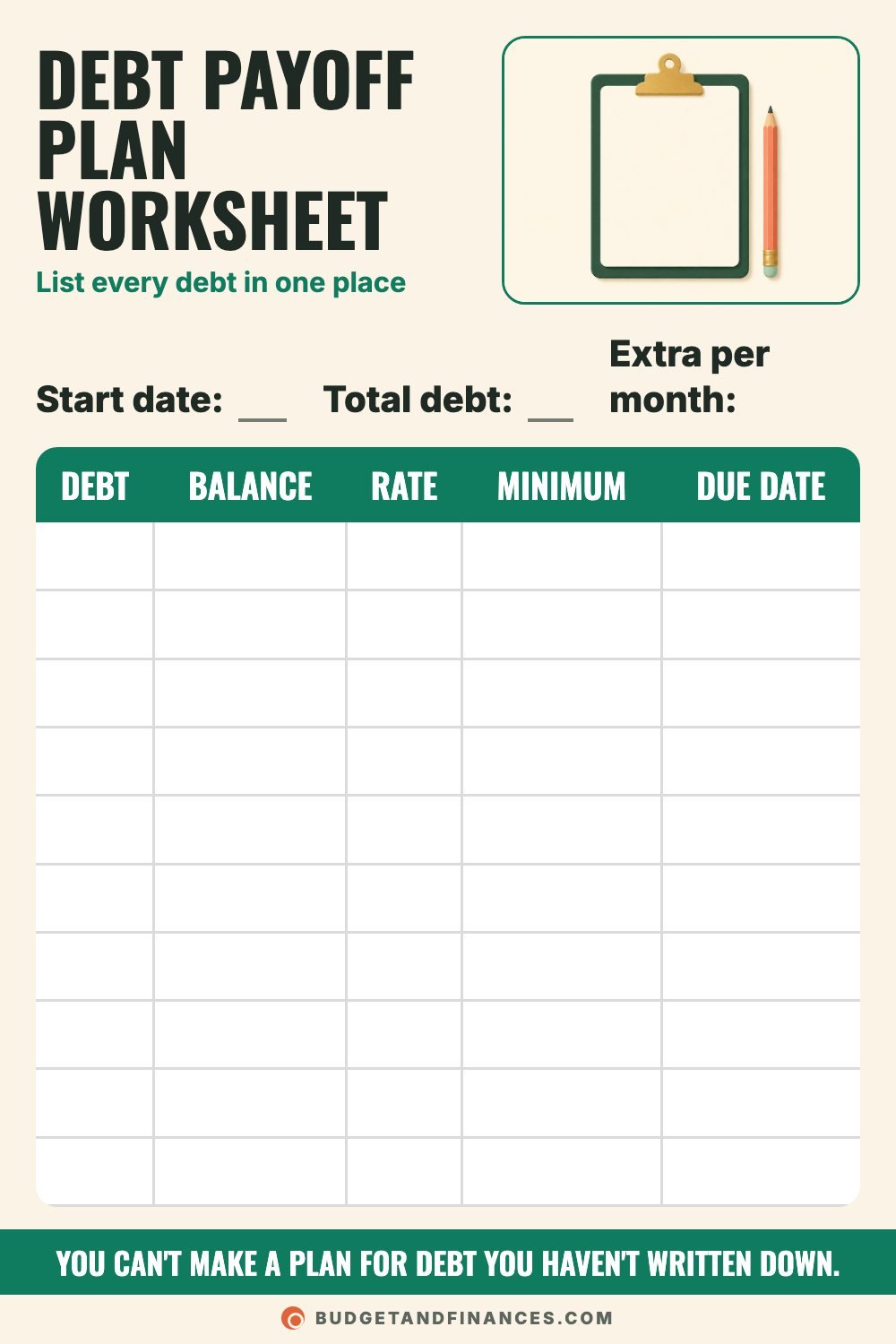
You can’t make a plan for debt you haven’t written down. Pull up the latest statement for every debt and fill in the worksheet:
- Debt: the name of the card, loan or bill
- Balance: what you owe today
- Rate: the interest rate (APR)
- Minimum: the minimum monthly payment
- Due date: when it’s due each month
Then add up every balance for your total debt, and write your start date at the top.
This step can feel uncomfortable. It’s also the step that makes everything after it possible. A number on paper is easier to deal with than a vague feeling.
Step 2: Build a small buffer
Before you throw extra money at debt, save a starter emergency fund. Many people aim for $1,000.
Without it, the first flat tire or urgent care visit goes right back on a credit card, and your plan goes backward. The buffer doesn’t need to be big. It just needs to cover the small surprises.
Step 3: Find your extra
Make a budget for the month and decide on a set extra payment amount. “Whatever’s left over” usually turns into nothing. Give debt a real line in your budget.
A sample budget with a debt payoff plan
Here’s one example on $4,000 a month of take-home pay. Yours will look different, but it shows how debt can get a real share without leaving out the basics.
| Category | Share | Amount | Examples |
|---|---|---|---|
| Housing | 30% | $1,200 | Rent or mortgage, renters or home insurance |
| Food | 10% | $400 | Groceries and a small eating-out amount |
| Transportation | 10% | $400 | Car payment, gas, insurance, maintenance |
| Utilities and phone | 7% | $280 | Electric, water, internet, phone |
| Health and insurance | 8% | $320 | Health premiums, copays, prescriptions |
| Debt payments | 20% | $800 | All minimums plus the extra payment on your target debt |
| Savings | 5% | $200 | Emergency fund buffer |
| Everything else | 10% | $400 | Kids, personal care, gifts, fun money |
The shares add up to 100% and the amounts add up to $4,000.
Ways to find extra money for debt
If your debt line looks too small, look for more:
- Cancel forgotten subscriptions. Check your statements for charges you don’t use and send that amount to debt.
- Shop your pantry first. Cook from what you already have for a week before buying groceries.
- Call about your bills. Ask your phone, internet and insurance providers about lower rates.
- Sell what you don’t use. Put sale money straight toward your target debt the same day.
- Send windfalls to debt. Tax refunds, bonuses and gifts can knock out a whole balance.
- Keep the raise. When your pay goes up, add the difference to your debt payment.
Found money goes to debt the day you find it.
Step 4: Pick an order
Pay the minimum on every debt, and send all your extra money to one target debt at a time. There are two popular ways to choose the order:
- Debt snowball: smallest balance first. You get quick wins.
- Debt avalanche: highest interest rate first. You usually pay less interest overall.
Either works as long as you stick with it.
Step 5: Automate it
Set autopay for every minimum payment so nothing is ever late. Then schedule the extra payment for payday, before the money has a chance to get spent.
Step 6: Review monthly
Once a month, update your balances on the worksheet and roll any paid-off payment forward to the next debt. More on that monthly check-in below.
Worked example: a plan on $800 a month
Let’s put the sample budget to work. The debts below are made up for illustration, and every result comes from a month-by-month calculation.
| Debt | Balance | Rate | Minimum |
|---|---|---|---|
| Credit card 1 | $1,200 | 25% | $40 |
| Credit card 2 | $3,500 | 21% | $105 |
| Personal loan | $6,000 | 11% | $195 |
Total debt: $10,700. Minimums add up to $340, which leaves $460 extra from the $800 debt line.
In this example, the smallest balance also has the highest rate, and the middle balance has the middle rate. So the snowball and avalanche orders are the same: credit card 1, then credit card 2, then the personal loan.
How the numbers were run: each month, interest is added at the yearly rate divided by 12, every minimum is paid, and the rest of the $800 goes to the target debt. When a debt is paid off, its payment rolls to the next one.
Month by month
| Month | Card 1 | Card 2 | Loan | Total debt |
|---|---|---|---|---|
| Start | $1,200.00 | $3,500.00 | $6,000.00 | $10,700.00 |
| 1 | $725.00 | $3,456.25 | $5,860.00 | $10,041.25 |
| 2 | $240.10 | $3,411.73 | $5,718.72 | $9,370.55 |
| 3 | $0 | $3,111.54 | $5,576.14 | $8,687.68 |
| 6 | $0 | $1,430.82 | $5,140.51 | $6,571.33 |
| 9 | $0 | $0 | $4,353.11 | $4,353.11 |
| 12 | $0 | $0 | $2,051.85 | $2,051.85 |
| 14 | $0 | $0 | $482.31 | $482.31 |
| 15 | $0 | $0 | $0 | $0 |
- Credit card 1 is paid off in month 3.
- Credit card 2 is paid off in month 9.
- The personal loan is paid off in month 15, with a final payment of $486.73.
- Total interest paid: $986.73.
For comparison, paying only the minimums and never rolling payments forward would take 51 months and cost $3,583.04 in interest. The plan finishes 36 months sooner and saves $2,596.31.
Get the free worksheet
The worksheet has spaces for your start date, total debt and extra per month, plus rows for every debt with its balance, rate, minimum and due date.
Your monthly debt payoff check-in
Twenty minutes a month keeps your plan on track.
Update (5 minutes). Write each new balance on your tracker, add up your new total debt, and compare it to last month.
Check (5 minutes). Make sure every minimum was paid on time, the extra payment went to the right debt, and no new charges were added.
Adjust (5 minutes). Raise the extra payment if you can. Roll any paid-off payment forward. Plan for big expenses coming up.
Celebrate (5 minutes). Cross off anything paid in full. Mark a free reward for the win. Write down how much you’ve paid down so far.
Watching the total go down every month is what keeps you going.
Common mistakes
Skipping the buffer. Without a small emergency fund, one surprise bill goes on a card and undoes months of work.
Leaving debt as “whatever’s left.” Give it a set amount in your budget, like the $800 line above.
Forgetting to roll payments. In the example, the extra only works because each paid-off payment moves to the next debt. If it gets spent, the plan slows down.
Adding new charges. Paying down a card while still using it keeps the balance stuck.
Never reviewing. Balances, rates and budgets change. A plan you review every month is a plan that keeps working.
FAQ
What’s the first step in a debt payoff plan?
List every debt with its balance, interest rate, minimum payment and due date, then add up your total. Everything else in the plan builds on that list.
How much of my income should go to debt payments?
There’s no single right number. In the sample budget above, 20% of a $4,000 take-home pay, or $800, goes to all debt payments. Start with what your budget can reliably carry and raise it when you can.
Should I save or pay off debt first?
Many people save a small starter emergency fund, often around $1,000, then put extra money toward debt while keeping up every minimum.
Should I use the debt snowball or avalanche?
The snowball pays smallest balance first for quick wins. The avalanche pays highest rate first and usually costs less interest. Pick the one you’ll stick with.
How often should I update my plan?
Once a month. Update balances, check that payments went where they should, and roll any paid-off payment forward.
This is general education, not personal financial advice.