

Payday comes, the bills go out, and a few days before the next check you’re checking your balance before every swipe. Then it happens again, the cycle of living paycheck to paycheck.
Living paycheck to paycheck is exhausting, and it isn’t always about income. It can happen at many income levels. The pattern is the same: no cushion, so every surprise lands on a card or turns into a late fee.
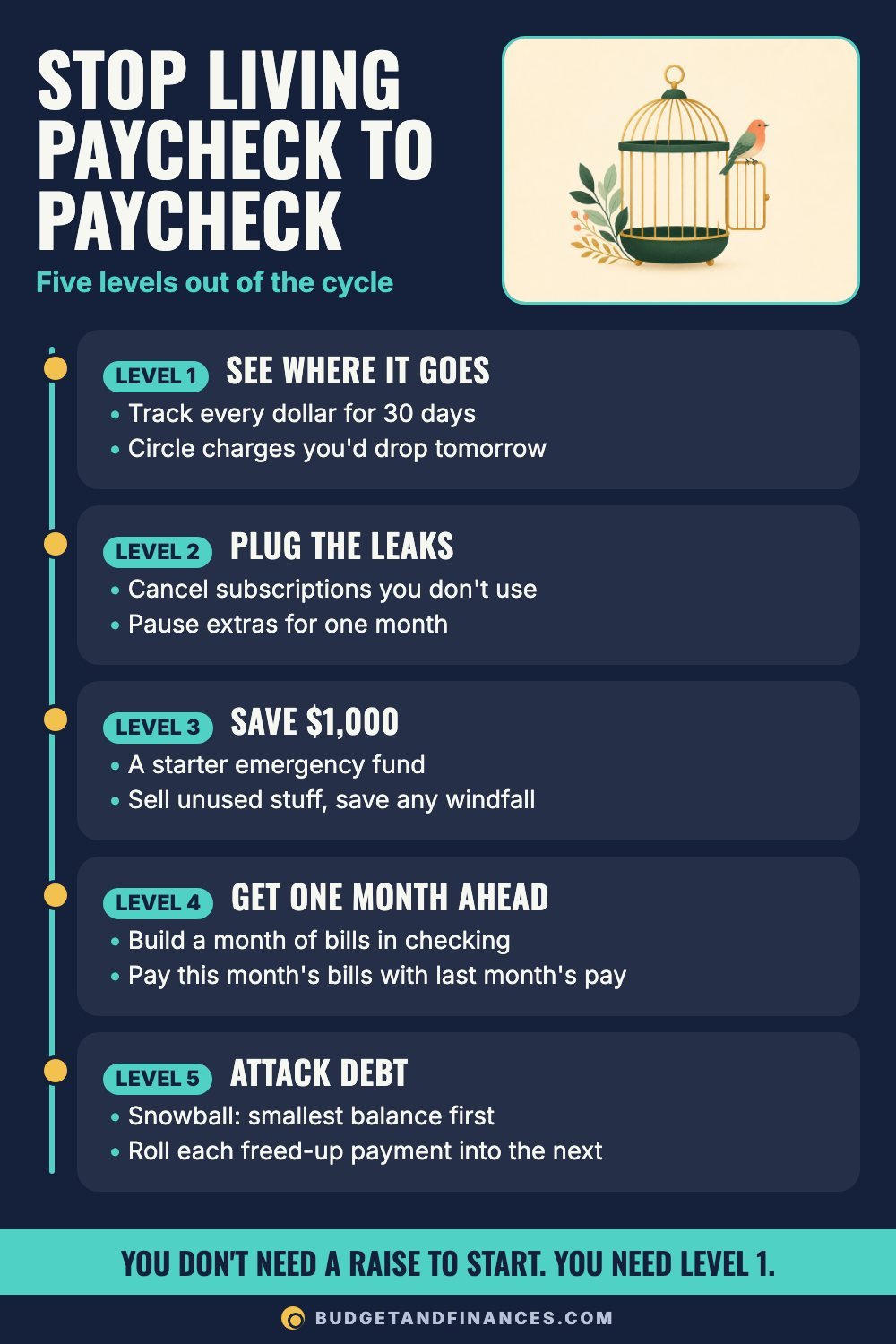
You don’t need a raise to start breaking the cycle. You need a plan with small, clear steps. Here’s one.
Signs you’re living paycheck to paycheck
How many of these sound familiar?
- Swipe anxiety. Checking the balance before every swipe.
- Credit for groceries. Using a card to get to payday.
- Overdraft fees. Hitting zero before the next check.
- Late payments. Paying bills whenever money shows up.
- No savings. Nothing set aside for surprises.
- Back to zero. Every payday resets the same way.
- Where did it go? Money gone with little to show for it.
- Repair panic. One car repair would wreck the month.
- Payday planning. Plans depend on which day pay lands.
If you checked three or more, start with a spending tracker. Recognizing the pattern is how you start breaking it.
Level 1: See where it goes
Track every dollar for 30 days. Write down each purchase, however small.
As you go, circle the charges you’d drop tomorrow if you noticed them. Almost everyone finds a few. You’re not cutting anything yet. You’re just looking.
Level 2: Plug the leaks
Now use what you found.
- Cancel subscriptions you don’t use.
- Pause extras for one month, like takeout, impulse shopping, or add-ons to your phone plan.
Small leaks add up. Say you cancel three subscriptions you’d forgotten about at $15, $12 and $10 a month. That’s $37 a month, or $444 a year.
Level 3: Save $1,000
This is your starter emergency fund. It won’t cover everything, but it covers a lot of the surprises that used to go on a card: a car repair, a copay, a broken appliance.
Ways to build it faster:
- Sell unused stuff.
- Save any windfall, like a tax refund, rebate or birthday cash.
- Use the savings chart below, and color in a box every time you set money aside.
If you can save $50 a week, you’ll reach $1,000 in 20 weeks.
Level 4: Get one month ahead
This is the step that actually ends the scramble. The goal is to build a full month of bills in checking, so you pay this month’s bills with last month’s pay.
Once you’re a month ahead, it no longer matters which day your paycheck lands. The money for every bill is already there.
Say your monthly bills come to $2,400. If you save $100 a week toward this goal, you’ll get there in 24 weeks. Any third paycheck, bonus or tax refund shortens that.
Level 5: Attack debt
With a cushion in place, go after debt using the snowball method. Pay the minimum on everything, and put every extra dollar toward the smallest balance first.
When that debt is gone, roll its freed-up payment into the next smallest. Each payoff makes the next payment bigger.
A worked example of the snowball
Say you have three debts, and you’ve found an extra $100 a month to put toward them:
| Debt | Balance | Minimum payment |
|---|---|---|
| Store card | $400 | $25 |
| Credit card | $1,500 | $50 |
| Car repair loan | $3,000 | $90 |
Here’s how the payments roll:
- Pay the minimums on all three. Send the extra $100 to the store card, so it gets $125 a month.
- When the store card is paid off, its $125 rolls to the credit card. That card now gets $125 plus its own $50 minimum, or $175 a month.
- When the credit card is paid off, that $175 rolls to the car repair loan. It now gets $175 plus its $90 minimum, or $265 a month.
The total you pay each month stays the same. It just gets aimed at fewer debts, so each one goes faster. How long it takes depends on your interest rates, so check your statements for payoff estimates.
Small moves when money is tight
Before you can save, you might need to free up some cash. These can help before the next payday:
Call your bills. Ask phone, internet and insurance companies for a lower rate or a cheaper plan.
Shop your pantry first. Plan a week of meals from what you already have before buying more groceries.
Move your due dates. Ask billers to shift due dates so they land right after payday.
Sell one thing a week. Clothes, baby gear and furniture you don’t use can become your first savings.
Use cash for groceries. A set amount of cash each week keeps the grocery bill from creeping up.
Save every windfall. Tax refunds, rebates and birthday cash go straight to your emergency fund.
Add a little income. Extra shifts, babysitting or a small side gig can build a buffer faster.
Small wins add up. Start with the one you can do today.
Try a 30-day paycheck reset
If you want a jump start, spend one month on bills and basics only. Every day that you spend only on necessities, color in that day on a calendar. Send whatever you don’t spend to savings.
Thirty days of basics-only spending can start your first buffer. It also shows you which extras you actually missed, and which ones you didn’t.
Get the free printables
The Save Your First $1,000 chart has 36 boxes: twenty $25 boxes, ten $20 boxes and six $50 boxes. Together they add up to exactly $1,000. Fill boxes in any order, whenever you have the cash.
The 30-day reset tracker is a calendar with space for the month and your savings goal. Color in every day you spend only on bills and basics.
Common mistakes
Trying every level at once. Paying off debt with no cushion usually means the next surprise goes right back on a card. Work through the levels in order.
Skipping the tracking step. Cutting spending without knowing where it goes is mostly guessing.
Using the $1,000 for non-emergencies. A sale isn’t an emergency. If you do use the fund for a real one, refill it before moving on.
Cutting so hard it can’t last. A month with zero extras is fine as a reset. A plan with zero extras forever tends to break.
Waiting for a raise. More income helps, but without a plan, extra money often disappears the same way. Start with Level 1 now.
FAQ
How long does it take to stop living paycheck to paycheck?
It depends on your income, expenses and debt. For many people, the starter fund takes a few months and getting a month ahead takes longer. Every level you finish makes the next month less stressful.
Should I save or pay off debt first?
This plan saves a $1,000 starter fund and gets a month ahead first, so a surprise doesn’t push you back onto credit. Keep making at least the minimum payment on every debt the whole time.
What if I can’t find any money to save?
Start with the small moves above: call your bills, cook from the pantry, sell something you don’t use. Even $5 or $10 a week gets the habit going.
Where should I keep my $1,000 starter fund?
A separate savings account works well, so it isn’t mixed in with spending money. Some people use a savings account at a different bank so it’s harder to dip into.
This is general education, not personal financial advice.