

Most budgeting advice assumes the same paycheck lands on the same day every month. If you have irregular income from tips, commission, gigs or seasonal pay, that advice falls apart fast.
One month you’re comfortable. The next month you’re moving bills around and hoping a client pays on time. The ups and downs make it hard to plan anything.
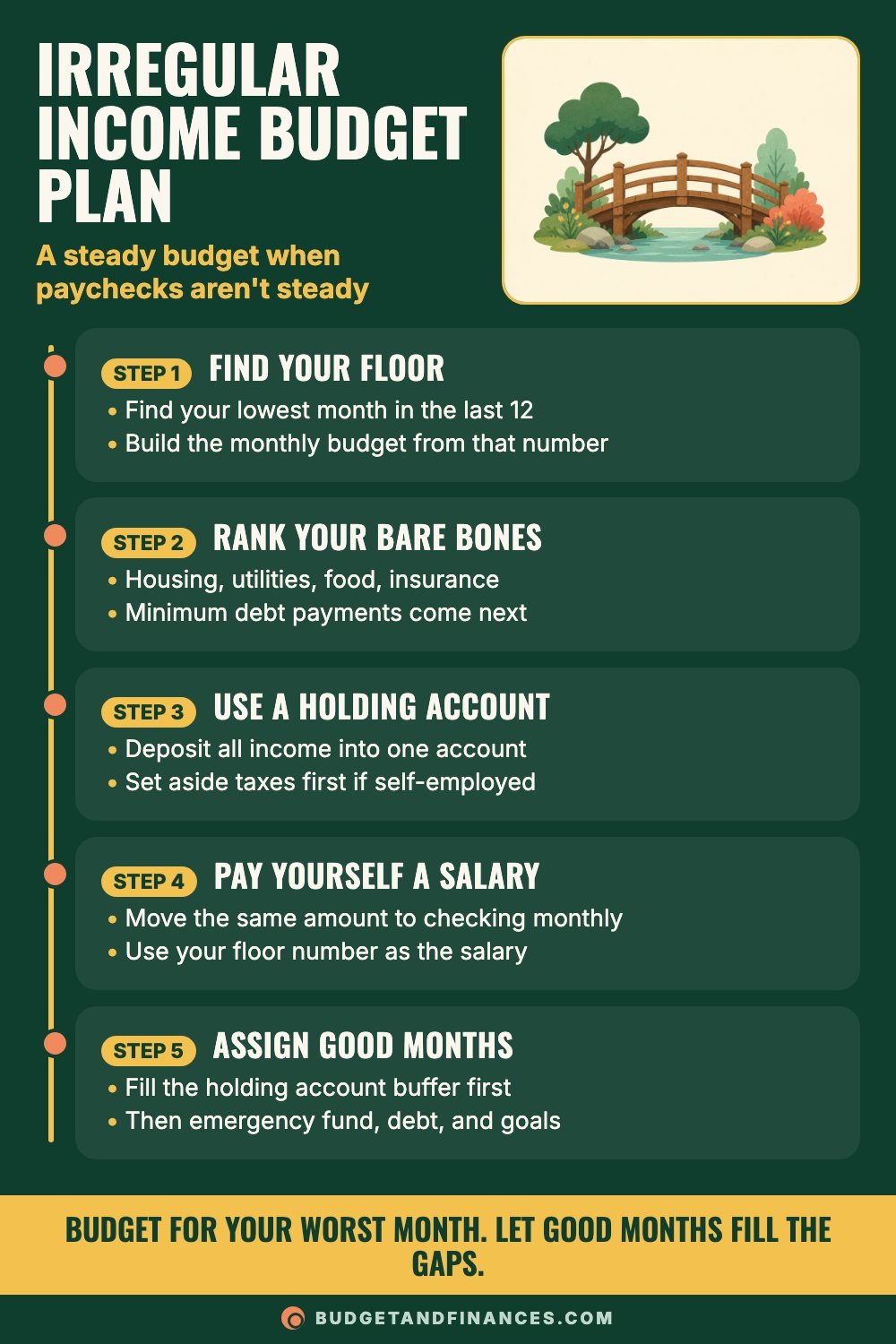
The fix is to stop budgeting on what you hope to earn. Build the budget for your worst month, and let good months fill the gaps.
Who needs an irregular income budget
If your pay swings, this method is for you. That includes:
- Stylists and nail techs, whose tips and bookings swing week to week.
- Delivery drivers, with busy weeks and slow weeks.
- Real estate agents, whose pay arrives at closing.
- Freelancers, whose client work comes and goes.
- Servers, whose tips change every shift.
- Commission salespeople, with big months and quiet months.
- Seasonal workers, where busy season pays for the slow one.
- School-year workers, where summer can mean fewer paychecks.
- Small business owners, whose sales rise and fall with the seasons.
Step 1: Find your floor
Look at your income for the last 12 months and find the lowest month. That’s your floor. Build your monthly budget from that number.
If you don’t have a year of records, start tracking now and use your lowest month so far. Your floor will get more accurate as time goes on.
Step 2: Rank your bare bones
List your expenses in priority order. At the top are housing, utilities, food and insurance. Minimum debt payments come next.
Number every expense. That way, a slow month tells you exactly what to pause, with no scrambling or guessing.
Step 3: Use a holding account
Deposit all of your income into one separate account. Think of it as your personal payroll account. Money arrives unevenly, but it all lands in the same place.
If you’re self-employed, set aside money for taxes first, before anything else leaves this account. A tax professional can help you figure out the right amount to hold back for your situation.
Step 4: Pay yourself a salary
Once a month, move the same amount from the holding account to your checking account. Use your floor number as that salary.
Now your checking account behaves like a regular paycheck. You budget on the same number every month, even though your actual income changes.
Step 5: Assign the good months
When a month comes in above your floor, the extra stays in the holding account. Give it jobs in this order:
- Fill the holding account buffer first, so a slow month can still pay your full salary.
- Then build your emergency fund.
- Then extra debt payments and other goals.
A worked example: low, normal and high months
Getting to a fully steady salary takes time, because you need a buffer first. While you build it, it helps to plan ahead for what each kind of month pays for.
Here’s a sample plan with a low month of $2,500, a normal month of $4,000 and a high month of $5,000:
| Category | Low: $2,500 | Normal: $4,000 | High: $5,000 |
|---|---|---|---|
| Core bills | 70% ($1,750) | 45% ($1,800) | 36% ($1,800) |
| Groceries and gas | 16% ($400) | 12% ($480) | 10% ($500) |
| Holding account buffer | 6% ($150) | 15% ($600) | 18% ($900) |
| Emergency fund | 4% ($100) | 10% ($400) | 14% ($700) |
| Extra debt payoff | 0% ($0) | 8% ($320) | 10% ($500) |
| Fun and goals | 4% ($100) | 10% ($400) | 12% ($600) |
Notice what happens. Core bills stay about the same, between $1,750 and $1,800. Groceries and gas only move from $400 to $500. The real difference is where the extra goes: the buffer grows from $150 in a low month to $900 in a high month.
In this example, the floor is $2,500. Once the holding account has enough saved, you’d pay yourself $2,500 every month and stop worrying about which kind of month it is.
Budget tips for variable income
Live on last month’s income. Another approach is to spend this month only what came in last month. That way you always know the number before the month starts.
Rank every expense. Number bills by priority so a slow month tells you exactly what to pause.
Aim high on emergency savings. The usual guideline is 3-6 months of expenses. Lean toward the top of that range, since your pay isn’t guaranteed.
Plan for slow seasons. Look at past years. If January is always quiet, save for it in the fall.
Keep business money separate. A separate account for work income and expenses makes taxes and budgeting clearer.
Skip lifestyle upgrades. A big month isn’t a raise. Wait until good months become a steady pattern before you raise your spending.
Get the free variable income tracker
The tracker has space at the top for the year, your lowest month, and your monthly salary. Below are 12 rows, one per month, with columns for income, what you spent, and how much went to your buffer.
Fill in a row at the end of each month. After a year of real numbers, you’ll know your floor and can set a steady salary with confidence.
Common mistakes
Budgeting on your average month. An average includes your best months. Any month below average will leave you short. Use your floor.
Spending a big month right away. Good months have to cover the slow ones. Send the extra to the buffer first.
Mixing tax money with spending money. If you’re self-employed, taxes aren’t withheld for you. Set that money aside the day it arrives.
No priority list. Without one, a slow month turns into guessing about which bill to pay late.
Forgetting seasonal patterns. If you know certain months are slow every year, the budget should expect them.
FAQ
What if my lowest month doesn’t cover my bare-bones expenses?
Then the first goal is closing that gap. Look for the biggest costs you can lower, and look at ways to raise your floor, like steady part-time work or retainer clients. Meanwhile, the good months need to cover the shortfall in the slow ones.
How big should my holding account buffer be?
A good first target is one month of salary, so a single slow month can’t disrupt your paycheck. More than that gives you extra breathing room. Your emergency fund is separate and comes next.
How do I pick my salary if my lowest month was unusual?
If your lowest month was a one-time event, like a medical leave, you can use your second-lowest month instead. Be honest about it, though. If slow months like that happen every year or two, keep the true floor. A salary that’s a little low is much easier to live with than one that’s too high.
Does this work if my partner has a steady paycheck?
Yes, and it gets easier. Build the core budget around the steady income first, then treat the irregular income as the part that goes through the holding account. Good months fill the buffer and savings, and slow months don’t touch the bills.
How do I start if I have no buffer yet?
Use the low, normal and high month plan above. Pay core bills first each month, and send everything above that to the buffer until it can cover your salary.
This is general education, not personal financial advice.