You’ve probably seen a chart of budget percentages telling you exactly what percentage of your income should go to rent, food and savings. Then you look at your own rent and wonder if the chart was made for somewhere else.
Budget percentages are useful. They give you a starting line and a way to spot the category that’s furthest off. But the right split changes with your income, where you live and what stage of life you’re in.
Here are sample budget percentages at several income levels, how to compare them to your real numbers, and the rules of thumb worth knowing.
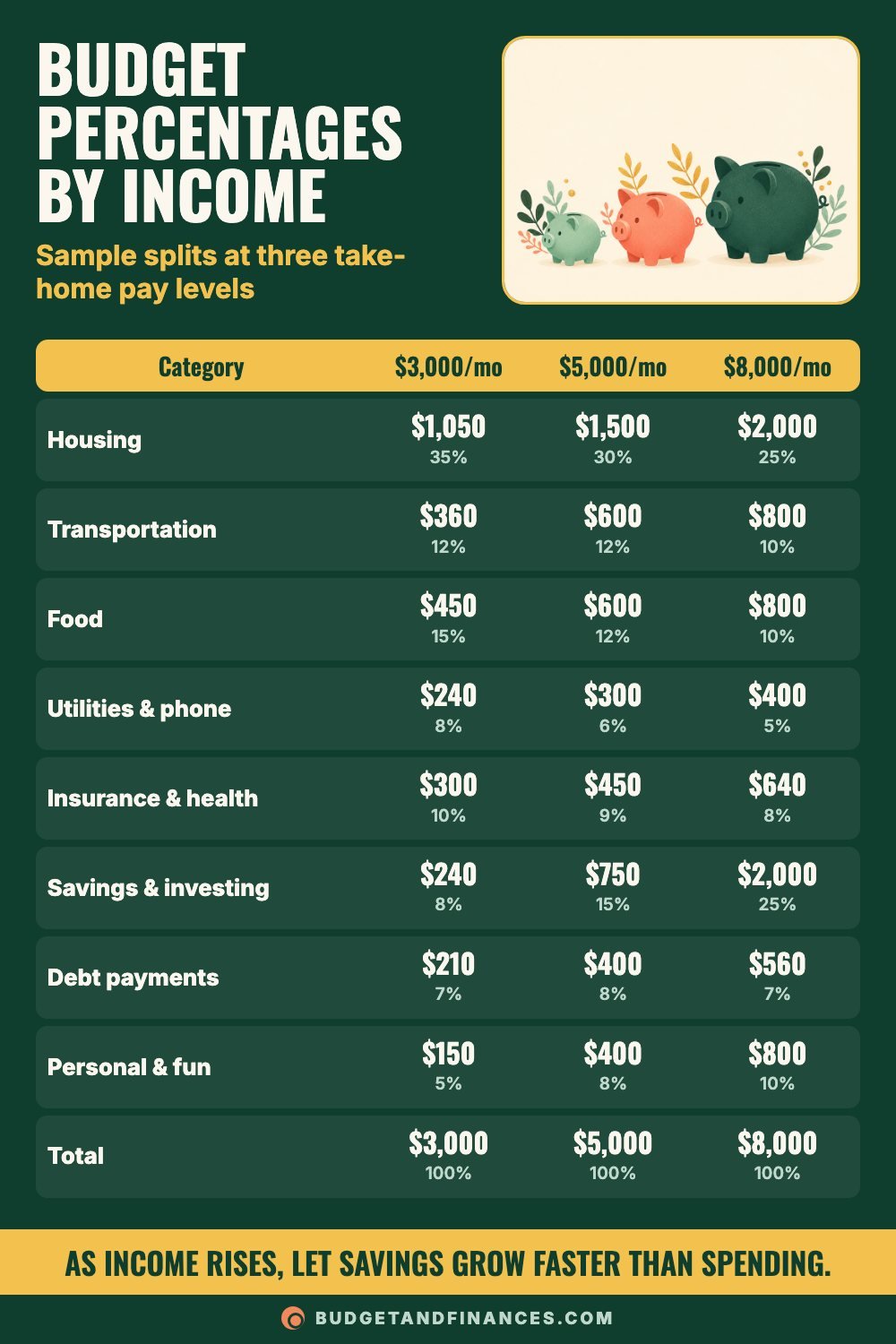
Sample budget percentages at three income levels
Here’s one way to split monthly take-home pay of $3,000, $5,000 and $8,000:
| Category | $3,000 | $5,000 | $8,000 |
|---|---|---|---|
| Housing | 35% ($1,050) | 30% ($1,500) | 25% ($2,000) |
| Transportation | 12% ($360) | 12% ($600) | 10% ($800) |
| Food | 15% ($450) | 12% ($600) | 10% ($800) |
| Utilities and phone | 8% ($240) | 6% ($300) | 5% ($400) |
| Insurance and health | 10% ($300) | 9% ($450) | 8% ($640) |
| Savings and investing | 8% ($240) | 15% ($750) | 25% ($2,000) |
| Debt payments | 7% ($210) | 8% ($400) | 7% ($560) |
| Personal and fun | 5% ($150) | 8% ($400) | 10% ($800) |
Each column adds up to 100%. Look at the pattern rather than any single number.
As income rises, housing, food and utilities take a smaller share, even though the dollar amounts go up. Savings grows the fastest, from 8% to 25%. As income rises, let savings grow faster than spending.
A budget on $2,500 a month
On a tighter income, the basics take a bigger share. Here’s one realistic way to split $2,500 in monthly take-home pay:
| Category | Share | Amount | What it covers |
|---|---|---|---|
| Housing | 38% | $950 | Rent, renters insurance |
| Utilities and phone | 8% | $200 | Electric, water, internet, a basic phone plan |
| Groceries | 14% | $350 | Meal-planned groceries and household basics |
| Transportation | 12% | $300 | Gas, car insurance, bus pass |
| Health insurance | 6% | $150 | Premiums and prescriptions |
| Debt minimums | 8% | $200 | Credit card and loan minimum payments |
| Savings | 6% | $150 | Starter emergency fund first |
| Personal and fun | 8% | $200 | Haircuts, clothes, a little guilt-free money |
| Total | 100% | $2,500 |
Savings is only 6% here, and that’s fine. A small budget still gets a savings line. At $150 a month, a $1,000 starter emergency fund takes seven months, since six months gets you to $900.
How to use budget percentages
Guidelines are a starting point, not a grade. Here’s how to put them to work.
Step 1: Use take-home pay
Unless a rule specifically says gross income, run percentages on what hits your bank account after taxes and deductions.
Step 2: Compare to your real numbers
Average your last three months of spending in each category. Then divide each average by your monthly take-home pay to get your own percentages, and see how far off each one is from the sample.
Step 3: Expect housing to bend
In high-rent areas, housing often runs over the guideline. That doesn’t mean your budget is broken. Balance it with smaller lines elsewhere.
Step 4: Keep debt as its own line
List minimum payments on their own, so they don’t get lost inside other categories.
Step 5: Change one category at a time
Pick the line furthest from the guideline and work on that one first. Trying to fix everything in one month rarely sticks.
Step 6: Grow savings with income
When your pay goes up, raise the savings share before lifestyle catches up.
A worked example
Say your take-home pay is $5,000 a month and your three-month average for food is $750. Divide $750 by $5,000 and you get 15%.
The sample budget at $5,000 shows food at 12%, or $600. You’re 3 percentage points, or $150 a month, above it.
Maybe that’s fine, because you have a big family. Or maybe it’s the category to work on this month. Either way, you now know where you stand instead of guessing.
Tight income vs higher income
Priorities shift as pay grows.
On a tight income, cover the basics first. Housing and food take a bigger share. Even a small savings amount counts. Cut costs on the biggest bills first, and build a $1,000 starter fund. Extra income moves the needle most.
On a higher income, watch lifestyle creep. Needs take a smaller share of pay, so push savings toward 20% or more. Watch the wants that grow with every raise, build 3-6 months of expenses, and automate retirement contributions.
Percentages shift with income. Saving first works at every level. More income only helps if more of it stays with you.
Money rules of thumb to know
These quick guidelines come up again and again. They’re rules of thumb, not laws, so adjust them to your life.
- 50/30/20 rule. Take-home pay split into 50% needs, 30% wants, and 20% savings and debt.
- 30% rent rule. Keep rent at or under 30% of your gross pay.
- 28/36 rule. A guideline lenders use: housing costs at or under 28% of gross monthly income, and total debt payments at or under 36%.
- Starter emergency fund. Save $1,000 as a first cushion.
- Full emergency fund. Save 3-6 months of expenses.
- Pay yourself first. Move money to savings on payday, before spending.
- 80/20 budget. Save 20% and spend the other 80% freely.
- Rule of 72. Divide 72 by an annual rate of return to estimate how many years it takes money to double. At 6%, that’s about 12 years. At 8%, about 9 years. It’s an estimate, and returns are never guaranteed.
- Fidelity’s retirement guideline. Fidelity suggests aiming for 1x your salary saved by 30, 3x by 40, 6x by 50, 8x by 60 and 10x by 67.
Guidelines give you a starting line, not a finish line.
Common mistakes
Treating percentages as pass or fail. A sample budget is one example. Your real bills are the reality.
Mixing gross and take-home pay. The 30% rent rule and the 28/36 rule use gross income. Most budget splits use take-home pay. Mixing them up makes your numbers look better or worse than they are.
Copying someone else’s split. A family of five and a single renter shouldn’t have the same food percentage.
Letting spending rise with every raise. If your percentages stay the same while income grows, you’re spending most of your raises.
Ignoring small categories. A few points over in three small lines can add up to as much as one big line.
FAQ
What percentage of income should go to housing?
It depends on your income and area. The 30% rent rule uses gross pay. The sample budgets here range from 25% to 38% of take-home pay. If yours is higher, look for room in other categories.
What percentage should I save?
The 50/30/20 rule suggests 20% for savings and debt payments beyond the minimums. On a tight income, start with whatever you can, even a few percent, and raise it as your income grows.
Are budget percentages based on gross or net income?
Most budget splits, including the ones in this guide, use take-home pay. Some rules, like the 30% rent rule and the 28/36 rule, use gross income. Check which one a rule means before comparing.
What if my percentages don’t match any sample?
That’s normal. Use the samples to find the one or two categories furthest off, and decide whether they’re a choice you’re comfortable with or something to work on.
This is general education, not personal financial advice.