

You want savings, but a big number like “save $1,000” feels too far away to start. And every time you try to save “whatever’s left,” there’s nothing left.
The 52-week money challenge fixes both problems. You start with $1 in week one, add $1 each week, and put $52 away in week 52. Color in a box each time. When the chart is full, you have $1,378.
It works because the first few months are almost painless. By the time the deposits get bigger, saving is already a habit. The catch is those bigger weeks at the end, so this guide shows you exactly what’s coming and how to plan for it.
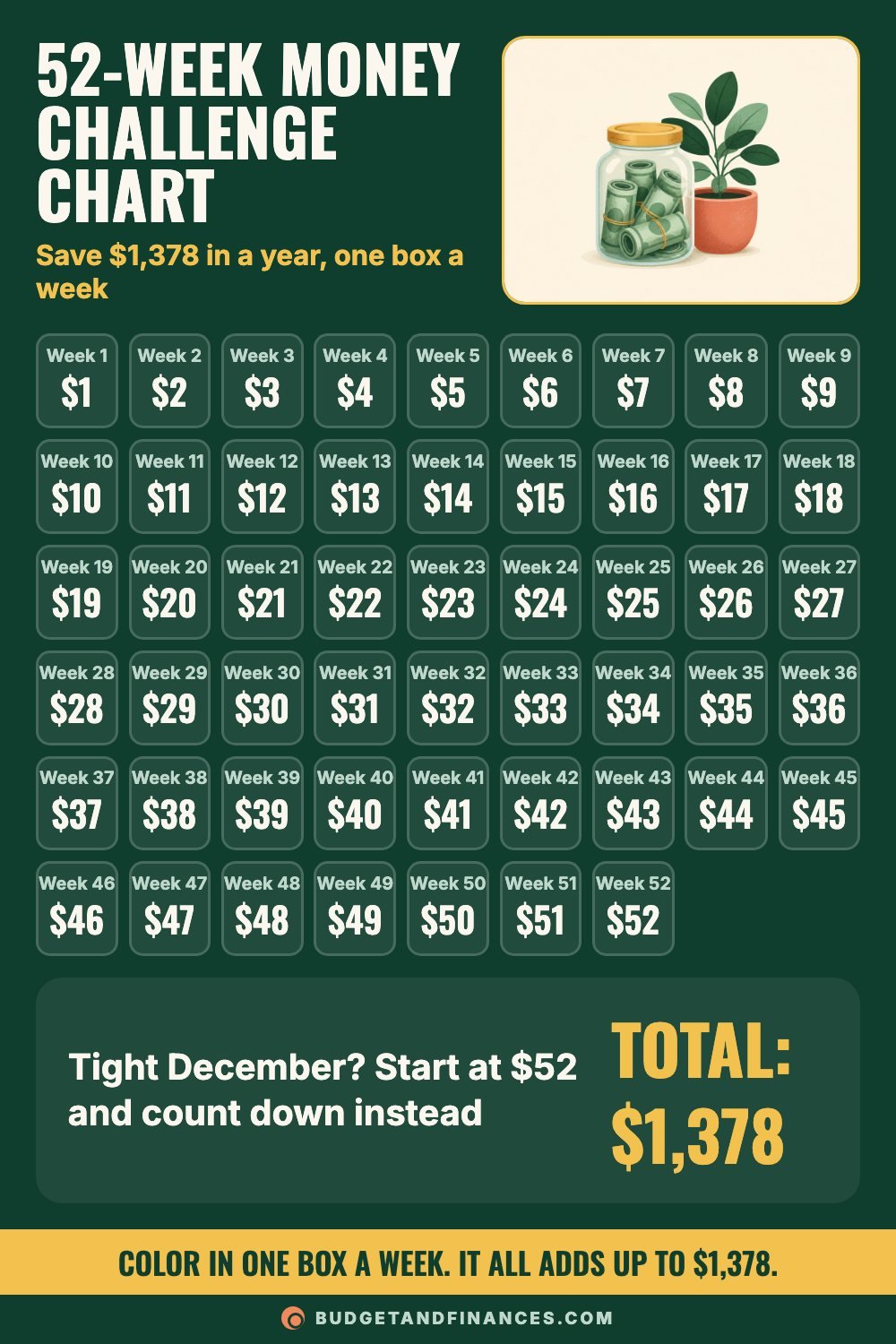
How the 52-week money challenge works
The rule is simple. The week number is the dollar amount.
- Week 1: save $1
- Week 2: save $2
- Week 10: save $10
- Week 52: save $52
Add up 1 + 2 + 3 all the way to 52 and you get $1,378. You don’t need to do that math yourself. The chart does it for you, one box at a time.
Your average deposit works out to $26.50 a week, because $1,378 divided by 52 is $26.50. That number is useful later if you want a flat version.
Step 1: Pick your version
The classic climb from $1 to $52 is only one way to do it. Here are six versions that fit different budgets and personalities.
Classic
$1 in week one, up to $52 in week 52. Total: $1,378. Easy start, harder finish.
Reverse
Start at $52 and count down to $1. Total: $1,378. The big deposits happen while your motivation is fresh, and the last weeks cost almost nothing. If your year ends in December, this also means the $1 and $2 weeks land right around the holidays.
Pick any box
Each week, choose any box you haven’t colored in yet and save that amount. Total: $1,378. Tight week? Pick $4. Got a refund? Knock out $51. Just make sure you finish all 52 boxes.
Flat weekly
Save $26.50 every week. Total: $1,378. Same money, no surprises. This one is the easiest to automate.
Payday pairs
If you’re paid every two weeks, color in two boxes each payday and save both amounts together. You still finish all 52 boxes and $1,378. It lines the challenge up with when money actually lands.
Double it
Save $2 in week one, $4 in week two, up to $104 in week 52. Total: $2,756. Only choose this one if the classic version would be too easy for your budget.
Step 2: Set it up in ten minutes
A little setup before week one keeps the whole year from depending on willpower.
Set up the money. Open a separate savings account so the money isn’t sitting next to your spending. Schedule a weekly transfer on payday. If you prefer cash, pick a jar or envelope and deposit it regularly so you’re not keeping a pile of cash at home.
Make it visible. Print the chart. Stick it on the fridge or inside a cabinet door. Set a weekly phone reminder for the day you’ll color in your box.
Pick your dates. Decide your start date and write your finish date on the chart. You don’t have to start in January. Any week works.
Plan for hard weeks. Circle the weeks that fall near birthdays and holidays. Decide your catch-up rule now, before you need it. And write what the money is for at the top of the chart. A goal is harder to skip than a number.
Step 3: Know what each quarter costs
Most people quit the 52-week challenge in the back half, when deposits jump into the $40s and $50s. Seeing the numbers ahead of time helps you plan for them.
Here’s the classic version split into four 13-week quarters:
| Weeks | Deposits | Saved this quarter | Running total |
|---|---|---|---|
| 1-13 | $1 to $13 | $91 | $91 |
| 14-26 | $14 to $26 | $260 | $351 |
| 27-39 | $27 to $39 | $429 | $780 |
| 40-52 | $40 to $52 | $598 | $1,378 |
Look at that last row. $598 of the $1,378 comes in the final 13 weeks. That’s over 40% of the total in the last quarter of the year.
At the halfway point, week 26, you’ve saved $351. That’s only about a quarter of your goal, even though you’re half done with the weeks. This is normal. It’s just how a climbing challenge works, and it’s why the next section matters.
Worked example: planning the classic challenge
Say you start the classic version the first week of the year and you’re paid every Friday.
Weeks 1-13 ($91 total). Your deposits are $1 to $13. This is the easy stretch, so use it to set up the automatic transfer and get used to coloring in the box.
Weeks 14-26 ($260 total). Deposits climb from $14 to $26. At week 26, check that your chart is up to date and your running total is $351.
Weeks 27-39 ($429 total). Deposits pass $30. This is where it starts to feel real. Look for one small expense to trim, like one takeout meal a week, so the deposit has somewhere to come from.
Weeks 40-52 ($598 total). If you started in January, these weeks run from early October to late December. That’s right on top of holiday spending. Decide in September how you’ll cover it. Two options: switch to the reverse version for next year, or set aside a little extra in the lighter weeks now.
If that December squeeze worries you, reverse is the fix. The $598 stretch moves to the first 13 weeks of the year and your holiday weeks cost between $1 and $13.
Tips to actually finish
Front-load the big weeks. Do it in reverse so the $50 weeks come early, before holiday spending starts.
Automate the transfer. Set a weekly transfer to savings on the day your pay arrives. For the classic version, you’ll need to update the amount each week, or use the flat $26.50 version and set it once.
Keep it out of sight. Use a separate savings account so you don’t see the money every time you check your balance.
Name the goal. “$1,378” is easy to skip. “Car repair fund” or “Christmas without a credit card” is harder.
Catch up in small bites. Missed a week? Add a few dollars to the next few deposits instead of trying to double up all at once.
Mark every box. Coloring in the chart takes 10 seconds and shows you how far you’ve come on the weeks you feel like stopping.
Get the free printable chart
The chart has all 52 weeks numbered with the dollar amount in each box, so you just color in as you go. It works for the classic, reverse and pick-any-box versions.
Common mistakes
Starting without a place for the money. If the $1, $2 and $3 deposits sit in your checking account, they get spent. Move them somewhere separate from day one.
Ignoring the back half. The last 13 weeks hold $598, which is more than the first 26 weeks combined ($351). Plan for them in advance instead of being surprised in November.
Treating one missed week as failure. A missed week is fine. Quitting the chart is the only real miss.
Picking a version that’s too big. Doubling it sounds great in January. $104 in a single week is a lot. Start with the classic and go bigger next year if it felt easy.
Keeping cash at home. A jar is fun, but by the end it could hold over a thousand dollars. Deposit it regularly.
FAQ
How much do you save with the 52-week money challenge?
The classic version saves $1,378. That’s 1 + 2 + 3 and so on up to 52. The doubled version, $2 to $104, saves $2,756.
Can I start the 52-week challenge in the middle of the year?
Yes. Start whenever you’re ready and write your finish date on the chart. If your 52 weeks end near the holidays, consider the reverse version so the smallest deposits land then.
What if I can’t afford the big weeks at the end?
Switch to the reverse or pick-any-box version, or save a flat $26.50 each week. All three still reach $1,378. You can also use the easy early weeks to save a little extra as a cushion.
Is it better to do the 52-week challenge with cash or a bank account?
A separate savings account is easier to automate and keeps the money safe. Cash in a jar is more visible and can feel more satisfying. If you use cash, deposit it regularly instead of letting it build up at home.
What should I do if I miss a week?
Don’t restart. Spread the missed amount over the next few weeks, a few dollars at a time, and keep coloring in boxes.