

If you’ve never had a budget, the hardest part is knowing where to begin. Every guide seems to assume you already know your numbers, and you don’t.
That’s fine. Nobody starts with a perfect budget. Your first one just has to exist, and it’s allowed to be messy.
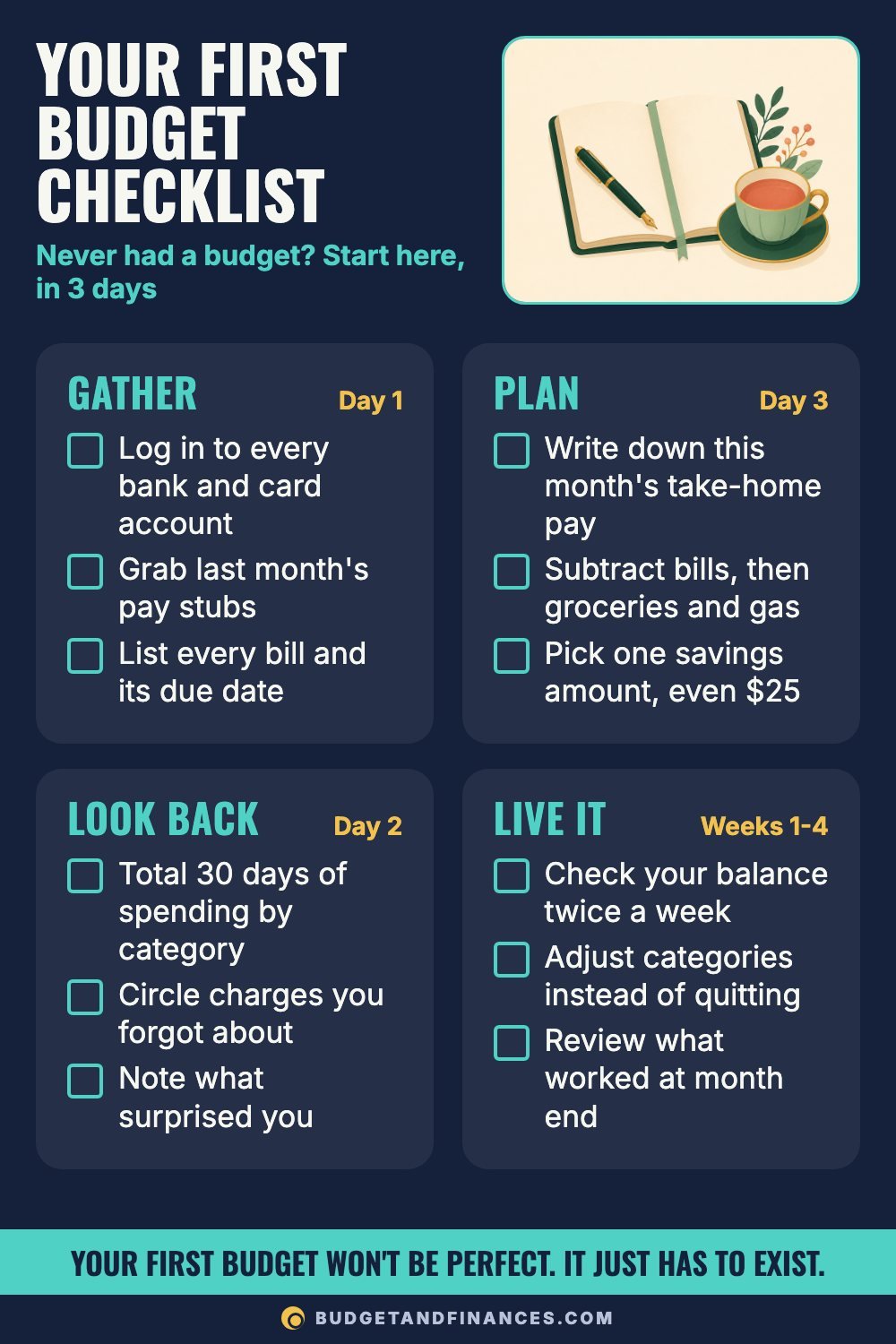
This guide breaks it into three short days of setup, then one month of living with it. After that, there’s a simple roadmap for what to focus on next.
Before you start: track your spending for 30 days
The easiest first step is to write down what you spend. Every purchase, for 30 days: the date, what you bought, the amount, and whether it was a need or a want.
You don’t have to change anything yet. Just watch. By the end of the month, you’ll know where your money actually goes, and the budget almost writes itself.
If you’d rather not wait a month, you can start with the three-day checklist below and look back at last month’s statements instead. Keep tracking going forward either way.
Day 1: Gather everything
Set aside an hour and collect:
- Every account. Log in to every bank account and every credit card.
- Your pay stubs. Grab last month’s, so you know your real take-home pay.
- Your bills. List every bill and its due date, including the ones on autopay.
That’s all for Day 1. You’re just getting everything in one place.
Day 2: Look back at last month
Go through the last 30 days of spending and total it up by category: groceries, gas, eating out, shopping, subscriptions, and so on.
As you go:
- Circle the charges you forgot about.
- Note what surprised you.
Most people find at least one subscription they stopped using, or a category that ran higher than they thought. Don’t judge it. You’re collecting information.
Day 3: Make your first plan
Now build the budget with this simple order:
- Write down this month’s take-home pay.
- Subtract your bills.
- Then subtract groceries and gas.
- Pick one savings amount, even $25.
Whatever is left covers everything else, including a little fun money. If the numbers come out negative, look at your Day 2 notes for the easiest places to trim.
Weeks 1-4: Live with it
A budget on paper does nothing until you use it. For the first month:
- Check your balance twice a week.
- When a category runs over, adjust the categories instead of quitting.
- At the end of the month, review what worked and what didn’t.
A worked example
Here’s how Day 3 might look. Say your take-home pay this month is $3,200.
| Step | Amount | Left over |
|---|---|---|
| Take-home pay | $3,200 | $3,200 |
| Bills (rent, utilities, phone, insurance, minimum payments) | $2,050 | $1,150 |
| Groceries | $450 | $700 |
| Gas | $180 | $520 |
| Savings | $25 | $495 |
That leaves $495 for everything else: household items, personal care, a haircut, and some fun money.
If your Day 2 look-back showed you spent $600 on everything else last month, you know you’re about $105 over. You could trim a forgotten subscription and eat out one less time, then check again in two weeks.
Your numbers will be different. The order is what matters: bills first, then food and gas, then savings, then the rest.
Budget categories beginners forget
A lot of first budgets fall apart because of costs that don’t show up every month. Irregular doesn’t mean unexpected. Check whether any of these are missing from yours:
- Car maintenance: oil changes, tires, registration.
- Gifts: birthdays, holidays, showers.
- Medical costs: copays, prescriptions, the dentist.
- Pets: food, vet visits, grooming.
- Annual renewals: memberships billed once a year.
- Personal care: haircuts, toiletries, makeup.
- School costs: supplies, field trips, fees.
- Home repairs: the leaky faucet and the broken appliance.
- Clothing: kids outgrow shoes fast.
For each one that applies, add a small monthly amount as a sinking fund. That’s money you set aside each month so the cost is already covered when it arrives.
Tips for your first budget
Start with real numbers. Base your budget on last month’s actual spending, not what you wish you spent.
Budget bills first. Rent, utilities and minimum payments go in before groceries, gas or anything fun.
Keep some fun money. A small amount you can spend freely keeps you from blowing up the whole plan.
Expect a messy first month. Your categories will be off. Treat that as useful information, fix the numbers, and keep going.
Pick one tool. Paper, a spreadsheet or a budgeting app all work. The best one is the one you’ll open every week.
Set a weekly money date. Fifteen minutes a week to check balances and upcoming bills keeps surprises small.
Change one habit at a time. Cutting everything at once feels awful. Pick one category to work on this month.
What to focus on after your first budget
Once you have a budget that works, here’s a simple order for what comes next. Finish one level before you worry about the next.
Level 1: Know your numbers
Track every dollar for one month. List your income, bills and debts.
Level 2: Make a simple budget
Bills first, then food and gas. Give yourself a little fun money.
Level 3: Save $1,000
This is a starter emergency fund. Keep it in a separate savings account so it isn’t mixed in with spending money.
Level 4: Pay off debt
Pick a method. The debt snowball pays the smallest balance first. The debt avalanche pays the highest interest rate first. While you work on debt, keep getting any employer retirement match if your job offers one.
Level 5: Build the full safety net
Save 3-6 months of expenses. Then turn your attention to retirement and other goals.
Get the free spending tracker
The 30-day spending tracker has space for the month, your starting balance, and 16 rows per page for the date, what you bought, the amount, and whether it was a need or a want. Print a few pages and keep them where you’ll see them.
Common mistakes
Building the budget on wishes. If you spent $500 on groceries last month, a $250 grocery line won’t hold. Start from reality and trim gradually.
Leaving out irregular costs. Car repairs and birthdays will happen. Put them in the plan as small monthly amounts.
Quitting after one bad week. Going over in a category is normal early on. Move money from another line and keep going.
Cutting all fun money. A budget that feels like punishment rarely lasts. Keep a small amount for yourself.
Never checking in. A budget you set up once and never look at again won’t help. Fifteen minutes a week is enough.
FAQ
How long does it take to get good at budgeting?
Give it a few months. The first month shows you where your guesses were off, and each month after that gets closer.
Do I need an app?
No. Paper and a spreadsheet work just as well. Pick whatever you’ll actually use every week.
What if my income is less than my bills?
Start with the look-back from Day 2 and find the biggest costs you can lower, like housing, transportation or subscriptions. Adding income, even temporarily, can help too. Cover essentials like housing, utilities and food first.
Should I save or pay off debt first?
A common order is a $1,000 starter emergency fund first, then debt. The starter fund keeps a small surprise from going back on a credit card while you pay debt down.