Most budgets fall apart for one of two reasons. Something got left off the list, or the plan was never checked against what actually happened.
A good monthly budget template fixes both. You plan every category before the month starts, then write in what you really spent and see the difference in plain numbers.
This guide shows you how to fill in the free printable template line by line, how to use the paycheck-by-paycheck sheet if money arrives every two weeks, and what a finished budget looks like on $3,800 a month.
What’s on the monthly budget template
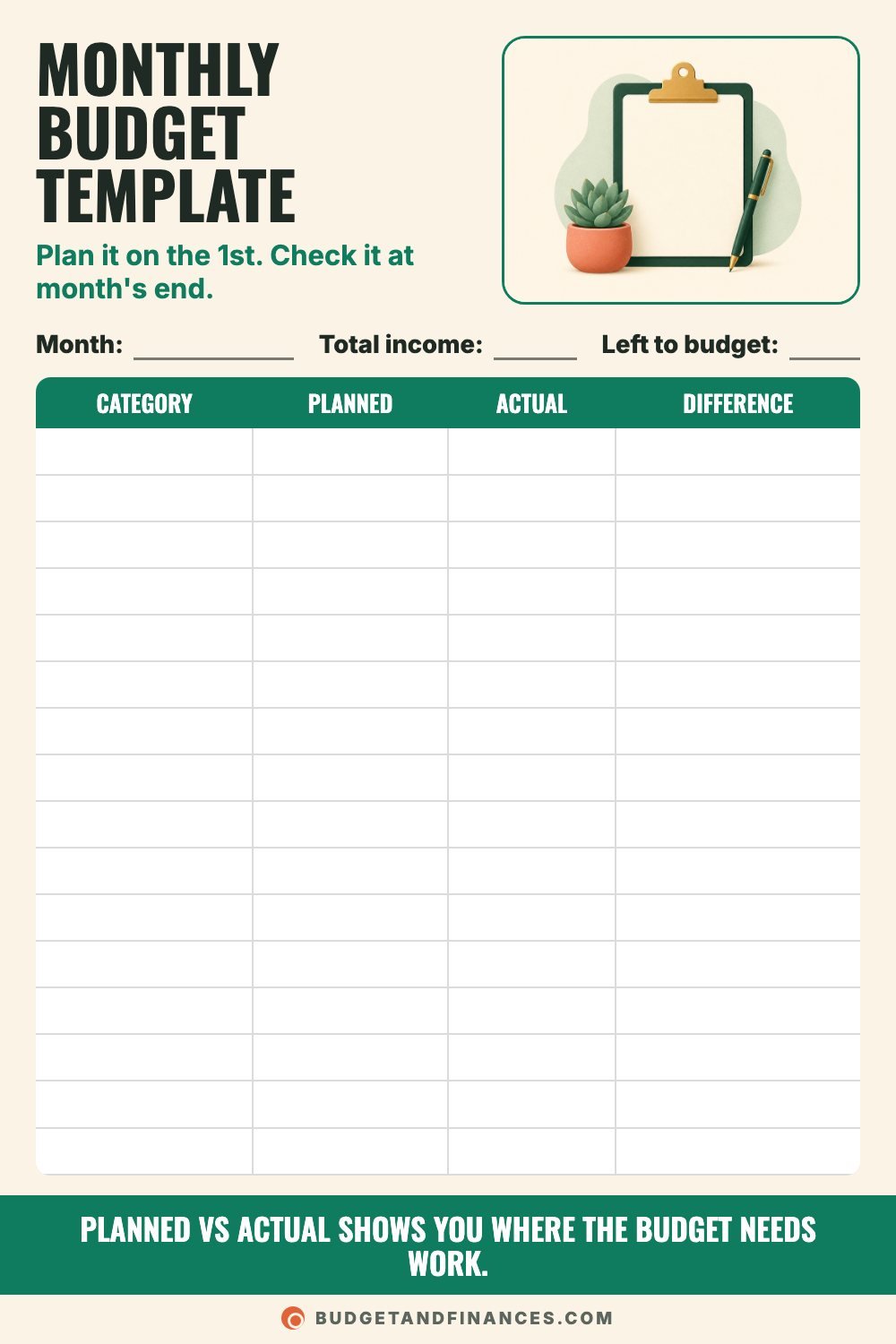
The main sheet has three fields at the top and four columns below.
Top fields
– Month: the month you’re planning.
– Total income: your take-home pay for the month.
– Left to budget: total income minus everything you plan in the table. Your goal is to get this to $0.
Columns (16 rows)
– Category: rent, groceries, gas, savings and so on.
– Planned: what you plan to spend or save, written before the month starts.
– Actual: what really went out, filled in as the month goes.
– Difference: Planned minus Actual.
Plan it on the 1st. Check it at month’s end. Planned vs actual shows you where the budget needs work.
How to fill out a monthly budget in 5 steps
Do steps 1 to 4 before the month starts. Step 5 happens during the month.
Step 1: Write down your income
Use take-home pay, the amount that lands in your account after taxes and deductions. Don’t use your salary before taxes, or every number below it will be too high.
If your pay changes month to month, use your lowest recent month. If more comes in, you’ll get to decide where the extra goes.
Step 2: List fixed bills
These are the bills that cost about the same every month: rent, insurance, phone, car payment. Copy the amounts and due dates from your last statements so they’re exact.
Step 3: Add savings and debt
Pay yourself first with a set savings amount, even a small one. Then add debt: every minimum payment, plus any extra you plan to put toward a balance.
Putting savings here, before flexible spending, keeps it from being whatever happens to be left over.
Step 4: Plan flexible spending
Groceries, gas, eating out, personal spending. These change every month, so don’t guess. Check last month’s bank statement for real numbers and start from those.
Now subtract every planned amount from your total income and write the result in Left to budget. If it’s above $0, give those dollars a job, like extra savings or debt. If it’s below $0, trim flexible categories until it reaches $0.
When left to budget reads $0, every dollar has a job.
Step 5: Track and adjust
Fill in actual amounts every week. A quick Sunday check with your bank app is enough.
If one category runs over, move money from another category that’s under. The budget is a plan you can change, as long as the total still matches your income.
What to include in a monthly budget
Here are the categories people forget until the bill shows up. Use this list to fill the Category column.
Home
– Rent or mortgage
– Renters or homeowners insurance
– Electric, gas, water and trash
– Internet and phone
Getting around
– Car payment and insurance
– Gas or transit passes
– Oil changes and repairs
– Registration and parking
Food
– Groceries
– Eating out and coffee
– School or work lunches
Family & personal
– Childcare and kids’ activities
– Clothes and haircuts
– Medical copays and prescriptions
– Pet food and vet visits
Money goals
– Emergency fund
– Debt payments
– Retirement savings
– Sinking funds for gifts and trips
Just for you
– Subscriptions
– Hobbies and fun money
– Giving
That’s more than 16 lines, so combine a few. “Utilities” can hold electric, gas, water and trash. If you spend money on it, it belongs somewhere on the list.
Sample monthly budget on $3,800
Here’s a filled-in example on $3,800 of take-home pay. Your numbers will differ. The point is every dollar has a spot.
| Category | Share | Planned | Examples |
|---|---|---|---|
| Housing | 30% | $1,140 | Rent or mortgage and renters insurance |
| Groceries & household | 12% | $456 | Food, cleaning supplies, toiletries |
| Transportation | 10% | $380 | Car payment, gas, insurance, upkeep |
| Utilities & phone | 8% | $304 | Electric, water, internet, cell phone |
| Health | 7% | $266 | Insurance premiums, copays, prescriptions |
| Debt payments | 10% | $380 | Credit card and student loan payments |
| Savings | 10% | $380 | Emergency fund and sinking funds |
| Personal & fun | 13% | $494 | Eating out, clothes, hobbies, gifts, subscriptions |
| Total | 100% | $3,800 |
Left to budget: $3,800 minus $3,800 is $0.
Worked example: planned vs actual at month’s end
Say you get to the end of the month and fill in the Actual column. Most lines land close, but three stand out:
| Category | Planned | Actual | Difference |
|---|---|---|---|
| Groceries & household | $456 | $510 | -$54 |
| Utilities & phone | $304 | $281 | $23 |
| Personal & fun | $494 | $440 | $54 |
A negative difference means you went over. A positive one means you spent less than planned.
Groceries ran $54 over, and personal and fun came in $54 under, so the two cancel out. That’s the move from Step 5: shift money between categories so the total still works.
The bigger lesson is for next month. If groceries run over two months in a row, the plan is too low. Raise it to something closer to $510 and take that money from a category that keeps coming in under.
The paycheck-by-paycheck budget sheet
If you’re paid every two weeks or twice a month, one monthly total can hide a problem: most of your bills might land on the same paycheck. This sheet lets you match each bill to the paycheck that pays it.
Top fields: Month, Paycheck 1 and Paycheck 2 (the amount of each).
Columns (14 rows)
– Bill: the name of the bill.
– Due: the due date.
– Amount: what’s owed.
– Paycheck: write 1 or 2, the paycheck that covers it. A good rule is the most recent paycheck that arrives before the due date.
– Paid: check it off when it’s paid.
Worked example: splitting bills across two paychecks
Say the $3,800 comes in as two paychecks of $1,900, on the 1st and the 15th.
Paycheck 1 covers: rent $1,140 (due the 1st), internet $70 (due the 8th) and electric $120 (due the 12th). That’s $1,330, leaving $570 for groceries, gas and savings until the next check.
Paycheck 2 covers: student loan $180 (due the 15th), car payment $220 (due the 20th), car insurance $110 (due the 22nd), phone $65 (due the 25th) and credit card $200 (due the 28th). That’s $775, leaving $1,125.
Paycheck 1 is tight because rent lands on it. Seeing this on paper tells you to keep groceries lean in the first half of the month, or to ask a lender if you can move a due date into the second half.
If you’re paid every two weeks, most years have two months with a third paycheck. Decide ahead of time where that extra check goes.
Split bills by paycheck and the end of the month gets calmer.
Common mistakes
Budgeting with gross pay. Use take-home pay. Taxes and deductions never reach your account.
Guessing flexible categories. Pull last month’s statement. Guesses are almost always low.
Forgetting non-monthly costs. Car registration, gifts and yearly renewals still happen. Save a little each month as a sinking fund.
Never filling in the Actual column. Without it, the template is a wish list. Fifteen minutes a week keeps it real.
Quitting after one rough month. The first budget is rarely right. Adjust the planned numbers and try again.
FAQ
When should I fill out my monthly budget?
Before the month starts, ideally a few days before the 1st. That way your first paycheck already has a plan.
What if my income is irregular?
Budget using your lowest recent month. When a bigger month comes in, send the extra to savings or to a buffer that covers slow months.
How many categories should my budget have?
Enough to cover everything, few enough that you’ll track them. The template has 16 rows, and combining related costs like utilities keeps it inside that.
What does “left to budget” mean?
It’s your income minus everything you’ve planned. When it reads $0, every dollar has a job. It doesn’t mean you spend it all, since savings and debt payments are jobs too.
Should savings really come before fun money?
That’s the idea behind paying yourself first. When savings gets planned early, it happens. When it’s planned last, there’s often nothing left.