

Most money trouble starts small, the kind a monthly money routine is built to catch early. A bill that slipped by. A subscription that renewed quietly. A grocery category that ran a little hot three months in a row.
None of that is a disaster on its own. The problem is when nobody looks for a while, and small things stack up into a stressful month.
A monthly money routine fixes that. About an hour a month, spread across a few check-ins, is enough to catch problems while they’re still easy to fix. Here’s the whole routine.
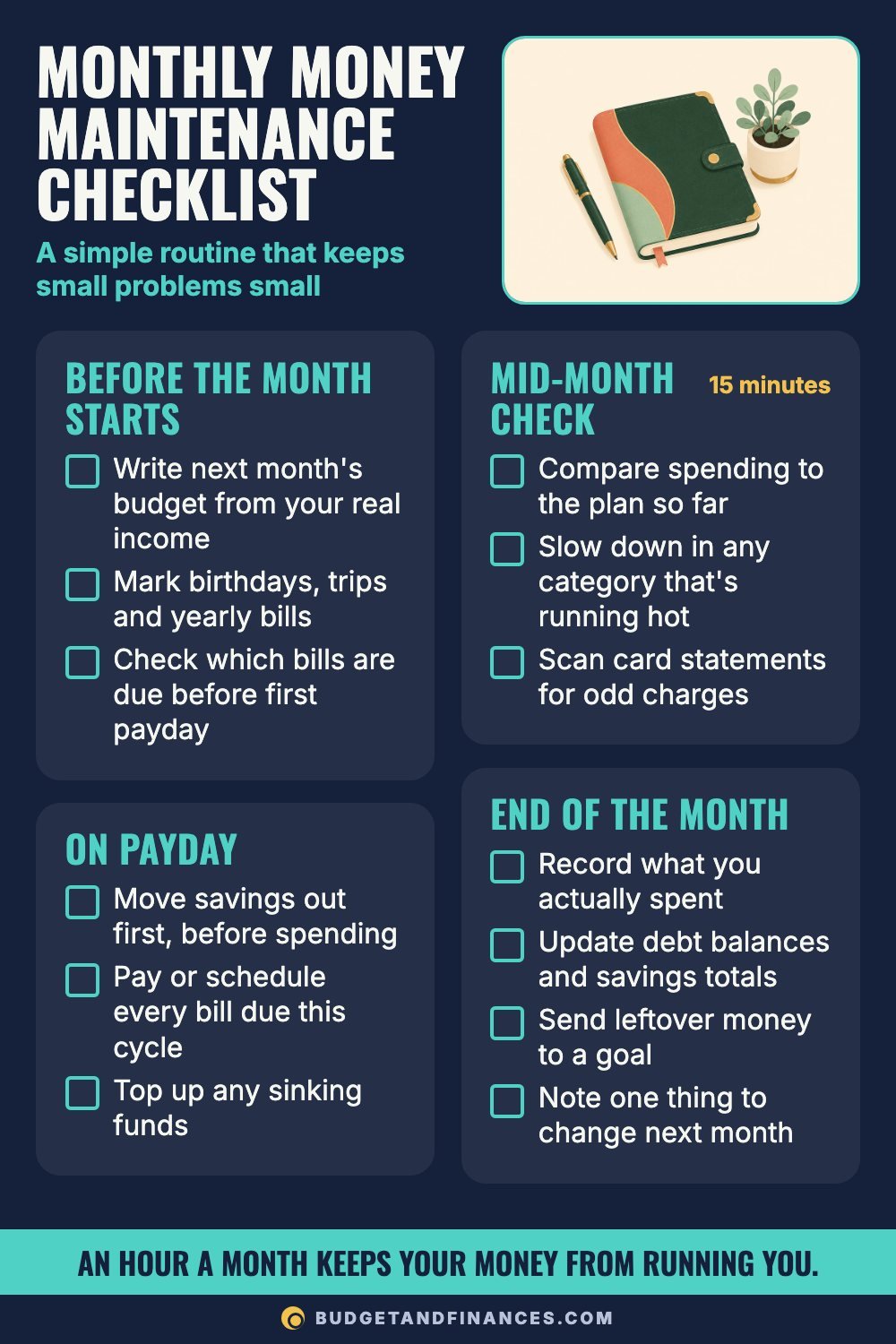
The monthly money maintenance checklist
Think of the month in four moments: before it starts, payday, the middle, and the end.
Before the month starts
- Write next month’s budget from your real income.
- Mark birthdays, trips and yearly bills.
- Check which bills are due before first payday.
“Real income” means your take-home pay, the amount that actually lands in your account. If your hours or commissions vary, plan from a lower, typical month and treat anything extra as a bonus.
The bills due before your first payday matter most. If rent is due on the 1st and you get paid on the 5th, the money for rent has to come from last month’s paycheck.
On payday
- Move savings out first, before spending.
- Pay or schedule every bill due this cycle.
- Top up any sinking funds.
This is pay yourself first in action. Savings leaves the account before spending starts, so it doesn’t depend on what’s left at the end.
A sinking fund is money you set aside each month for a cost you know is coming, like car repairs, gifts or an annual fee.
Mid-month check (15 minutes)
- Compare spending to the plan so far.
- Slow down in any category that’s running hot.
- Scan card statements for odd charges.
Halfway through the month is when you can still do something. If groceries are at 70% of the plan on the 15th, you have two weeks to adjust.
End of the month
- Record what you actually spent.
- Update debt balances and savings totals.
- Send leftover money to a goal.
- Note one thing to change next month.
Leftover money sitting in checking tends to disappear. Give it a destination on the last day: savings, a sinking fund, or an extra debt payment.
9 things to check every month
When you sit down for your end-of-month review, run down this list. It takes about 30 minutes.
- Card statements. Scan every line for errors.
- Checking balance. Is there enough for bills until next payday?
- Savings progress. Did the automatic transfers go through?
- Subscriptions. Are you still using everything you pay for?
- Debt balances. Write them down and watch them drop.
- Next month’s events. Birthdays, trips, school costs.
- Yearly bills coming. Renewals and annual fees ahead.
- Goal amounts. How close are you to each one?
- Top spending category. Where did most of the money go?
Nine quick checks. About 30 minutes. Fewer surprises.
How to run a monthly money date
A “money date” is just a name for the end-of-month review, set up so you actually want to show up. Here’s how to make it work.
Pick a regular day. The first Sunday of the month works for a lot of people. Same day each month, on the calendar.
Make it pleasant. Good coffee, a snack, your favorite playlist. It’s easier to show up for something nice.
Start with a win. Name one thing that went right last month before you look at anything that didn’t.
Look at the real numbers. Open your accounts. Compare what you planned to spend with what you actually spent.
Plan the month ahead. Check the calendar for birthdays, trips and yearly bills, then set next month’s amounts.
Pick one change. One small adjustment per month is plenty. Write it down so you remember it next time.
Stop on time. Set a timer for 30 minutes. A short check-in you keep beats a long one you skip.
If you share finances with a partner, do it together. The same agenda works for two.
Weekly vs monthly check-ins
You might wonder whether weekly or monthly is better. They do different jobs.
| Weekly check-in | Monthly check-in | |
|---|---|---|
| Best for | Catching drift | The big picture |
| Time | About 10 minutes | About 30 to 60 minutes |
| What you do | Spot overspending while it’s small, log receipts and cash purchases, check bills due this week | Compare the full plan to real spending, update debt and savings balances, plan for yearly bills and events, set next month’s amounts |
| Good when | Money is tight | You want to see progress over time |
Doing both, short weekly and fuller monthly, covers the most ground. If that’s too much right now, start with the monthly one. The best routine is the one you keep doing.
A worked example: planning for yearly bills
Yearly bills are where monthly budgets tend to break, so here’s how the routine handles them. These are sample numbers.
Say your take-home pay is $3,800 a month, and on your “before the month starts” check you list these yearly costs:
- Car registration: $120 a year
- Holiday and birthday gifts: $600 a year
- An annual membership: $60 a year
Divide each by 12:
- $120 / 12 = $10 a month
- $600 / 12 = $50 a month
- $60 / 12 = $5 a month
That’s $65 a month total. On payday, $65 goes into a sinking fund along with your regular savings transfer. When the registration bill arrives, the $120 is already waiting, and your regular budget for that month doesn’t take the hit.
Then, at mid-month, you notice groceries are at $420 of a $500 plan on the 15th. You slow down, lean on what’s in the pantry, and finish the month at $510. That’s $10 over, which is fine. At the end-of-month review, you note it, and next month you either plan $510 or pick one thing to change.
Get the free printable
The printable includes the four-part monthly checklist and a blank bill due date tracker with columns for the bill, due date, amount, whether it’s on autopay, and a box to check when it’s paid.
Common mistakes
Budgeting from your gross pay. Taxes and deductions come out before you ever see the money. Plan from what actually lands in your account.
Only looking at the end of the month. By then, the money is spent. The mid-month check is what gives you time to adjust.
Forgetting yearly and seasonal costs. They aren’t surprises if they happen every year. Divide by 12 and save for them monthly.
Letting leftover money sit. Money with no job tends to get spent. Move it to a goal on the last day of the month.
Making the review too long. If your check-in takes two hours, you’ll start skipping it. Keep it to 30 minutes and stop on time.
Changing five things at once. Pick one change per month. It’s easier to tell what worked.
FAQ
How long should a monthly money routine take?
About an hour across the whole month: a short planning session before the month starts, a few minutes on payday, a 15-minute mid-month check, and a 30-minute review at the end.
What day of the month is best for a budget review?
Any day you’ll stick to. Many people like the first weekend of the month or the day after payday. Put it on the calendar as a repeating event.
What if I get paid every two weeks?
Most months you’ll get two paychecks, and twice a year you’ll get three. Plan each month on two paychecks, and decide in advance where a third one goes, such as savings or a debt.
Do I need both a weekly and a monthly check-in?
Not at first. Start with the monthly review. If you notice overspending keeps catching you by surprise, add a 10-minute weekly look.
What should I do if I went over budget?
Note it without beating yourself up, figure out which category ran over and why, and adjust next month’s plan. An honest plan that gets tweaked each month works better than a strict one you abandon.
An hour a month keeps your money from running you.