
When you’re on a tight budget, budgeting advice can feel like it was written for someone else. Cut the lattes, sure. But what if there were never any lattes?
Living on a small income is mostly about two things. Giving every dollar a clear job so the big bills are covered, and finding ways to enjoy your life that don’t cost much.
This guide gives you a sample budget for $2,500 a month, sample percentages at three income levels, a weekly routine that keeps spending on track, and a list of free and cozy things that make a low-cost life feel good.
Step 1: Give every dollar a job
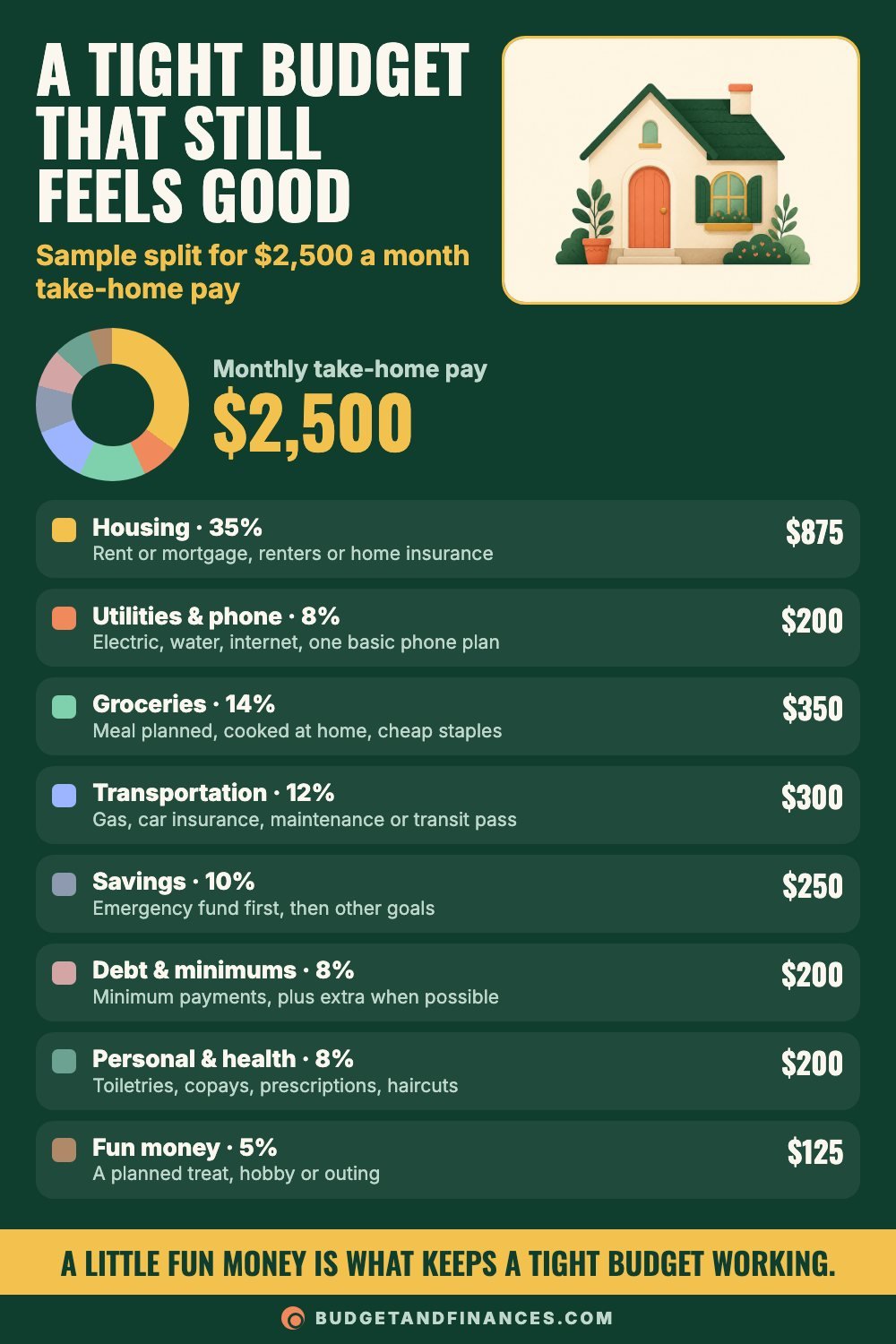
A tight budget works best when it’s written down before the month starts. Here’s a sample split for $2,500 a month in take-home pay.
- Housing, 35%: rent or mortgage, plus renters or home insurance.
- Utilities and phone, 8%: electric, water, internet and one basic phone plan.
- Groceries, 14%: meal planned, cooked at home, built on cheap staples.
- Transportation, 12%: gas, car insurance, maintenance or a transit pass.
- Savings, 10%: emergency fund first, then other goals.
- Debt and minimums, 8%: minimum payments, plus extra when possible.
- Personal and health, 8%: toiletries, copays, prescriptions and haircuts.
- Fun money, 5%: a planned treat, hobby or outing.
This is a starting point, not a rule. If your rent is higher, the other lines have to shrink to match. Fit it to your real bills.
Why fun money stays in
It’s tempting to cut fun to zero when money is tight. That usually backfires. A little fun money is what keeps a tight budget working, because a plan with no breathing room is one people abandon.
Step 2: Check your percentages against your income
The right split depends on how much comes in. At a lower income, fixed costs like housing take a bigger share, and there’s less room for savings.
Here are sample splits at three take-home incomes:
| Category | $2,000 | $2,500 | $3,000 |
|---|---|---|---|
| Housing | 40% | 36% | 33% |
| Food | 15% | 14% | 13% |
| Transportation | 12% | 12% | 11% |
| Utilities and phone | 10% | 9% | 8% |
| Savings | 5% | 8% | 12% |
| Debt payments | 8% | 8% | 8% |
| Personal and fun | 10% | 13% | 15% |
Each column adds up to 100%. Notice the $2,500 column here is a little different from the budget in Step 1. There’s no single correct split. Both are reasonable starting points you adjust to your own costs.
Use these as a starting point, then fit them to your real bills.
Step 3: Build a weekly rhythm
A budget on paper only helps if you check it. A simple weekly routine does most of the work so willpower doesn’t have to.
Sunday: plan the week (30 minutes)
- Check the calendar for costs coming up, like a birthday, a school fee or a bill.
- Plan meals from what’s already in the kitchen.
Monday: one grocery trip (with a list)
- Buy only what the meal plan needs.
- Put the receipt total in your tracker.
Midweek: check in on spending (10 minutes)
- Compare what you’ve spent so far to your weekly limit.
- Move any extra money to savings.
Friday: plan cheap fun (on purpose)
- Pick a free or low-cost weekend plan.
- Use your fun money guilt-free.
Monthly: reset and review (1 hour)
- Review bills and subscriptions.
- Adjust next month’s budget based on what really happened.
Step 4: Enjoy life for free
The best parts of life were never the expensive parts. Here are free things to do, sorted by where you are.
Get outside
- Walk a new trail or park each month.
- Pack a picnic instead of eating out.
- Watch the sunset from a favorite spot.
- Check your town’s free outdoor concerts.
At home
- Movie night with library DVDs and popcorn.
- Cook a new recipe from pantry staples.
- Rearrange a room with what you already own.
- Start a small herb garden.
With people
- Host a potluck dinner.
- Have a game night with games you own.
- Swap clothes or books with friends.
- Call someone you miss.
In your community
- Go to library events and classes.
- Visit museums on free admission days, which many museums offer.
- Volunteer somewhere you care about.
- Attend free local festivals.
Step 5: Add small comforts that cost almost nothing
A tight budget can still feel cozy. None of these need a shopping trip.
- A candlelit dinner: same meal, nicer evening.
- A long bath: with what’s already in the cabinet.
- A library book: free, with a due date to motivate you.
- Houseplant cuttings: ask a friend for a clipping.
- Music while you cook: kitchen time becomes your own time.
- Coffee at home: in your favorite mug.
- Fresh sheets: line-dried if you can.
- An evening walk: no gym membership needed.
- Journaling: a cheap notebook is enough.
Worked example: $2,500 a month in dollars
Here’s the Step 1 budget turned into dollar amounts. Each line is the percentage times $2,500.
| Category | % | Monthly |
|---|---|---|
| Housing | 35% | $875 |
| Utilities and phone | 8% | $200 |
| Groceries | 14% | $350 |
| Transportation | 12% | $300 |
| Savings | 10% | $250 |
| Debt and minimums | 8% | $200 |
| Personal and health | 8% | $200 |
| Fun money | 5% | $125 |
| Total | 100% | $2,500 |
Turning the grocery line into a weekly limit
The weekly routine needs a weekly number. A month isn’t exactly four weeks, so do it this way: $350 × 12 = $4,200 a year, and $4,200 ÷ 52 weeks = about $80.77 a week. Round down to $80 so you have a small cushion.
Savings over a year
At $250 a month, savings reach $250 × 12 = $3,000 in a year.
The same categories at other incomes
From the Step 2 table, housing is 40% of $2,000 = $800, and 33% of $3,000 = $990. Savings is 5% of $2,000 = $100, and 12% of $3,000 = $360. That’s the pattern: as income rises, savings can take a bigger share.
Common mistakes
Copying percentages that don’t fit your rent. If housing takes 45% of your income, the sample split won’t work as written. Start from your real fixed costs, then divide what’s left.
Cutting all the fun. It feels responsible and lasts about a month. Keep a small fun line.
Skipping the midweek check. Small purchases pile up quietly during the week. Ten minutes midweek catches them while there’s still time to adjust.
Forgetting irregular costs. Birthdays, car registration and school fees aren’t monthly, but they still come. The Sunday calendar check is how you see them early.
Waiting to save until there’s extra. Even $100 a month is $1,200 a year. Move it on payday.
FAQ
How do I budget on a low income?
Write down your take-home pay and your fixed bills first. Then split what’s left using a sample like the ones above, adjusted to your real costs. Check spending once a week.
What percentage of income should go to rent on a tight budget?
There’s no single right number. In the samples above, housing ranges from 33% to 40% depending on income. If yours is higher, you’ll need to trim other lines to make the budget balance.
How much should I save if money is tight?
Something is better than nothing. The samples above save 5% at $2,000 a month, which is $100. Start there, build a small emergency fund, and raise the amount when income goes up or a bill goes away.
How can I have fun with no money?
Use the library, go outside, host potlucks and game nights, and look for free community events. Many museums also have free admission days.
How do I stick to a weekly grocery budget?
Turn the monthly amount into a weekly one (monthly × 12 ÷ 52), plan meals before you shop, make one trip with a list, and log the receipt total the same day.
This is general education, not personal financial advice.