

You want a budget, but you don’t want to track forty categories and log every coffee. That is exactly who the 50/30/20 rule is for.
It gives you three buckets instead of dozens of lines. Half of your take-home pay goes to needs, 30% goes to wants, and 20% goes to savings and paying down debt. That’s the whole rule.
The simple part is the math. The harder part is deciding what counts as a need, and what to do when rent alone eats most of your 50%. This guide covers both, with real numbers.
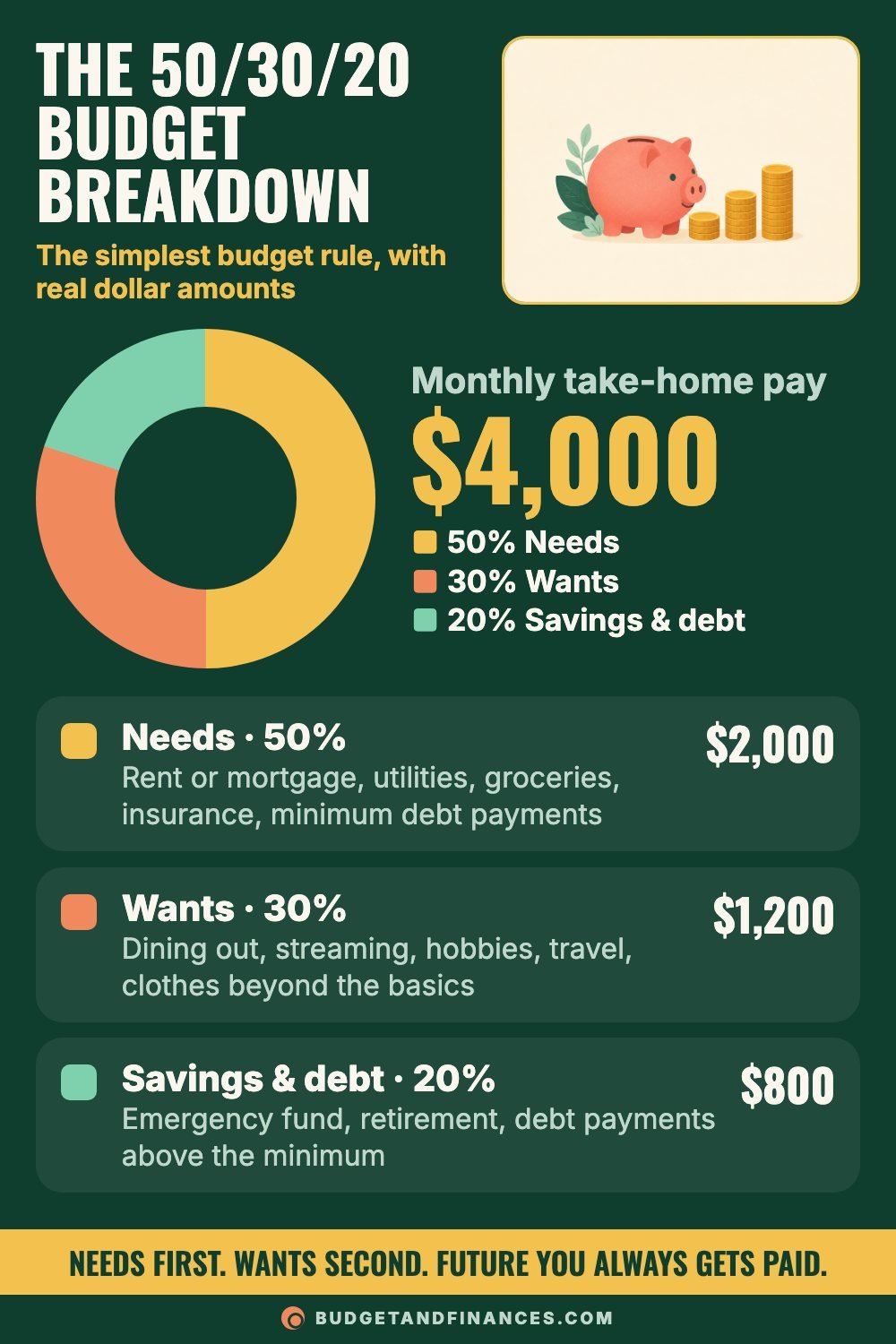
What the 50/30/20 rule actually says
The rule splits your monthly take-home pay into three shares:
- Needs (50%): rent or mortgage, utilities, groceries, insurance, and minimum debt payments.
- Wants (30%): dining out, streaming, hobbies, travel, and clothes beyond the basics.
- Savings and debt (20%): your emergency fund, retirement contributions, and any debt payments above the minimum.
Notice where debt shows up. Minimum payments are a need, because skipping them has real consequences. Anything extra you pay on top of the minimum counts toward the 20%, because it moves you forward the same way saving does.
Step 1: Find your take-home number
Use what actually lands in your bank account after taxes and paycheck deductions, not your salary. A $60,000 salary is not $5,000 a month to spend, and budgeting as if it were is how people end up short.
Add up last month’s paychecks. If you have side income you can reliably count on, include it. If it comes and goes, leave it out and treat it as a bonus when it shows up.
Then multiply that total by 0.5, 0.3 and 0.2. Those three numbers are your targets.
Step 2: Sort your spending into needs and wants
Pull the last 30 days of bank and card statements. Go line by line and tag each charge as a need, a want, or savings. Then total each group.
This is where most of the thinking happens, because plenty of expenses are part need and part want. A few examples:
- Rent or mortgage: need. A roof is non-negotiable.
- Basic groceries: need. Restaurant meals are a want.
- Phone plan: need. The newest phone is a want.
- Minimum payments: need. Extra payments count as savings.
- Streaming services: want, even the cheap ones.
- Health insurance: need. It protects everything else.
- Vacations: want. Plan for them in the 30.
- Car and gas: need. A pricier car than you require is partly a want.
- Gym membership: a want for most budgets.
When you’re stuck on one, use this test: if you’d still pay it after losing your job, it’s a need. Cable would go. Car insurance would stay.
Step 3: Compare your real numbers to the targets
Now you have two sets of numbers: what the rule says, and what you actually spent. Put them side by side.
If each group lands close to its target, you’re in good shape. If one is far off, that’s where your attention goes this month. You don’t have to fix everything at once.
Step 4: Close the gaps
If wants are running high, look for the easy trims first. Cancel one subscription you forgot about. Set a weekly spending limit for wants, so you can see partway through the month whether you’re on track.
If needs are running high, you have a few options, covered in detail below. The short version: borrow from wants before you borrow from savings.
Step 5: Automate the 20%
Schedule a transfer to savings for the day your paycheck arrives. If the money sits in checking waiting for you to move it, it tends to get spent. Put fixed bills on autopay where you can, too.
Then recheck the split next month. The first month is a rough draft.
A worked example on $4,000 a month
Say your monthly take-home pay is $4,000. Here’s the split:
| Bucket | Share | Monthly amount |
|---|---|---|
| Needs | 50% | $2,000 |
| Wants | 30% | $1,200 |
| Savings and debt | 20% | $800 |
| Total | 100% | $4,000 |
So you have $2,000 for rent, utilities, groceries, insurance and minimum payments. You have $1,200 for everything fun or optional. And $800 moves to savings or extra debt payments on payday.
Now say your needs actually come to $2,400, which is 60% of your pay. You don’t abandon the plan. You shrink wants to 20%, or $800, and keep savings at 20%, or $800. That gives you a 60/20/20 budget: $2,400 plus $800 plus $800 still adds up to $4,000.
A 60/20/20 budget you follow beats a 50/30/20 you don’t.
When needs take more than 50%
High rent, childcare, or a single income can push needs well past half. Here’s how to make the rule fit a real, pricey life.
Borrow from wants first
If needs hit 60%, shrink wants to 20% before you touch the savings share. Savings is the part that protects you from the next surprise, so it’s the last thing to cut.
Treat 50/30/20 as a target
Close counts. Adjust a few points, then check again next month. The rule is a guideline, not a grade.
Shop your fixed bills
Needs can shrink too. Once a year, ask for better rates on insurance, phone and internet, or compare plans. A lower bill in the needs bucket frees up room everywhere else.
Rethink housing at renewal
Rent is usually the biggest need. When your lease is up, a roommate or a cheaper place can shift the whole budget more than a dozen small cuts.
Keep savings automatic
Even when needs are high, move the savings share on payday. If it’s smaller for now, that’s fine. Keeping the habit is what matters.
50/30/20 vs a zero-based budget
These are two of the most popular ways to budget, and they suit different people.
The 50/30/20 budget is best for busy people. You work with three big buckets instead of dozens of lines. It’s quick to set up from one paycheck number, it gives you flexible spending inside each bucket, and it’s easy to check once a month. The downside is that overspending can hide inside the wants bucket.
A zero-based budget is best for tight months. Every dollar gets a specific job, and income minus the plan equals zero. It shows exactly where your money goes and catches small leaks fast, but it takes more time each month.
A good approach: start with 50/30/20. If money still disappears and you can’t tell where, switch to zero-based. The best budget is the one you’ll open again next month.
Get the free printable
The worksheet walks you through the same four steps as the setup checklist: find your number, sort your spending, close the gaps, and automate it. It has space to write your three targets next to what you actually spent, so you can see the gap at a glance.
Common mistakes
Using gross pay. Taxes and deductions come out before you see a dollar. Run the percentages on take-home pay.
Counting extra debt payments as needs. Only the minimum is a need. Anything above it belongs in the 20%, which also makes your progress easier to see.
Calling every want a need. Groceries are a need. The specialty coffee order added to the grocery run is a want. Be honest in the sorting step, or the numbers won’t tell you anything.
Letting the 30% become a black hole. Wants is one big bucket, which is flexible but easy to overspend. A weekly limit keeps it from running out by the 20th.
Giving up when needs are high. A 60/20/20 split is still a budget. Adjust and keep going.
FAQ
Is the 50/30/20 rule based on gross or take-home pay?
Take-home pay. That’s the money you can actually spend and save, after taxes and paycheck deductions.
Do retirement contributions taken from my paycheck count toward the 20%?
They’re savings, so they belong in that bucket. If your contribution comes out before your paycheck lands, it won’t show up in your take-home number. Some people add it back in so the full picture is clear. Either way, be consistent month to month.
What if I can’t save 20% right now?
Save what you can and keep it automatic. Shrink wants before savings, and raise the savings share when a bill goes away or your pay goes up.
Where do sinking funds for things like car repairs go?
Money you set aside for future costs, like car repairs or holiday gifts, fits in the 20% savings bucket while you’re building it up. When you spend it on a repair, that repair was a need.
Should I switch to a different budget if this one doesn’t work?
If you’ve tried 50/30/20 for a couple of months and still can’t tell where your money goes, a zero-based budget gives you more detail. Many people start with 50/30/20 and move to zero-based later, or the other way around.