

Buying for every adult in the family made sense when there were five of you. Then people got married, had kids, and the list quietly doubled. Now December means a pile of rushed gifts and a bill nobody enjoys, the exact problem a gift exchange is meant to fix.
A gift exchange fixes that. Everyone still gives. Everyone still opens something. But each person buys one thoughtful gift instead of a stack of generic ones.
This guide shows the math, how to bring it up without making it awkward, the rules that keep it fair, theme ideas that work under a low limit, and how to run a white elephant game.
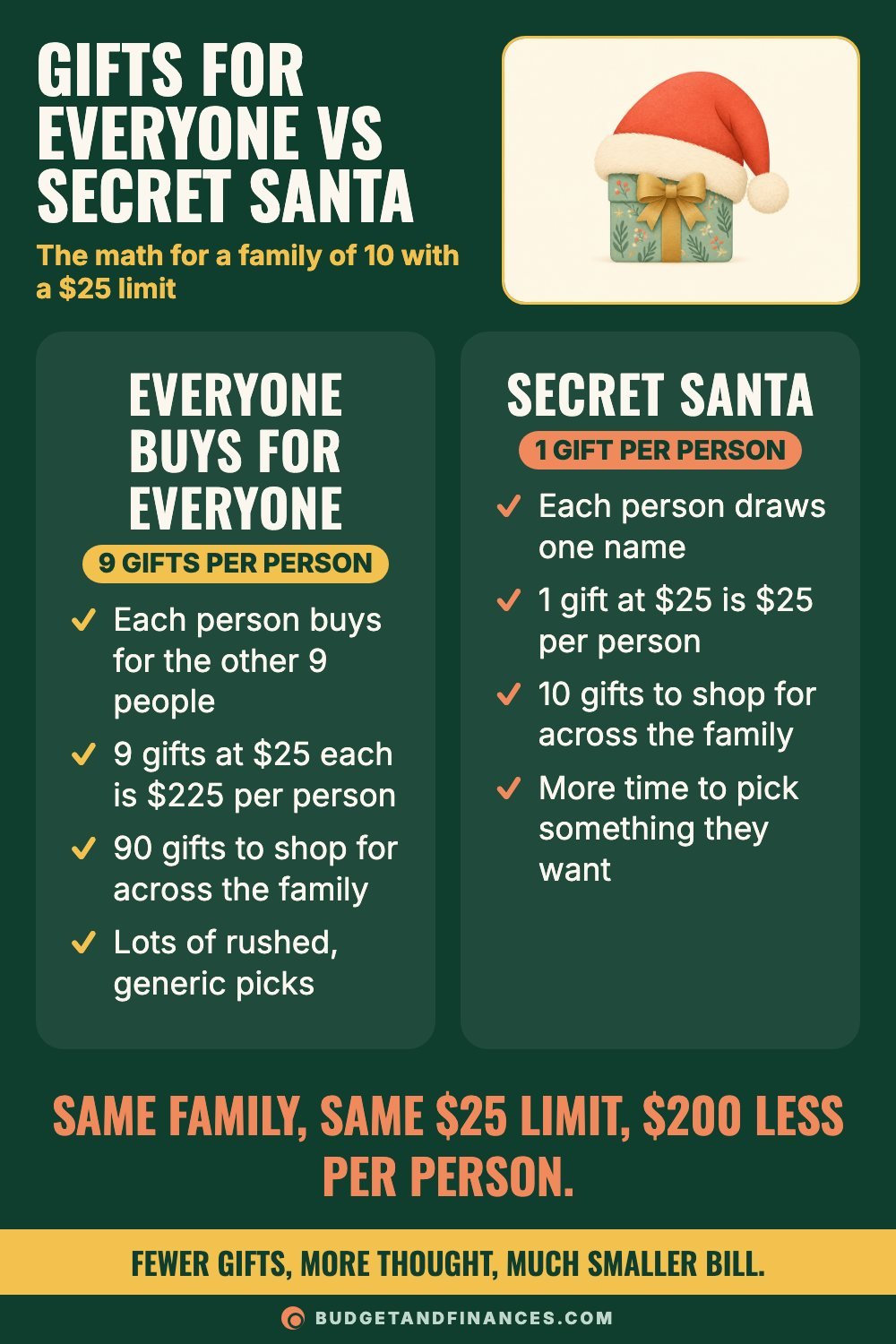
The math: gifts for everyone vs Secret Santa
Here’s what changes for a family of 10 people with a $25 limit per gift.
Everyone buys for everyone
- Each person buys for the other 9 people.
- 9 gifts at $25 each is $225 per person.
- That’s 90 gifts to shop for across the family.
- Lots of rushed, generic picks.
Secret Santa
- Each person draws one name.
- 1 gift at $25 is $25 per person.
- That’s 10 gifts to shop for across the family.
- More time to pick something the person actually wants.
Same family, same $25 limit, $200 less per person. Across all 10 people, that’s $2,250 down to $250, or $2,000 that stays in the family’s pockets.
And it isn’t only money. Shopping for 1 person instead of 9 gives everyone back hours in December.
How to suggest a gift exchange
Someone has to say it first. It might as well be you. Here’s how to bring it up kindly.
Bring it up early
Suggest it before anyone starts shopping, ideally a month or two ahead. Once people have bought gifts, changing plans feels like a loss.
Make it about everyone
Frame it as a relief for the whole group, not a problem with your own budget. Try something like: “Buying for everyone is a lot. Want to draw names this year?”
Many people feel the same pressure and are glad someone else said it.
Offer to organize it
People say yes more easily when someone else handles the draw. Volunteer to collect names, run the draw and send reminders.
Suggest a clear limit
Name a number so nobody has to guess what counts as too much. A clear limit is a kindness to everyone, especially people on tighter budgets.
Keep kids separate
Some families draw names for adults and still give small gifts to kids. That keeps the fun for children while the adults cut back.
Don’t guilt anyone
If someone still wants to give extra, let them. Just don’t feel you have to match it.
Gift exchange rules everyone can agree on
Set these once and skip the awkward surprises. Write them in the group chat or on a printed sheet so nobody has to remember.
Before the draw
- Decide who’s in. Including partners, and whether kids take part in the draw or get separate gifts.
- Pick a draw method everyone can use. Names from a hat at a gathering, or a free online name picker for families spread out.
- Keep couples from drawing each other. They’ll likely exchange gifts anyway.
The price limit
- Agree on one firm dollar limit.
- Say whether it includes shipping. This matters for family who live far apart.
- Going over the limit isn’t allowed. A $25 limit only works if nobody shows up with a $60 gift.
Wish lists
- Everyone shares 3 ideas under the limit. This saves guessing and returns.
- Include sizes and favorite colors.
- Say what you don’t want. Extra candles, clutter, or anything that clashes with a food allergy.
Exchange day
- Set a date and a place.
- Name a backup plan for anyone who can’t come. Mail the gift, or open it on a video call.
- Keep receipts for easy swaps.
Gift exchange themes that work under a low limit
A theme makes shopping faster and the limit easier to keep. Pick a theme and a price limit together.
- Favorite book: bring a book you loved.
- Cozy socks: the fuzzier the better.
- Snack swap: your favorite treats in a bag.
- Mug and a treat: a mug filled with cocoa or tea.
- Ornament swap: one ornament, bought or handmade.
- From your home: something nice you already own and don’t use.
- Handmade only: baked, crafted or sewn.
- Game night: a card game or puzzle.
- Grow something: a plant, seeds or a cutting.
“From your home” and “handmade only” can bring the cost close to zero, which makes them good choices for groups with very different budgets.
White elephant rules, step by step
White elephant is a gift swap game, popular at work parties and with friend groups. It brings big laughs with one small gift each. Here’s how to run it.
Step 1: Set the limit
Agree on one price limit for every gift. Gifts can be silly, useful or follow a theme.
Step 2: Wrap and pile
Wrap gifts so nobody can tell whose is whose. Put every gift in one pile.
Step 3: Draw numbers
Everyone draws a number for turn order. Player 1 opens a gift from the pile.
Step 4: Open or steal
Each next player either opens a new gift from the pile or steals an opened gift from someone else. A player whose gift is stolen takes another turn, opening a new gift or stealing a different one.
Step 5: Set a steal limit
A common house rule is that a gift is locked after 3 steals. Another is no stealing back the gift that was just taken from you. Agree on these before you start.
Step 6: Final swap
When the pile is empty, player 1, who never got a chance to steal, gets one last chance to swap. Then everyone keeps what they’re holding.
Worked example: one family’s switch
Say a family of 10 adults has always bought for everyone, with about $25 per gift.
Before. Each person buys 9 gifts at $25, which is $225 each. Together the family spends 10 × $225 = $2,250 and shops for 90 gifts.
The switch. In October, one sibling suggests a name draw and offers to run it. They agree on a $25 limit including shipping, with each person sharing 3 ideas under the limit.
After. Each person buys 1 gift at $25. Together the family spends 10 × $25 = $250, shops for 10 gifts, and each person keeps $225 − $25 = $200.
Keeping it fun for kids. They also agree that the adults each give the kids in the family one small gift, with its own limit. That part of the budget is planned separately so it doesn’t sneak into the $25 draw.
Free printable: gift exchange rules checklist
Print the checklist and use it when you set up the exchange, or snap a photo and share it in the family group chat. It covers who’s in, the draw, the price limit, wish lists and exchange day.
Common mistakes
Suggesting it too late. If people have already bought gifts, a name draw feels like wasted money. Bring it up early.
Leaving the limit vague. “Something small” means $10 to one person and $50 to another. Name a number.
Not saying whether shipping counts. For far-away family, shipping can eat a big part of a low limit.
Skipping wish lists. Without ideas, people guess, and guessed gifts often get returned.
Matching someone who goes over. If one person breaks the limit, let it go. The rules protect everyone else.
FAQ
What is a good Secret Santa price limit?
Pick a number that works for the person in the group with the tightest budget. There’s no standard amount. What matters is that everyone agrees to it, and that it’s clear whether shipping counts.
What’s the difference between Secret Santa and white elephant?
In Secret Santa, you draw a specific person’s name and buy a gift for them. In white elephant, everyone brings a gift for a shared pile, and players open or steal gifts during a game.
Should couples be in the same gift exchange?
Yes, but most groups set the draw so partners can’t pick each other, since couples usually exchange gifts on their own.
How do we do Secret Santa if family lives far apart?
Use a free online name picker for the draw, agree that the price limit includes shipping, and open gifts together on a video call if you can.
How do I bring up a gift exchange without sounding cheap?
Make it about everyone. Say buying for everyone has gotten to be a lot, suggest drawing names, and offer to organize it. People are often relieved someone said it.