

Weekly savings challenges are great, until you get paid every two weeks and every other week feels broke. The money never seems to be there on the day the chart says to save, exactly the mismatch a 26-paycheck savings challenge is designed to fix.
The 26-paycheck savings challenge fixes that by matching your savings to your actual payday. You save $10 from your first paycheck, $20 from the second, and keep adding $10 each payday. By paycheck 26, you’ve saved $3,510.
If that’s too big, there are smaller versions too. This guide covers all of them, plus a 15-minute payday routine that keeps the whole thing running.
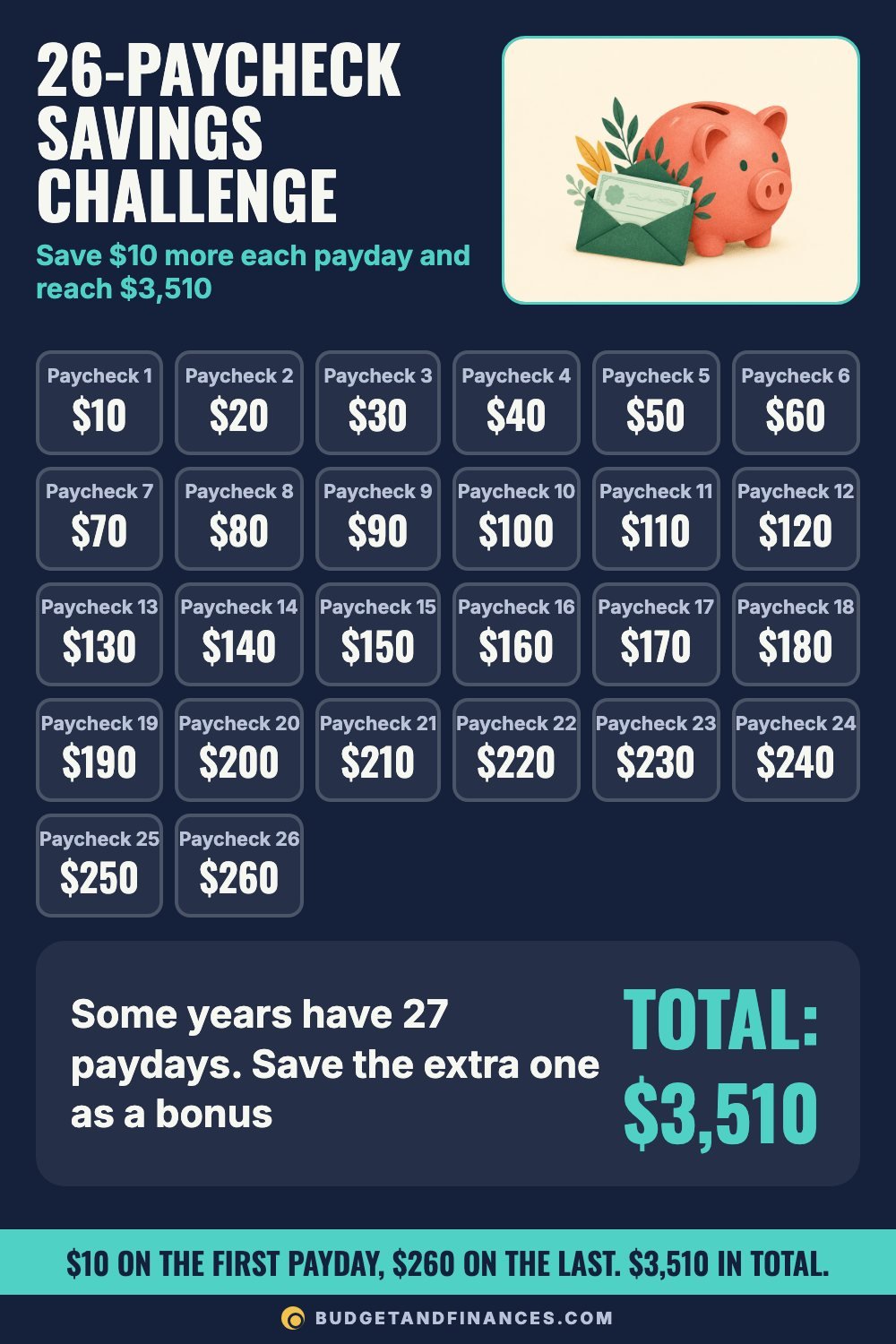
How the 26-paycheck challenge works
If you’re paid every two weeks, you get 26 paychecks in most years. Each one gets a box on the chart.
- Paycheck 1: save $10
- Paycheck 2: save $20
- Paycheck 3: save $30
- Paycheck 26: save $260
Add $10 + $20 + $30 all the way up to $260 and you get $3,510.
Some years have 27 paydays, depending on how the calendar falls. If you get one, save the extra paycheck’s amount as a bonus.
Step 1: Pick your version
Adding $10 each payday is the biggest version. If your budget can’t carry a $260 deposit near the end, start smaller. You can always move up next year.
| Version | How it works | Total over 26 paydays |
|---|---|---|
| $10 flat | $10 each payday | $260 |
| $25 flat | $25 each payday | $650 |
| $50 flat | $50 each payday | $1,300 |
| Add $5 each time | $5 up to $130 | $1,755 |
| $100 flat | $100 each payday | $2,600 |
| Add $10 each time | $10 up to $260 | $3,510 |
The flat versions are the easiest to automate because the transfer never changes. The climbing versions start easier and ask for more later.
Start with the one you won’t skip.
Step 2: Know what’s coming
On the add-$10 plan, most of the money comes late. Here are the running totals:
| Paychecks | Deposits | Saved in this stretch | Running total |
|---|---|---|---|
| 1-6 | $10 to $60 | $210 | $210 |
| 7-13 | $70 to $130 | $700 | $910 |
| 14-19 | $140 to $190 | $990 | $1,900 |
| 20-26 | $200 to $260 | $1,610 | $3,510 |
At paycheck 13, you’re halfway through the year but only $910 into your $3,510 goal. The last seven paydays alone add $1,610.
That’s not a problem if you plan for it. It just means the budget you have in paycheck 3 needs to stretch further by paycheck 23.
Step 3: Set up a payday routine
Saving works best when it happens before any spending. This 15-minute routine turns every payday into the same short checklist.
Morning of payday (5 minutes)
- Confirm your paycheck landed.
- Move this payday’s challenge amount to savings.
- Check off the box on your chart.
Cover the bills (5 minutes)
- List the bills due before your next payday.
- Set aside money for each one.
- Check for any autopay changes.
Plan the two weeks (5 minutes)
- Set a grocery amount.
- Set a gas and errands amount.
- Decide your fun money.
Once a month
- Write your running savings total on the chart.
- Look ahead for a three-paycheck month.
- Adjust next month if this one felt tight.
Same routine every payday. Saving stops being a decision.
Tips that make biweekly saving stick
Save before you spend. Schedule the transfer for payday morning so it happens before any bills or shopping.
Use three-paycheck months. In most years, two months have three paydays. Your regular bills are often planned around two paychecks, so the third can go toward the challenge.
Budget by paycheck. Split your bills between your two paydays so neither check comes up short. If rent takes most of one check, move smaller bills to the other.
Keep a separate account. A savings account apart from checking keeps the money from blending in.
Raise it with a raise. Got a pay increase? Move up to a bigger version of the challenge.
Log every payday. Check off the box and write your running total on the chart.
Worked example: a year on the add-$10 plan
Here’s how the milestones play out.
Paychecks 1-6: Easy start ($210 saved). Deposits run from $10 to $60. Use this stretch to set up an automatic transfer on payday. You’ll need to raise the amount by $10 each time, so set a reminder to update it.
Paychecks 7-13: Halfway there ($910 saved). You save $700 in this stretch. After paycheck 13, check that the plan still fits your budget. If $130 already feels tight, this is a good time to switch to a flat version rather than quitting later.
Paychecks 14-19: Bigger deposits ($1,900 saved). You save $990 in this stretch. If one of your three-paycheck months falls here, use that extra check to get ahead. For example, making paycheck 20’s $200 deposit early.
Paychecks 20-26: The final push ($3,510 saved). Deposits climb from $200 to $260 and you save $1,610 in this stretch. Check off the last box and you’re done.
If your job pays a 27th check that year, the chart note applies: save it as a bonus.
Get the free printable chart
The chart has 26 boxes, one for each paycheck, with the add-$10 amounts filled in. Check off each box and write your running total as you go.
Common mistakes
Saving whatever is left at the end. On a two-week pay cycle, there’s rarely anything left. Move the challenge amount the morning money lands.
Choosing the biggest version first. $260 in one payday is a lot. Start with a version you can finish and move up next year.
Forgetting to update the transfer. On the climbing versions, the amount changes every payday. If your automatic transfer stays at $10, you’ll fall behind without noticing.
Putting all the big bills on one check. If one paycheck covers rent, car and insurance, that’s the payday you’ll skip. Spread bills across both.
Spending the third paycheck. Three-paycheck months are the easiest place to get ahead. Plan them in advance.
FAQ
How much do you save with the 26-paycheck challenge?
Adding $10 each payday saves $3,510. Adding $5 each payday saves $1,755. Flat versions save $260 ($10), $650 ($25), $1,300 ($50) or $2,600 ($100).
What if I get 27 paychecks this year?
Some years have 27 biweekly paydays. Treat the extra one as a bonus deposit and add it to your savings.
Can I do this challenge if I’m paid twice a month instead of every two weeks?
Twice a month gives you 24 paydays, not 26. You can still use the chart. Just know you’ll have two boxes left at the end of the year, so either do two extra deposits or pick a flat version and adjust the total.
What’s a three-paycheck month?
When you’re paid every two weeks, most years include two months where three paydays land in the same month. If your bills are budgeted around two checks, the third can go straight to savings.
Should I do the challenge in a separate account?
Yes. A separate savings account keeps the challenge money from mixing with your spending money, and it makes your running total easy to check.