

Maybe one of you wants to stay home with the kids. Maybe a job ended, or someone needs to care for a parent. Whatever the reason, the question is the same: can the family actually live on one income?
The first number most people look at is the lost income, and it’s scary. But that’s only half the math. A second job also comes with costs, and many of them go away when the job does.
This guide shows you how to find your real gap, test drive a one-income budget before you commit, and set up the routines that keep one paycheck stretching all month.
Step 1: Add up the costs that can drop
Before you panic about the lost paycheck, list what the second job costs your family. Compare what the second job costs, not just what it pays.
Costs that can drop on one income:
- Childcare. Often the biggest one.
- Commuting. Gas, parking, transit passes.
- Work lunches. Grabbing food near the office.
- Work clothes. Dress clothes, uniforms, dry cleaning.
- Coffee runs. The drive-thru on the way in.
- Convenience meals. Takeout on tired weeknights.
- A second car. Maybe, if one car can do the job.
- Income taxes. Less income can mean a lower tax bill.
- Paid help. Cleaning or lawn service.
Not every family will drop every cost. Be honest about which ones would really go away for you.
Step 2: Find your real gap
Here’s how the math can work. Say the second earner brings home $2,400 a month after taxes. Now say these costs would go away:
| Cost that drops | Monthly amount |
|---|---|
| Childcare | $1,100 |
| Commuting | $150 |
| Work lunches | $120 |
| Work clothes and dry cleaning | $50 |
| Coffee runs | $40 |
| Convenience meals | $140 |
| Total | $1,600 |
The lost paycheck is $2,400, but $1,600 of costs disappear with it. The real gap is $800 a month.
That’s still a real number to close. It’s also far easier to plan for than $2,400.
One note on taxes: if you’re using take-home pay, the taxes on the second income are already subtracted. Don’t count them twice. Your tax situation can change in other ways with one income, so it’s worth checking with a tax professional.
These numbers are only an example. Use your own.
Step 3: Build the one-income budget
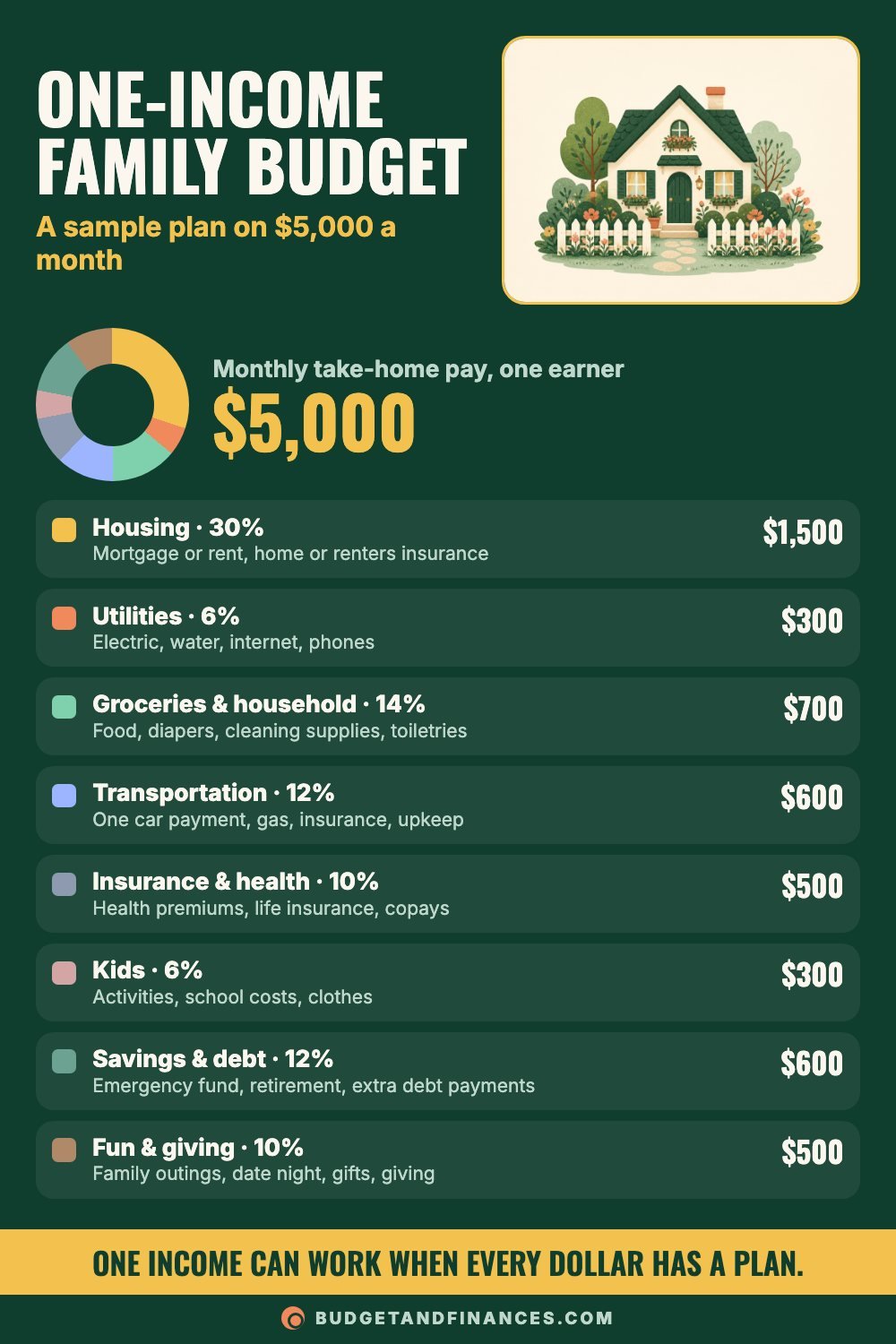
Now make a budget using only the earner’s take-home pay. Here’s a sample one-income family budget on $5,000 a month:
| Category | Share | Amount | What it covers |
|---|---|---|---|
| Housing | 30% | $1,500 | Mortgage or rent, home or renters insurance |
| Utilities | 6% | $300 | Electric, water, internet, phones |
| Groceries and household | 14% | $700 | Food, diapers, cleaning supplies, toiletries |
| Transportation | 12% | $600 | One car payment, gas, insurance, upkeep |
| Insurance and health | 10% | $500 | Health premiums, life insurance, copays |
| Kids | 6% | $300 | Activities, school costs, clothes |
| Savings and debt | 12% | $600 | Emergency fund, retirement, extra debt payments |
| Fun and giving | 10% | $500 | Family outings, date night, gifts, giving |
| Total | 100% | $5,000 |
Notice a few things. Transportation covers one car payment. Groceries include diapers and household basics. And savings and fun both still get a line. One income can work when every dollar has a plan.
A timeline for switching to one income
If you have time to prepare, a slower switch is a calmer one. Here’s a timeline to test drive one income before you give up the second one.
12 months out: run the numbers
Budget the family on one take-home pay. List the costs that go away, like childcare.
9 months out: live on one income
Deposit the second paycheck straight into savings and live on the first. Adjust the budget wherever it pinches.
This step does two jobs. It shows you whether the budget really works, and it builds savings at the same time. In the example above, saving a $2,400 paycheck for nine months would put $21,600 in the bank. Keep in mind that during the practice run you’re still paying work costs like childcare, so you may not be able to save the whole paycheck.
6 months out: build the cushion
Work toward 3-6 months of expenses in an emergency fund. Pay down high-interest debt.
3 months out: protect the family
Review life and disability insurance, since the whole family will depend on one paycheck. Confirm what your health coverage will be after the change.
Month one: check in weekly
Compare the plan to your real spending. Keep fun money for each adult.
Tips for living on one income
Practice first. Live on one paycheck for a few months and save the other one before you make the switch.
Count what goes away. Childcare, a second commute and work lunches may disappear. Subtract them first.
Plan every week’s meals. Groceries are one of the biggest costs you can control. A plan cuts waste and takeout.
Buy kids’ things used. Clothes, gear and toys get outgrown fast. Hand-me-downs and resale shops stretch the budget.
Give each adult fun money. A small personal allowance for both of you keeps money talks from turning tense.
Use sinking funds. Save monthly for birthdays, car repairs and holidays so they don’t hit a credit card.
Protect the earner. Review life and disability insurance. The whole family depends on one paycheck.
A money routine that keeps it working
Small check-ins keep one paycheck stretching all month.
Every week (15 minutes)
– Plan meals around what’s on sale.
– Check the grocery budget balance.
– Talk through upcoming spending together.
Every month
– Move savings on payday.
– Refill sinking funds for kids and the car.
– Review the budget as a couple.
Every season
– Swap or buy used kids’ clothes.
– Look for free local events.
– Cancel subscriptions you stopped using.
Every year
– Shop car and home insurance.
– Review life and health coverage.
– Update the budget for any raise.
Common mistakes
Only looking at the lost paycheck. Without subtracting the costs that go away, the gap looks bigger than it is, and you might decide against a change that would have worked.
Skipping the test drive. A budget on paper can hide problems that one real month would show you.
Cutting all personal spending. When one person earns the money, it’s easy for the other to feel they can’t spend any. Fun money for both adults prevents a lot of tension.
Forgetting insurance. If the family depends on one income, life and disability coverage matter more than before.
Making the budget one person’s job. One income means one plan, made together. Review it as a couple.
FAQ
How much income does a family need to live on one income?
There’s no single number. It depends on your housing costs, where you live, how many kids you have and your debts. Build a one-income budget with your real numbers and test drive it for a few months.
Should we pay off debt before switching to one income?
Paying down high-interest debt before the switch frees up room in the budget. Many families also build their emergency fund first, so a surprise doesn’t go on a credit card.
What if the numbers don’t work yet?
Look for the biggest costs you could lower, like housing or a second car. Some families add a small amount of flexible part-time income, or push the switch back a few months to save more.
How do we handle retirement savings on one income?
Keep a savings line in the budget, even if it’s smaller for now. A spouse without earned income may still be able to contribute to a retirement account based on the working spouse’s income, so it’s worth asking a tax professional about your options.
This is general education, not personal financial advice.