
Search for ways to make extra money from home and you’ll find two kinds of results. A few are real work. A lot of them want your money, your time, or your personal details first.
If you’re home with kids, between jobs, or just need a little breathing room in the budget, you don’t have time to fall for the second kind.
This guide sticks to realistic options: real work that pays you for what you do. You’ll get nine ideas, a 5-step plan to start, a guide to selling what you already own, the red flags that mark a scam, and example math showing how small amounts add up. Earnings depend on your time, skills, and area, so every number here is an example, not a promise.
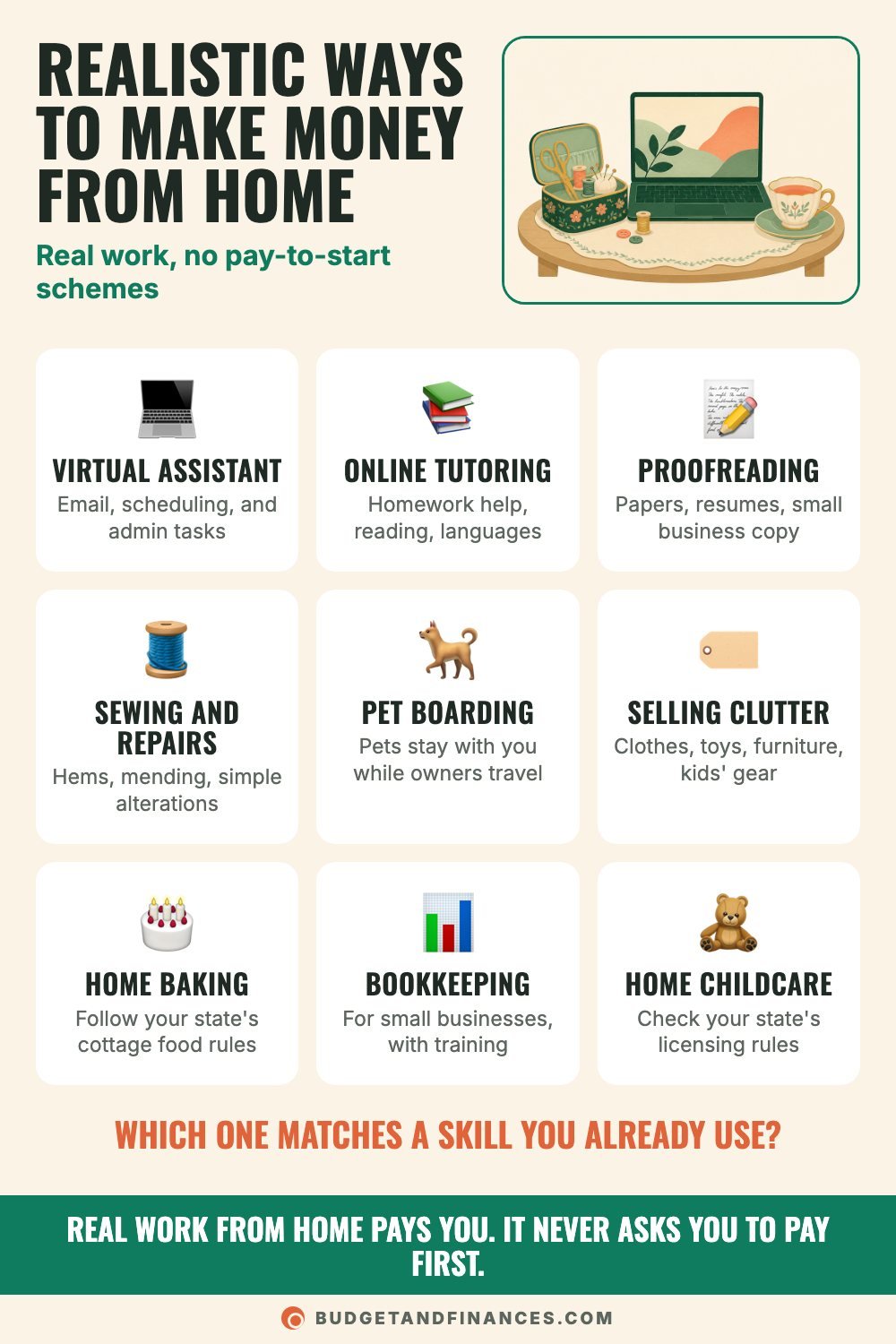
9 realistic ways to make money from home
1. Virtual assistant
Email, scheduling, and admin tasks for small business owners. If you’ve done office work, you already have the skills.
2. Online tutoring
Homework help, reading, and languages. Start with the subjects and ages you know best.
3. Proofreading
Papers, resumes, and small business copy. A sharp eye for mistakes is a skill people pay for.
4. Sewing and repairs
Hems, mending, and simple alterations. Neighbors and local community groups are a good place to start.
5. Pet boarding
Pets stay with you while their owners travel. Check your lease or HOA rules first, and ask whether your insurance covers it.
6. Selling clutter
Clothes, toys, furniture, and kids’ gear. This is often the fastest way to get extra cash, since you already own the stock. More on this below.
7. Home baking
Follow your state’s cottage food rules, which set out what you can sell from a home kitchen and how it must be labeled.
8. Bookkeeping
For small businesses, once you have training. Some people start by helping a friend’s business with basic record keeping while they learn.
9. Home childcare
Watching other people’s children in your home often requires a state license, depending on how many children and how often. Check your state’s licensing rules before you start.
Which one matches a skill you already use?
Start earning from home in 5 steps
Step 1: List what you can do
- Write down skills from work, school, and home. Include the ones that feel ordinary, like organizing, cooking, or explaining things clearly.
- Circle the ones people already pay for.
Step 2: Check your real time
- Count the hours you truly have each week, after kids, meals, and rest.
- Note your quiet times, like naps or early mornings. That’s when focused work fits.
Step 3: Test it small
- Offer it to 3 to 5 people you know.
- Set a starter price you can raise later. Look at what others nearby charge so you don’t start far too low.
Step 4: Handle the money
- Keep earnings in a separate account.
- Save part of each payment for taxes. Side income is usually taxable, so check the rules where you live.
Step 5: Grow what works
- Ask for reviews and referrals from happy customers.
- Drop what pays too little for your time.
Start small, learn fast, keep what works.
What to sell from home for extra cash
The fastest extra cash is often already in your closet.
Often sells online (easy to ship)
- Kids’ clothes sold in bundles by size
- Shoes and bags in good shape
- Video games, consoles, and electronics
- Books and textbooks
Often sells locally
- Furniture too big to ship
- Strollers, high chairs, and baby gear
- Bikes, outdoor toys, and tools
Check baby gear for recalls before listing. The U.S. Consumer Product Safety Commission keeps a searchable list of recalled products. Selling a recalled item can put a child at risk.
Donate instead
- Items worth less than your time to list
- Worn clothes with stains or damage
- Things listed for weeks with no offers
Stay safe
- Meet buyers in a public place. Some police stations offer a spot for this.
- Get paid in full before handing it over.
- Bring someone along for big items.
- Be wary of buyers who send more than the asking price and ask you to refund the difference.
Real home jobs vs scam red flags
When a home job sounds too easy, check twice.
Signs it’s a real opportunity
- You get paid for work you actually do.
- There’s a clear pay rate, schedule, and list of duties.
- You can look up the company and read reviews.
- There’s an application or a real conversation first.
- It never asks you to pay to start.
Signs it’s likely a scam
- It asks you to pay for a kit or training. Real employers don’t charge you to work for them.
- It sends a check and asks you to send some back. The check can bounce days later, after your money is gone.
- It wants you to reship packages from home. These schemes often involve stolen goods, and you can be left responsible.
- It promises big money for little work. Real pay reflects real work.
- Pay depends on recruiting other people. If your income comes from signing others up instead of selling a real product or service, walk away.
If you have to send money to earn money, stop there. If you think you’ve run into a scam, you can report it to the Federal Trade Commission.
How small extra income adds up
These are example numbers, not promises. Your amounts will vary. The point is that small, steady amounts turn into real money over a year.
| Example | The math | Over time |
|---|---|---|
| $20 a week | $20 × 52 weeks | $1,040 a year |
| $50 a week | $50 × 52 weeks | $2,600 a year |
| $100 a month | $100 × 12 months | $1,200 a year |
| 10 hours a week at an example $15 an hour | $15 × 10 hours | $150 a week before taxes and costs |
| $150 a week | $150 × 52 ÷ 12 months | about $650 a month |
Two notes on that table:
- $100 a month for a year is $1,200, which is more than a $1,000 starter emergency fund.
- A month isn’t exactly four weeks. A year has 52 weeks, not 48. Multiplying $150 by 4 gives $600, but $150 a week over a full year averages about $650 a month.
Worked example: pointing extra money at a real goal
Extra money slips into daily spending unless it has a job waiting. Here’s how to give it one.
Say you sell a few small items each week and average $20 a week. Your goal is a $1,000 starter emergency fund.
- Pick the goal and the number. $1,000.
- Do the math. $1,000 ÷ $20 = 50 weeks. That’s just under a year.
- Give the money one place to go. Open a separate savings account, or use a savings spot inside your bank, and move each week’s sales there the day you’re paid.
- Speed it up if you can. If you add a small weekly gig and reach $50 a week, $1,000 ÷ $50 = 20 weeks.
- Remember taxes. If your extra income comes from work or reselling for profit, it’s usually taxable. Selling your own used things for less than you paid is often treated differently, so check your local rules.
Small amounts count when they go somewhere on purpose.
Common mistakes
Paying to get started. Any “opportunity” that needs your money first is the biggest red flag there is.
Skipping the rules. Home childcare, home baking, and pet boarding can have state, local, lease, or HOA rules.
Underpricing to get the first job and never raising it. Start with a price you can raise, and actually raise it.
Letting the money blend in. Without a separate account and a goal, extra income disappears into everyday spending.
Forgetting about taxes. Set part of each payment aside from the start.
FAQ
What is the easiest way to make extra money from home?
Selling things you no longer use is often the quickest, since there’s nothing to learn and no customers to find first. For ongoing income, pick something that uses a skill you already have.
How can I tell if a work from home job is legit?
Real jobs pay you for work, explain the pay and duties clearly, and never ask you to pay to start. Look up the company and read reviews before sharing personal details.
How much can I make from home?
It depends on your time, skills, rates, and area. The numbers in this post are examples of how amounts add up, not what you’ll earn.
Do I have to pay taxes on money I make from home?
Income from work or businesses is usually taxable. Rules vary by location and situation, so check your local rules or ask a tax professional.
Is it worth selling small items?
Only if they’re worth more than your time to photograph, list, and hand off. Low-value items are often better donated.
This is general education, not personal financial advice.