
If you get to the end of the month and honestly can’t say where the money went, a zero-based budget is built for you.
The idea is simple. Before the month starts, you give every dollar of income a job. Rent, groceries, savings, a little fun money. When you subtract all those jobs from your income, the answer is zero.
That zero is on paper, not in your bank account. Money you haven’t spent yet still has a job. It might be sitting in savings, or waiting for next week’s grocery run.
How a zero-based budget works
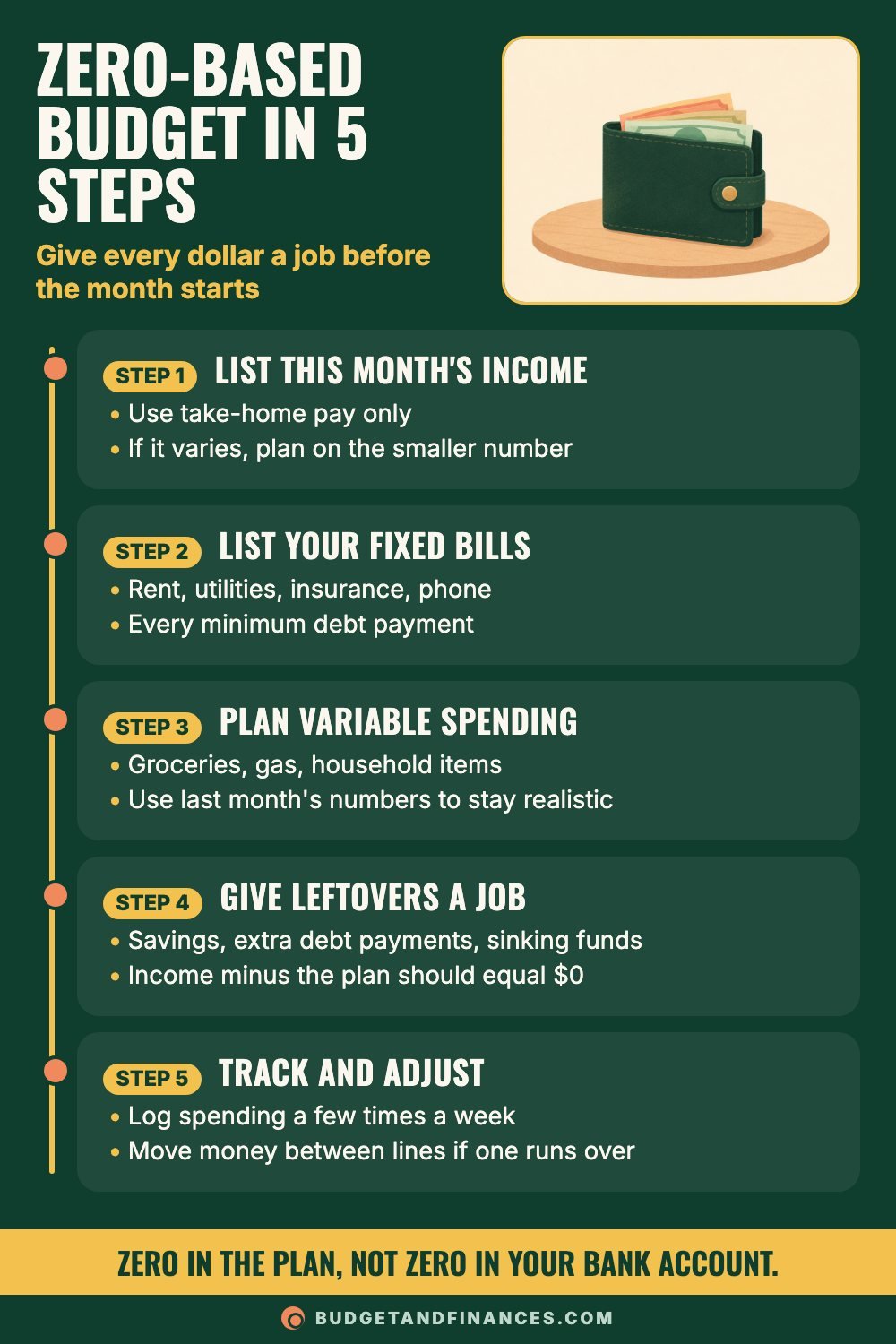
Income minus planned spending, saving and debt payments equals zero. That’s the whole method.
A dollar without a job tends to find one on its own, usually something you didn’t plan and won’t remember. Assigning every dollar ahead of time is what stops the quiet leaks.
Here’s how to build one from scratch in five steps.
Step 1: List this month’s income
Use take-home pay only, meaning what lands in your account after taxes and deductions.
If your income varies, plan on the smaller number. If the month turns out better, you’ll assign the extra when it arrives. Planning with money you don’t have yet is one of the fastest ways to break the budget.
Step 2: List your fixed bills
These are the costs that stay about the same each month:
- Rent or mortgage
- Utilities and phone
- Insurance
- Every minimum debt payment
Write each one down with its amount. Include the small ones. A forgotten $15 charge still counts.
Step 3: Plan your variable spending
Next come the costs that change month to month: groceries, gas, and household items like toilet paper and dish soap.
Don’t guess. Look at the last two or three months of bank statements or receipts and start from the real average. Last month’s numbers keep the plan realistic.
Step 4: Give the leftovers a job
Subtract Steps 2 and 3 from your income. Whatever is left needs an assignment too. Good jobs for leftover dollars:
- Your emergency fund
- Extra payments on a debt
- Sinking funds, which are small monthly amounts set aside for costs that come once or twice a year
- Fun money you plan to spend
Keep assigning until income minus the plan equals $0.
Step 5: Track and adjust
Log your spending a few times a week. If one line runs over, move money from another line to cover it. Groceries ran high but you barely ate out? Shift the money from eating out to groceries.
Moving money between lines isn’t cheating. That’s how the method is supposed to work. The total still equals your income.
Jobs your dollars can do
If you’re not sure which categories to include, check your plan against this list. Each one is a job a dollar can hold:
- Keep a roof over you: rent, mortgage, renters insurance.
- Feed the house: groceries and household basics.
- Get you to work: gas, transit, car insurance.
- Pay down debt: minimums plus any extra.
- Catch emergencies: an emergency fund you don’t touch.
- Plan for later: sinking funds for gifts and repairs.
- Grow for retirement: contributions to a retirement account.
- Fun money: guilt-free spending you planned.
- Checking buffer: a small cushion for timing slips.
If one of these is missing from your budget, ask whether you actually spend on it. Most people do, and it shows up later as a surprise.
A zero-based budget example on $3,500 a month
Here is a sample zero-based budget on $3,500 a month in take-home pay. Every dollar is assigned.
| Category | Share | Amount | What it covers |
|---|---|---|---|
| Rent | 34% | $1,190 | Rent plus renters insurance |
| Utilities and phone | 7% | $245 | Electric, water, internet, phone plan |
| Groceries | 12% | $420 | Food, cleaning supplies, toiletries |
| Transportation | 10% | $350 | Gas, car insurance, oil changes |
| Health insurance | 6% | $210 | Premiums, copays, prescriptions |
| Debt payments | 11% | $385 | Minimums plus an extra payment on one debt |
| Savings and sinking funds | 12% | $420 | Emergency fund, gifts, car repairs, annual bills |
| Fun and personal | 8% | $280 | Eating out, hobbies, haircuts, guilt-free cash |
| Total | 100% | $3,500 |
Check the math: $3,500 of income minus $3,500 of jobs leaves $0 to assign. The budget is done.
Now say it’s the middle of the month and groceries are already at $390, while only $120 of the $280 fun money has been spent. You could move $50 from fun and personal to groceries. Groceries become $470, fun becomes $230, and the total is still $3,500.
Your categories won’t look exactly like this. Rent might take more, or you might have no car payment. Swap in your own numbers and keep assigning until the total matches your income.
Get the free worksheet
The zero-based budget worksheet has space for your month, your total income, and a running “left to assign” number at the top. Below that are columns for each category’s planned amount, what you actually spent, and what’s left.
Fill in your income first. Then keep assigning until “left to assign” reads zero, and check the worksheet weekly.
Common mistakes
These small slips are usually why a zero-based budget falls apart by mid-month.
Forgetting yearly expenses
Car registration and birthdays aren’t surprises. They just don’t happen every month. Give them a monthly sinking fund line. If registration costs $120 a year, setting aside $10 a month covers it.
Leaving checking at $0
Zero is for the plan, not the account. Keep a small cushion in checking so a bill that posts a day early doesn’t cause an overdraft.
No fun money
A budget with zero room for joy tends to get abandoned. Plan a small amount you can spend freely without tracking every dollar of it.
Budgeting pay you don’t have
Plan with income you know is coming. Assign bonuses and side income after they arrive, not before.
Setting it and forgetting it
Check in weekly. Move money between lines when groceries run high and eating out runs low. The plan will be wrong at first. Adjust it instead of quitting.
Guessing at groceries
Look at the last two or three months of receipts and start from the real average. A hopeful grocery number is usually the first line to break.
FAQ
Does zero-based budgeting mean I spend all my money?
No. Savings, extra debt payments and sinking funds are all jobs. A budget can equal zero while a large share of it goes to savings.
How long does it take to set up?
The first month takes the longest, because you’re pulling statements and figuring out averages. After that, you can usually copy last month’s plan and adjust a few lines.
What if I get paid more than once a month?
You can still make one monthly plan. Some people prefer to make a mini zero-based plan for each paycheck, matching bills to the check that comes before them.
What do I do with money left over at the end of the month?
If a line has money left, you can roll it into next month’s same line, or move it to savings or debt. Either way, give it a job.
Is zero-based budgeting better than the 50/30/20 rule?
It’s more detailed, so it’s better at catching small leaks. It also takes more time. If you want something quicker, 50/30/20 uses three big buckets instead of many lines.