Short answer: to budget by paycheck, list every bill with its due date, match each bill to the paycheck that arrives before it, and give each paycheck its own plan before you spend any of it. On biweekly pay, plan for the two months a year that bring a third paycheck.
You get paid every two weeks, but your bills run on a monthly calendar. So one paycheck gets swallowed by rent, and the next one has to stretch across groceries, gas, the car payment and everything else, which is why it helps to budget by paycheck instead.
A monthly budget can look fine on paper and still feel tight in real life, because it doesn’t show when the money actually arrives. If every month still ends with nothing left, our guide on how to stop living paycheck to paycheck covers what to change first.
Budgeting by paycheck fixes that. Each paycheck gets its own plan before you spend a dollar, and every bill is matched to the check that pays it.
Monthly budget vs paycheck budget
Both methods can work. The difference is timing.
A monthly budget plans the whole month at once. It works well when pay arrives once a month. On biweekly pay, rent can drain the first paycheck, and the second half of the month can get tight.
A paycheck budget plans two weeks at a time. It matches bills to the check that covers them, and it shows cash shortfalls before bills come due. The one thing it needs is a plan for three-paycheck months, which is covered below.
If you’re paid every two weeks, budget the way the money actually arrives.
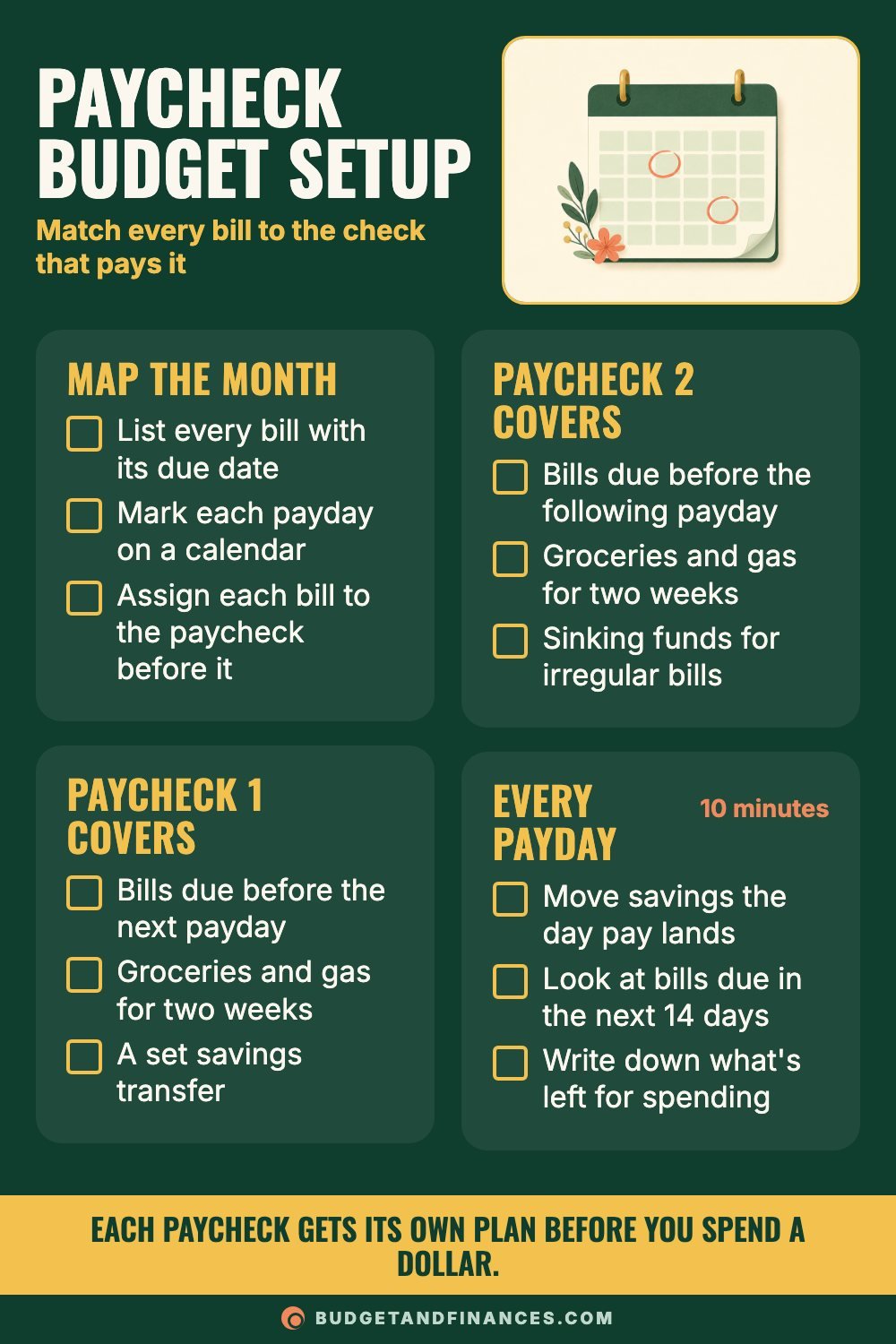
Step 1: Map the month
Start with a calendar and three lists.
- List every bill with its due date. Rent, utilities, phone, insurance, car payment, debt minimums, subscriptions.
- Mark each payday on the calendar.
- Assign each bill to the paycheck before it.
That last step is the heart of the method. A bill due on the 12th gets paid from the check that arrived before the 12th, not the one after.
If one paycheck ends up with far more bills than the other, you have two options. Split a big bill like rent across both checks, or ask a biller to move your due date so the load is more even.
Step 2: Plan paycheck 1
The first paycheck of the month covers:
- Bills due before the next payday
- Groceries and gas for two weeks
- A set savings transfer
Step 3: Plan paycheck 2
The second paycheck covers:
- Bills due before the following payday
- Groceries and gas for two weeks
- Sinking funds for irregular bills, like car registration, gifts or annual subscriptions
Step 4: Do a 10-minute check every payday
Each time you get paid:
- Move savings the day pay lands.
- Look at the bills due in the next 14 days.
- Write down what’s left for spending.
Your paycheck minus planned expenses should never go below zero. If it does, you’ve found a shortfall ahead of time, while you still have options.
A biweekly budget example: one $1,800 paycheck
Here’s a sample plan for a single biweekly take-home paycheck of $1,800:
| Category | Share | Amount | What it covers |
|---|---|---|---|
| Rent (half) | 38% | $684 | Half the month’s rent. The other half comes from the next check |
| Groceries | 17% | $306 | Two weeks of food and household basics |
| Gas | 8% | $144 | Two weeks of fill-ups |
| Utilities and phone | 10% | $180 | Whatever is due before the next payday |
| Savings | 10% | $180 | Emergency fund transfer on payday |
| Debt payment | 9% | $162 | Minimums due in the next two weeks |
| Fun and misc | 8% | $144 | Eating out, kids’ extras, small surprises |
| Total | 100% | $1,800 |
The rent line is the key move. Monthly rent in this example is $1,368. Instead of trying to pull all $1,368 out of one paycheck, each of the two checks sets aside $684. Neither one runs dry.
In practice, that means holding the first $684 in checking until the second check arrives, then paying rent in full. The same trick works for any bill that’s too big for one paycheck, like a car payment or insurance premium.
Your second paycheck plan will look similar, but the utilities and debt lines will change depending on which bills fall in those two weeks.
What to do with a third paycheck
Here’s a nice side effect of biweekly pay. Being paid every two weeks means 26 paychecks in most years. Since 12 months with two paychecks each only accounts for 24 of them, two months get a third paycheck.
In this example, that’s two extra checks of $1,800, or $3,600 a year that your regular budget doesn’t depend on.
Budget on two checks
Plan your monthly bills around two paychecks. That way the third one is truly extra instead of already spent.
Mark the dates now
Count your paydays on a calendar and circle the months with three. Knowing ahead of time lets you give the money a job before it arrives.
Good jobs for a third paycheck
- Pad the emergency fund. One extra paycheck can make a big dent in a starter emergency fund.
- Make an extra debt payment. Send it to your smallest balance or your highest interest rate debt.
- Fill sinking funds. Top up gifts, car repairs and yearly bills so they never land on a card.
- Get a month ahead. Hold it in checking to cover next month’s bills and break the paycheck scramble.
Get the free paycheck budget planner
The biweekly paycheck budget planner has fields at the top for the paycheck date, the amount, and your next payday. Below that are 14 rows with columns for the expense, its due date, the amount, and a box to check when it’s paid.
Fill one out every payday. It takes about 10 minutes.
Common mistakes
Assigning bills to the paycheck after they’re due. Always use the check that arrives before the due date, or you’ll be paying late.
Putting all of rent on one check. If rent takes most of one paycheck, the rest of those two weeks gets very tight. Split it.
Budgeting the third paycheck as regular income. If your normal plan needs three checks to work, the other ten months will fall short.
Forgetting irregular bills. Annual renewals, car registration and birthdays need sinking fund money from one check or the other.
Skipping the payday check-in. Due dates shift and surprise charges show up. The 10-minute review is what keeps the plan accurate.
FAQ
Is biweekly the same as twice a month?
No. Biweekly means every two weeks, which gives 26 paychecks in most years. Twice a month, or semimonthly, usually means two set dates each month, like the 1st and the 15th, which gives 24 paychecks and no three-paycheck months.
Does budgeting by paycheck work for weekly pay?
Yes. The idea is the same. Assign bills to the check that comes before them, and plan each week’s groceries and gas. Weekly pay also creates some months with five paychecks instead of four.
What if my paycheck amount changes from check to check?
Plan each check on the amount you actually received, not the amount you hope for. If overtime or extra shifts bring in more, give the extra a job on that payday, like savings or a sinking fund. If a check comes in short, look at your plan for that check first and trim the flexible lines, like fun money and eating out, before touching bills.
Do I need a separate account for money I’m holding for a bill?
It isn’t required, but it helps. If half of rent sits in your regular checking account for two weeks, it can look like spending money. Moving it to a separate account, or just writing the held amount at the top of your planner, keeps it from getting spent by accident.
Can I get out of budgeting by paycheck eventually?
Yes. Once you’ve built a month of expenses in checking, you can pay this month’s bills with last month’s money and plan monthly instead. A third paycheck is a good head start on that.