

Most people try to save money by picking one big budget category to cut and gritting their teeth. It usually lasts about two weeks.
There’s an easier way. Your budget has a lot of lines: rent, power, groceries, the car, your phone, streaming, eating out, clothes, gifts. Each one has a small leak you can fix without changing how you live.
This guide gives you one move per category, a checklist sorted by how often to do each thing, a list of “hacks” that quietly cost more, and a tracker so you can see the wins pile up.
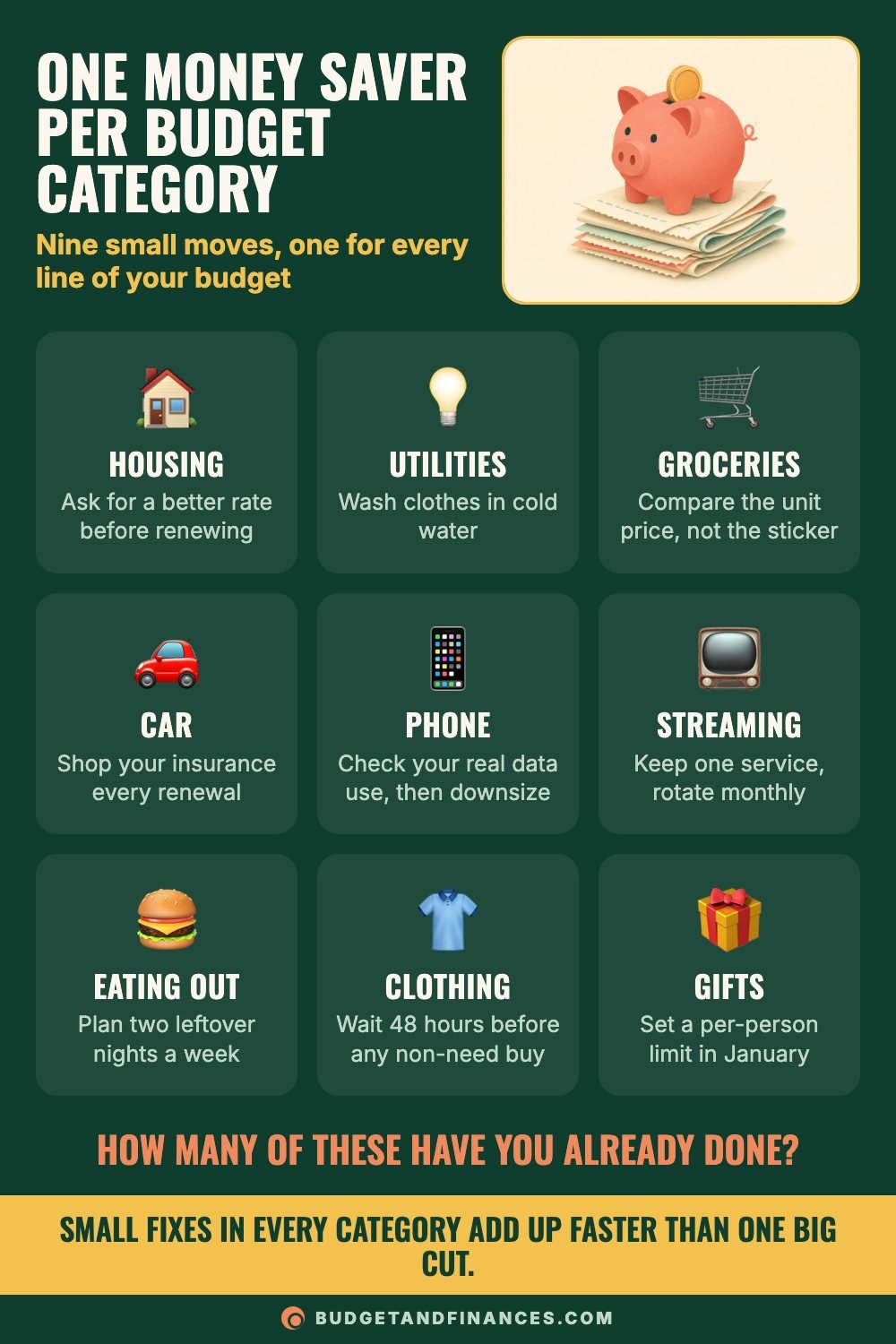
Step 1: Pick one move per budget category
You don’t need to do all nine this week. Pick the one that feels easiest and start there. Then add one a week.
Housing: ask before you renew
Before a lease renewal or insurance renewal, ask for a better rate. For renters, that can mean asking whether the increase is negotiable, especially if you’ve paid on time. For homeowners, it means getting quotes on your home insurance before it renews. The worst answer is no.
Utilities: wash clothes in cold water
Heating water is where a lot of a washer’s energy goes, and cold water gets everyday loads clean. Save hot water for heavily soiled items or anything the care label says needs it.
Groceries: compare the unit price
The sticker price tells you what the package costs. The unit price tells you what the food costs, per ounce or per count. That’s the number to compare. More on this in the example below.
Car: shop your insurance at every renewal
Your insurer doesn’t have to offer you its best price just because you stayed. Get a few quotes each time your policy is about to renew, and compare the same coverage levels side by side.
Phone: check your real data use
Look at your last few months of data use in your phone settings or your carrier account. If you use far less than your plan allows, a smaller plan may cost less.
Streaming: keep one, rotate monthly
Keep one streaming service at a time. When you finish what you wanted to watch, cancel and switch to the next one.
Eating out: plan two leftover nights a week
Cook enough on two nights to cover two more. Put the leftover nights on the calendar so they don’t turn into “nothing to eat, let’s order.”
Clothing: wait 48 hours
Any purchase that isn’t a need waits 48 hours. If you still want it after two days, buy it without guilt. Often you won’t remember it.
Gifts: set a per-person limit in January
Decide in January what you’ll spend per person for birthdays and holidays. Write the list down. December is much calmer when the numbers were set eleven months earlier.
Step 2: Put the habits on a schedule
Some money savers are one-time calls. Others only work if you repeat them. Sorting them by how often they happen keeps you from trying to do everything at once.
Once a year: your home
- Call your internet provider and ask for a lower rate.
- Shop your home or renters insurance at renewal.
- Check that your water heater is set to 120°F, a common recommended setting. Check your manual first if you have a reason to keep it higher.
- Sell or donate what you don’t use.
Every week: food
- Plan dinners before you shop.
- Shop with a list and stick to it.
- Eat what’s in the fridge before buying more.
- Pack lunch three days a week.
Every few months: transportation
- Compare car insurance quotes.
- Keep tires at the recommended pressure, which is usually listed on a sticker inside the driver’s door.
- Combine errands into one trip.
- Compare gas prices before you fill up.
Every quarter: bills and subscriptions
- List every recurring charge from your statements.
- Cancel anything you forgot you had.
- Downsize your phone plan to your real usage.
- Turn on autopay to avoid late fees, as long as you keep enough in checking to cover it.
Every purchase: shopping
- Use a 48-hour wait for wants.
- Unsubscribe from store marketing emails.
- Check the library or borrow before buying.
Step 3: Knock out the five-minute wins tonight
These take about five minutes each from the couch, and they keep working after you’re done.
- Turn off one-click checkout. An extra step at checkout gives you a few seconds to ask if you really need it.
- Unsubscribe from store emails. Fewer sale alerts in your inbox means fewer purchases you never planned.
- Scan last month’s statement. Look for charges that repeat and cancel the ones you forgot about.
- Set up automatic savings. Move a small amount on payday before you have a chance to spend it.
- Delete saved cards on sites. Remove stored payment info from the shopping sites you tend to browse when you’re bored.
- Check your phone data use. If you use far less than your plan allows, a smaller plan may cost less.
Step 4: Skip the hacks that backfire
Some “savings” cost you more. The test for all of them is the same: a deal only saves money if you’d have bought the thing anyway.
These actually save:
- Buying in bulk, but only what you always use.
- Store brand staples you’ve tested and like.
- Canceling a subscription you rarely open.
- Calling to ask for a better rate.
- Cooking a big batch and freezing portions.
These often backfire:
- Bulk packs of food that spoil before you finish them.
- Buying extra to reach a free shipping minimum.
- Free trials you forget to cancel.
- Store cards opened for one discount. They often carry high interest rates, and a balance can erase the discount quickly.
- Sale items you weren’t planning to buy.
Worked example: unit prices and a money saved log
Here’s the unit price math with sample shelf prices. Use the real prices at your store.
Say peanut butter comes in a 16-ounce jar for $2.00 and a 40-ounce jar for $5.49.
- 16 ounces: $2.00 ÷ 16 = 12.5 cents an ounce.
- 40 ounces: $5.49 ÷ 40 = about 13.7 cents an ounce.
The bigger jar costs more per ounce. Bigger isn’t always cheaper, which is why the unit price is the number to check.
Now the tracker. Say this month you canceled a $10.99 streaming service you rarely open and a $4.99 app you forgot about, and you returned an unworn shirt for a $24.00 refund. Your log looks like this:
| Date | What I did | Amount saved | Running total |
|---|---|---|---|
| 3rd | Canceled streaming service | $10.99 | $10.99 |
| 9th | Canceled forgotten app | $4.99 | $15.98 |
| 17th | Returned unworn shirt | $24.00 | $39.98 |
The two canceled subscriptions keep saving every month: $15.98 × 12 = $191.76 a year.
One rule for the tracker: only write down amounts you can see on a statement, a receipt or a bill. If you switched to cold water laundry, log the habit and leave the amount blank. Guessing makes the total feel good and tells you nothing.
Get the free Money Saved Tracker
The tracker has spaces for the month and your savings goal, then columns for the date, what you did, the amount saved and a running total. Stick it on the fridge or in your budget binder.
Common mistakes
Trying every tip in the first week. You’ll burn out. One category a week is plenty.
Counting savings you can’t see. Log real amounts from real statements. Estimates inflate the total and hide what’s working.
Letting saved money sit in checking. If you cancel a $10.99 charge and don’t move $10.99 somewhere, it tends to get spent on something else. Set up that automatic transfer.
Buying things to save money. Bulk packs, gadgets and store cards only help if they fit what you already buy.
Doing a big cleanup once and never again. Subscriptions and rates creep back. The quarterly and yearly checks are what keep the savings.
FAQ
What’s the fastest way to start saving money?
Scan last month’s bank and card statements for repeating charges and cancel the ones you don’t use. It takes a few minutes and the savings repeat every month.
Which budget category should I start with?
Start with whichever one annoys you most, or the one with the biggest monthly number. For many people that’s groceries or eating out, because those are weekly habits you control.
Do these tips work on a small income?
Yes. Most of them cost nothing: cold water laundry, a 48-hour wait, a meal plan, a phone call to ask for a lower rate. None require spending money first.
How often should I review my bills?
Recurring charges once a quarter, insurance at every renewal, and internet and phone once a year. Put reminders on your calendar so you don’t have to remember.
Is it worth calling to ask for a lower rate?
It costs you a phone call, and the worst answer is no. If you get a lower rate, write the new amount in your tracker and set a reminder to ask again next year.