

Utility bills are easy to ignore. They show up, autopay takes them, and you only notice when one is higher than you expected.
The good news is that a lot of the waste in a home costs nothing to fix. A dryer running extra minutes because of a clogged lint screen. A charger plugged in with nothing attached. Hot water heating up for a load that would be fine in cold.
This guide starts with free habits, walks you through the house room by room, and only then gets to things you’d buy. You’ll also learn how to read a year of bills so you can tell whether your changes are working.
Step 1: Start with free habit changes
These cost nothing and you can start tonight.
Wash laundry in cold water. Much of a washer’s energy goes to heating the water, and cold works for everyday loads.
Lower the water heater. Many are set higher than needed. 120°F is a common recommended setting. Check your manual before you change it, and keep it where it is if someone in your home has a medical reason for hotter water.
Unplug idle chargers. Chargers, game consoles and TVs on standby can draw power all day. A power strip you switch off makes this a one-second job.
Adjust the thermostat. A few degrees cooler in winter and a few degrees warmer in summer means your heating and cooling system works less.
Use curtains as insulation. Close them on hot summer afternoons. Open them on sunny winter days to let the sun warm the room.
Skip the heated dry. When the dishwasher finishes washing, open the door and let the dishes air dry.
Ask your utility company. Call and ask about free energy audits, rebates, or lower-rate hours in your area. Programs vary a lot by location, so ask directly.
Step 2: Walk the house room by room
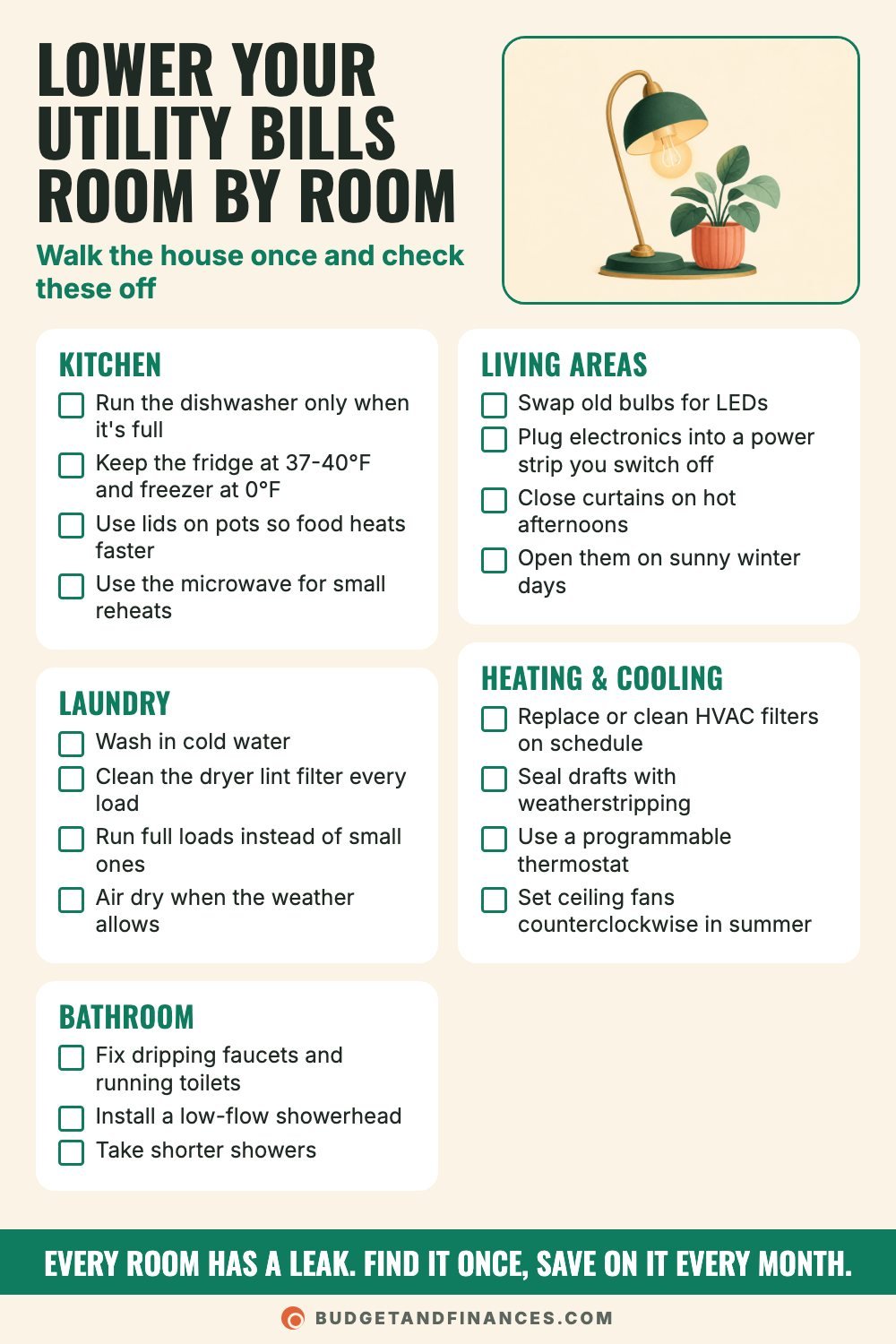
Take the checklist around your home once. Every room tends to have at least one small leak.
Kitchen
- Run the dishwasher only when it’s full.
- Keep the fridge at 37-40°F and the freezer at 0°F. Setting them much colder makes them work harder than they need to.
- Use lids on pots so food heats faster.
- Use the microwave for small reheats instead of the oven.
Laundry
- Wash in cold water.
- Clean the dryer lint filter every load. A clogged filter makes the dryer run longer.
- Run full loads instead of small ones.
- Air dry when the weather allows.
Bathroom
- Fix dripping faucets and running toilets. A running toilet wastes water all day and all night.
- Install a low-flow showerhead.
- Take shorter showers. Heating water uses a lot of energy.
Living areas
- Swap old bulbs for LEDs. If money is tight, replace them as the old ones burn out.
- Plug electronics into a power strip you switch off.
- Close curtains on hot afternoons.
- Open them on sunny winter days.
Heating and cooling
- Replace or clean HVAC filters on schedule. A dirty filter makes the system work harder.
- Seal drafts with weatherstripping. If you can feel air around a door on a cold day, that’s a gap worth sealing.
- Use a programmable thermostat.
- Set ceiling fans to run counterclockwise in summer so they push air down.
Step 3: Hunt for the nine common energy wasters
While you’re walking around, circle any of these you find:
- Standby electronics: TVs and consoles left in standby.
- Idle chargers: plugged in with nothing attached.
- Drafty doors: gaps you can feel on a cold day.
- Dirty air filter: makes heating and cooling work harder.
- Long hot showers: heating water uses a lot of energy.
- Running toilet: wastes water around the clock.
- Clogged lint filter: makes the dryer run longer.
- Old second fridge: running in the garage to chill a few drinks.
- Old bulbs: swap for LEDs as they burn out.
That second fridge is worth a hard look. If it mostly holds drinks, consider moving them into the main fridge and unplugging it.
Step 4: Spend in the right order
It’s easy to spend money trying to save money before you’ve done the free stuff. Follow this order instead.
- Free habit changes ($0). Cold water laundry and full loads only. Turn off lights and power strips when you leave. Adjust the thermostat a few degrees.
- Know your numbers ($0). Pull 12 months of bills from your utility accounts. Note your highest and lowest months. Call and ask about rebates or audits.
- Cheap fixes (under $50). Weatherstripping and door draft stoppers, LED bulbs in the lights you use most, and a low-flow showerhead.
- Mid-size upgrades (save up first). A programmable or smart thermostat, insulating curtains for drafty rooms, and insulation for exposed hot water pipes.
- Big replacements (when it’s time). When an old appliance dies, choose an efficient model, and check for utility or tax rebates before you buy.
Don’t replace a working appliance just to save on energy unless you’ve run the numbers. Step 5 is for when something needs replacing anyway.
Worked example: reading a year of electric bills
Step 2 says to pull 12 months of bills. Here’s what to do with them, using sample numbers. Plug in your own.
| Month | Electric |
|---|---|
| Jan | $142 |
| Feb | $131 |
| Mar | $104 |
| Apr | $88 |
| May | $91 |
| Jun | $126 |
| Jul | $158 |
| Aug | $164 |
| Sep | $119 |
| Oct | $92 |
| Nov | $101 |
| Dec | $137 |
Yearly total: add all twelve and you get $1,453.
Monthly average: $1,453 ÷ 12 = about $121.08. That’s a useful number if your utility offers budget billing, and it’s a realistic line for your budget.
Highest and lowest: August at $164, April at $88. That’s a $76 gap.
What the gap tells you: April and October are mild months with little heating or cooling, so they show roughly what the house uses for everything else. July and August together came to $158 + $164 = $322. At the April level, two months would be $88 × 2 = $176. The extra $146 is mostly the summer cooling load, which points you to the curtains, the thermostat and the fan direction first.
Then fill in the same months next year. Compare August to last August, not to April, because weather changes the bill more than anything else.
Get the free Utility Bill Tracker
The tracker has a spot for the year and a monthly goal, plus a row for each month with columns for electric, gas, water and internet. Fill it in when each bill arrives and the spikes jump out.
Common mistakes
Buying gadgets before trying free habits. A smart thermostat won’t help much if the doors are drafty and the filter is clogged.
Comparing a bill to last month instead of last year. January will almost always look worse than October. Compare the same month year over year.
Going too far on the thermostat. A few degrees is enough. Being miserable in your own home isn’t a plan you’ll keep.
Forgetting water. Leaks and running toilets don’t make noise on your electric bill, but they show up on the water bill.
Replacing working appliances too early. Efficient models are worth choosing when the old one dies. Swapping out a working one is a much bigger purchase to justify.
FAQ
What uses the most energy in a typical home?
Heating and cooling and water heating are usually the big ones, which is why the thermostat, the water heater and laundry temperature are the first places to look. Your own bills will show your pattern best.
Does unplugging chargers really help?
Chargers and electronics on standby can draw a small amount of power all day. Each one is small, so the easiest approach is a power strip you switch off for a whole group of devices.
What can renters do?
Almost all of the free habits and most cheap fixes work for renters: cold water laundry, curtains, LED bulbs, a power strip, door draft stoppers and a showerhead you can swap back when you move. Ask your landlord before anything permanent, and report leaks and running toilets.
Is a free energy audit worth it?
If your utility offers one, it costs nothing to ask. An audit can point out drafts and insulation problems you wouldn’t find on your own. Availability varies by area.
How do I know if my changes worked?
Track 12 months, then compare each month to the same month the year before. Weather and rate changes affect bills too, so look at your usage numbers on the bill, not just the dollar amount.