Your grocery bill is one of the few big budget lines you control every single week. That’s good news, because small habits show up on every receipt. For money-saving habits beyond the grocery store, see our frugal living tips.
Couponing works for some people, but it takes time and it can nudge you toward things you wouldn’t normally buy. You don’t need it.
This guide covers the everyday habits that lower the total, a before-during-after checklist for every trip, a sample $600 monthly grocery budget split by category, and a price book so you can spot real deals.
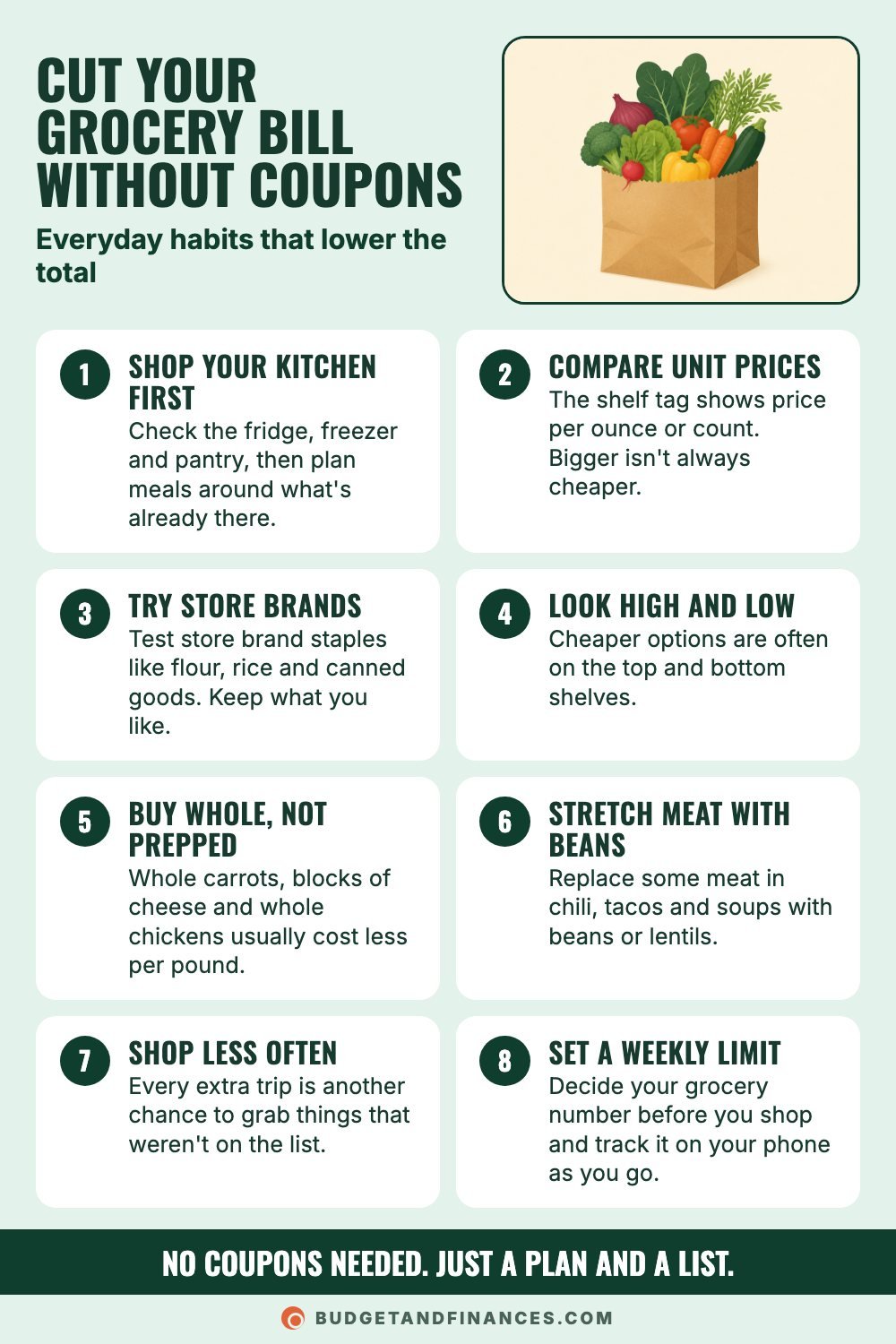
Eight habits that lower your grocery bill
1. Shop your kitchen first
Check the fridge, freezer and pantry, then plan meals around what’s already there. The cheapest groceries are the ones you already bought.
2. Compare unit prices
The shelf tag usually shows the price per ounce or per count. That’s the number to compare. Bigger isn’t always cheaper. If a tag doesn’t show it, divide the price by the size yourself.
3. Try store brands
Test store brand staples like flour, rice and canned goods. Keep the ones you like, and go back to the name brand for anything you don’t.
4. Look high and low
Cheaper options are often on the top and bottom shelves, so look past eye level before you grab the first brand you see.
5. Buy whole, not prepped
Whole carrots, blocks of cheese and whole chickens usually cost less per pound than baby carrots, shredded cheese and chicken breasts. You pay for the prep work.
6. Stretch meat with beans
Replace some of the meat in chili, tacos and soups with beans or lentils. The meal stays filling and the meat goes further.
7. Shop less often
Every extra trip is another chance to grab things that weren’t on the list. Aim for one planned trip a week.
8. Set a weekly limit
Decide your grocery number before you shop, and keep a running total on your phone as you go.
The grocery budget checklist
The grocery budget is mostly won at home, before you leave. Here’s a routine for every trip.
Before you go (at home)
- Check the fridge, freezer and pantry.
- Plan dinners for the week.
- Write a list grouped by store section.
- Set your spending limit.
- Eat something first.
In the store (stay on route)
- Stick to the list.
- Compare unit prices on the shelf tag.
- Check the high and low shelves.
- Keep a running total on your phone.
At checkout (last check)
- Watch prices as items scan.
- Put back anything not on the list.
- Save the receipt.
At home (same day)
- Log the total in your budget.
- Move older food to the front.
- Wash and prep produce.
- Freeze what you won’t use soon.
Habits that cost you more, and what to do instead
Your grocery bill follows your habits. Here are five common ones side by side with the swap.
| Costs you more | Saves you more |
|---|---|
| Shopping hungry | Eating before you shop |
| Several quick trips a week | One planned trip a week |
| Pre-cut and pre-washed produce | Whole produce you prep at home |
| Buying the eye-level brand | Checking the unit price on every shelf |
| Shopping without a meal plan | Planning meals around what you have |
Change one habit a week and watch your receipts.
How to split a grocery budget
Knowing what each category gets helps you shop with a plan. Here’s one way to split $600 a month. Adjust the percentages for your household.
- Produce, 25%: seasonal fruit and vegetables, frozen vegetables, potatoes.
- Protein, 25%: chicken, eggs, ground meat, beans, lentils.
- Grains and pantry, 15%: rice, pasta, oats, bread, flour, canned tomatoes.
- Dairy, 12%: milk, yogurt, cheese, butter.
- Snacks and drinks, 10%: coffee, popcorn, crackers, a few treats.
- Household basics, 8%: dish soap, trash bags, toilet paper.
- Buffer, 5%: stock-up deals and surprise needs.
The buffer matters. Without it, one good sale on something you use constantly blows the whole budget.
Keep a grocery price book
A price book is a list of what you actually pay for the groceries you buy most. Once you know your prices, you know a real sale when you see it.
For each item, write down:
- The item
- The size
- The price
- The unit price
- The date
Start with 10 to 15 things you buy every week or two. Use one page per store, since the printable has a spot for the store name at the top. After a month or two, you’ll know which store has the best regular price on your staples, and whether a “sale” is actually lower than usual.
Worked example: $600 a month, broken down
The category amounts
Each line is the percentage times $600:
| Category | % | Monthly | Weekly |
|---|---|---|---|
| Produce | 25% | $150 | $34.62 |
| Protein | 25% | $150 | $34.62 |
| Grains and pantry | 15% | $90 | $20.77 |
| Dairy | 12% | $72 | $16.62 |
| Snacks and drinks | 10% | $60 | $13.85 |
| Household basics | 8% | $48 | $11.08 |
| Buffer | 5% | $30 | $6.92 |
| Total | 100% | $600 | $138.46 |
The weekly column uses monthly × 12 ÷ 52, because a month is a bit longer than four weeks. $600 × 12 = $7,200 a year, and $7,200 ÷ 52 = about $138.46 a week. If you just divided $600 by 4, you’d get $150 a week, and $150 × 52 = $7,800, which is $600 over your yearly budget.
The weekly amounts are rounded to the cent, so the rows add up to $138.48 instead of $138.46.
A unit price check
Here’s the unit price math with sample shelf prices. Use the real prices at your store.
Say rice comes in a 32-ounce bag for $4.49 and a 64-ounce bag for $8.49.
- 32 ounces: $4.49 ÷ 32 = about 14.0 cents an ounce.
- 64 ounces: $8.49 ÷ 64 = about 13.3 cents an ounce.
Here the bigger bag is cheaper per ounce. Rice keeps a long time, so buying the bigger bag makes sense if you use rice often. For something that spoils, the smaller package can be the better deal even at a higher unit price.
Write both in your price book. Next time you see a “sale,” you’ll know whether it beats 13.3 cents an ounce.
Get the free Grocery Price Book
The printable has spots for the store and month, with columns for item, size, price, unit price and date. Keep it in your purse, car or kitchen drawer and fill it in from receipts.
Common mistakes
Dividing the monthly budget by four. Over a year, that lets you spend a whole extra month’s budget. Use monthly × 12 ÷ 52.
Buying big packages without checking the unit price. Sometimes the bigger size costs more per ounce.
Buying bulk food you won’t finish. The lowest unit price doesn’t help if half goes in the trash.
Shopping without a list “just for a few things.” Quick trips are where extras sneak in.
Not tracking the receipt. If you don’t log the total, you won’t know whether the changes are working.
FAQ
How much should I spend on groceries?
It depends on your household size, where you live and what you eat. Start by adding up your last month of grocery receipts, then set a slightly lower weekly limit and adjust from there.
How do I save on groceries without coupons?
Shop your kitchen first, plan meals, shop once a week with a list, compare unit prices, try store brands and buy whole instead of prepped. None of it requires clipping anything.
What is a unit price?
It’s the price per ounce, pound or count. It lets you compare different package sizes fairly. Many shelf tags show it. If yours doesn’t, divide the price by the size.
Are store brands as good as name brands?
Some are, some aren’t, and taste is personal. Test one staple at a time and keep the ones you like.
What’s a grocery price book?
A simple log of what you pay for the items you buy most, with the size, price, unit price and date. It shows you which store is cheapest for your staples and which sales are real.