Hobbies for adults are good for you. They give your evenings and weekends something to look forward to. They can also get expensive fast, especially when the excitement of a new hobby turns into a cart full of gear.
The fix is an order of operations. Try it cheap first, prove you like it, then spend a little at a time.
This guide gives you free and cheap hobby ideas sorted by type, the frugal version of common pricey hobbies, a step-by-step way to start any hobby on a small budget, and a tracker so you know what your hobbies really cost.
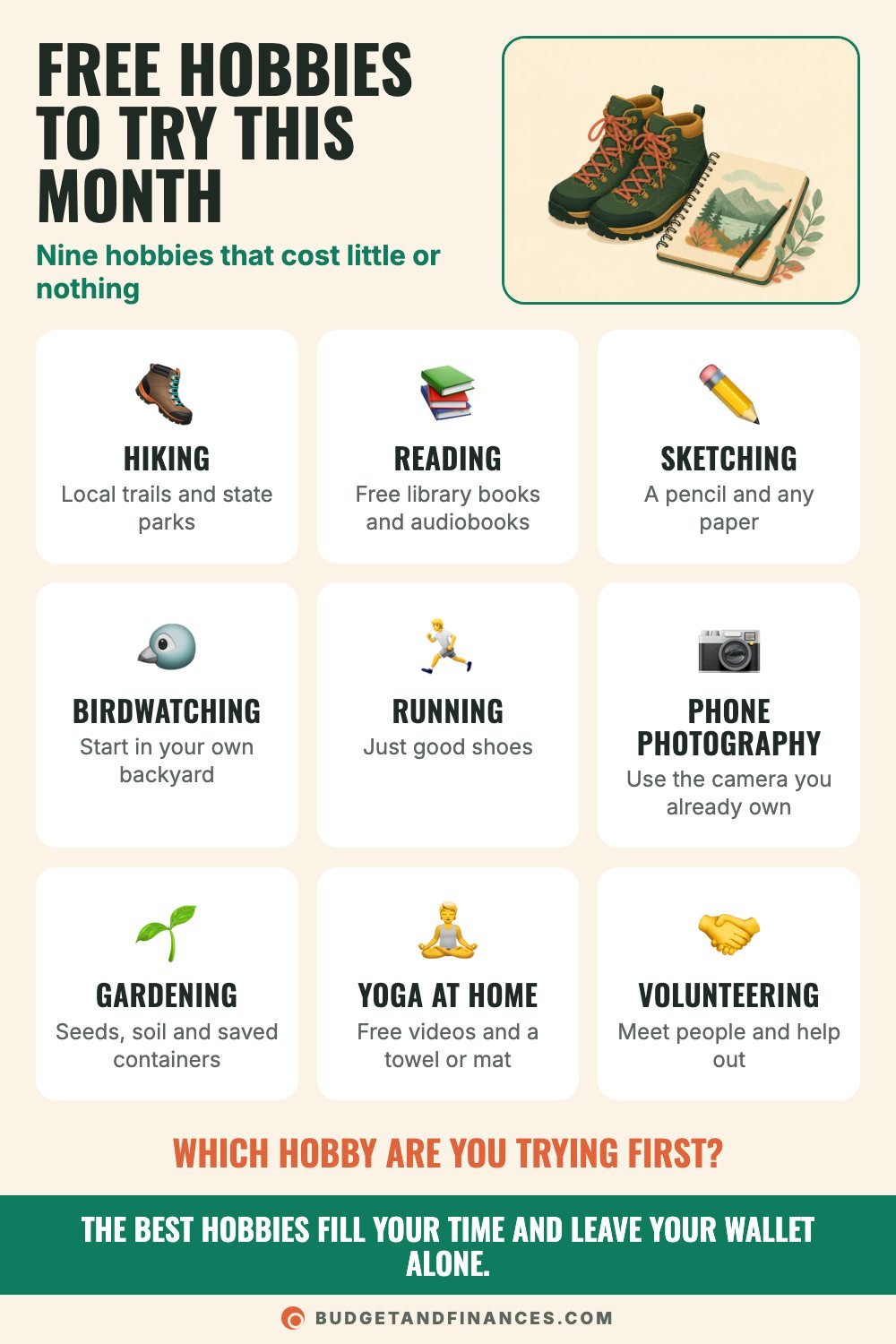
Nine free hobbies to try this month
Each of these costs little or nothing to start.
- Hiking: local trails and state parks.
- Reading: free library books and audiobooks.
- Sketching: a pencil and any paper.
- Birdwatching: start in your own backyard.
- Running: mostly just good shoes.
- Phone photography: use the camera you already own.
- Gardening: seeds, soil and saved containers.
- Yoga at home: free videos and a towel or mat.
- Volunteering: meet people and help out.
Some parks charge entry or parking fees, so check before you go. Many local trails are free.
Cheap hobbies sorted by type
If nothing above clicked, try picking one from each list and see what sticks.
Creative
- Drawing or watercolor painting
- Knitting or crochet
- Writing short stories or poems
- Mending and upcycling clothes
Outdoors
- Hiking and nature walks
- Gardening from seeds
- Stargazing
- Geocaching with your phone
Learning
- Learning a language with free apps
- Free online courses
- Learning to play an instrument you already own
- Genealogy with library resources
Social
- Board game nights
- A book club with library copies
- Community sports leagues
- Volunteering
At home
- Baking bread
- Puzzles swapped with friends
- Home workouts
- Cooking recipes from another country
The right hobby is the one you’ll actually do. It’s fine to try three and drop two.
Keep the hobby, lose the big bill
You don’t have to give up a hobby you love because it looks expensive. Most have a frugal version.
The pricey way (buy everything up front):
- A gym membership you rarely use.
- New craft kits for every project.
- A brand new bike and gear.
- Buying every book you want to read.
- Paid classes before you know you like it.
The frugal way (try first, upgrade later):
- Walking, running or free workout videos.
- Supplies from thrift stores or swaps.
- A used bike checked over by a local bike shop.
- Library holds and ebook apps.
- Free library or community workshops.
The rule behind all of it: prove you love a hobby before you pay for it.
How to start a new hobby without spending much
Follow these in order. Borrow, learn free, then buy used.
1. Borrow the gear first
Ask friends or family if they have supplies sitting unused in a closet. Plenty of people have a guitar, a sewing machine or a box of art supplies they’d happily lend.
2. Check the library
Many libraries lend more than books, and most have how-to books for popular hobbies. Ask what your branch offers.
3. Use free videos to learn
Watch beginner tutorials before you pay for any class. You’ll learn the basics and find out whether you enjoy it.
4. Set a starter budget
Decide on a small limit for the first month and stick to it. Write it at the top of your tracker so it’s in front of you.
5. Give it 30 days
If you still enjoy it after a month, then consider upgrading one item. One. The one that would make the biggest difference.
6. Buy used when you’re sure
Thrift stores and local resale groups often have hobby gear, sometimes from people who bought everything up front and quit. Check used items carefully, especially anything with safety parts like a bike’s brakes.
The 30-day check before you upgrade
When your first month is up, sit down with your tracker and answer four questions before you buy anything else.
- Did I actually do it? Count the sessions. A hobby you did twice is still an idea, not a habit.
- Did I look forward to it? If it started to feel like a chore, it’s fine to move on.
- What held me back? If a borrowed or cheap item kept getting in the way, that’s the one worth upgrading.
- Can I borrow or buy it used? Check with friends and local resale groups before you pay full price.
If you answered yes to the first two, pick one upgrade and add it to next month’s hobby budget. If not, return what you borrowed and try something else from the list.
Worked example: a $20 starter budget
Here’s how the tracker works with sample prices. Your prices will differ.
Say you want to try watercolor painting and set a $20 starter budget for the month. You borrow brushes from a friend, check out a how-to book from the library and buy two things.
| Date | Hobby | Item | Cost | Used it? |
|---|---|---|---|---|
| 2nd | Watercolor | Borrowed brushes | $0 | Yes |
| 2nd | Watercolor | Library how-to book | $0 | Yes |
| 4th | Watercolor | Watercolor paper | $8 | Yes |
| 4th | Watercolor | Used paint set, thrift store | $6 | Yes |
Spent: $8 + $6 = $14.
Left in the starter budget: $20 − $14 = $6.
Cost per session: if you painted 8 times that month, $14 ÷ 8 = $1.75 a session.
Now compare that with the cost-per-use math for something you pay for monthly. Say a membership costs $40 a month and you went twice. $40 ÷ 2 = $20 a visit. The same formula (cost divided by uses) shows you which spending is earning its spot.
After 30 days, if you still love painting, you might upgrade one item. If you don’t, you’re out $14 and you still have your own paper.
Get the free Hobby Budget Tracker
The tracker has spots for the month and your hobby budget, then columns for the date, hobby, item, cost and whether you actually used it. That last column is the one that keeps hobby spending honest.
Common mistakes
Buying the full setup on day one. The excitement of a new hobby is when spending is most tempting. Wait 30 days.
Paying for classes before trying free lessons. Free videos and library workshops can tell you whether you like something before you commit money.
Keeping memberships you don’t use. Run the cost-per-visit math. If it’s more than you’d pay for a single visit, reconsider.
Feeling guilty about any hobby spending. Hobbies are worth paying for. Just know the number and keep it in your budget.
Letting unused supplies pile up. Before starting a new hobby, finish or sell what’s left from the last one.
FAQ
What are some free hobbies for adults?
Hiking, reading library books, sketching, birdwatching, running, phone photography, home yoga and volunteering all cost little or nothing to start.
How much should I budget for a hobby?
Pick a small starter amount for the first month, and only raise it once you’ve stuck with the hobby for at least 30 days. The right number is whatever fits in your fun money without squeezing needs.
How do I try an expensive hobby cheaply?
Borrow gear, use free videos and library workshops, and buy used once you’re sure. For things like bikes, have a local shop check over a used one.
What are good social hobbies that don’t cost much?
Board game nights, a book club using library copies, community sports leagues and volunteering. Hosting at home keeps costs low for everyone.
Is it worth buying quality hobby gear?
Once you know you love the hobby, better gear can make sense, especially if cheap gear keeps breaking. Upgrade one item at a time and use cost per use to decide.