

The holiday season comes with a long list of holiday traditions that cost money. Light show tickets, photos with Santa, a big dinner out, new matching pajamas, gingerbread kits for everyone.
None of those are bad. But if money is tight, they can make December feel like a series of bills instead of a season your family looks forward to.
Here’s the good part. Kids remember what you did together, not what it cost. This guide covers free and cheap holiday traditions, how to swap pricey traditions for budget versions that keep the same feeling, and a 24-day plan you can print and fill in.
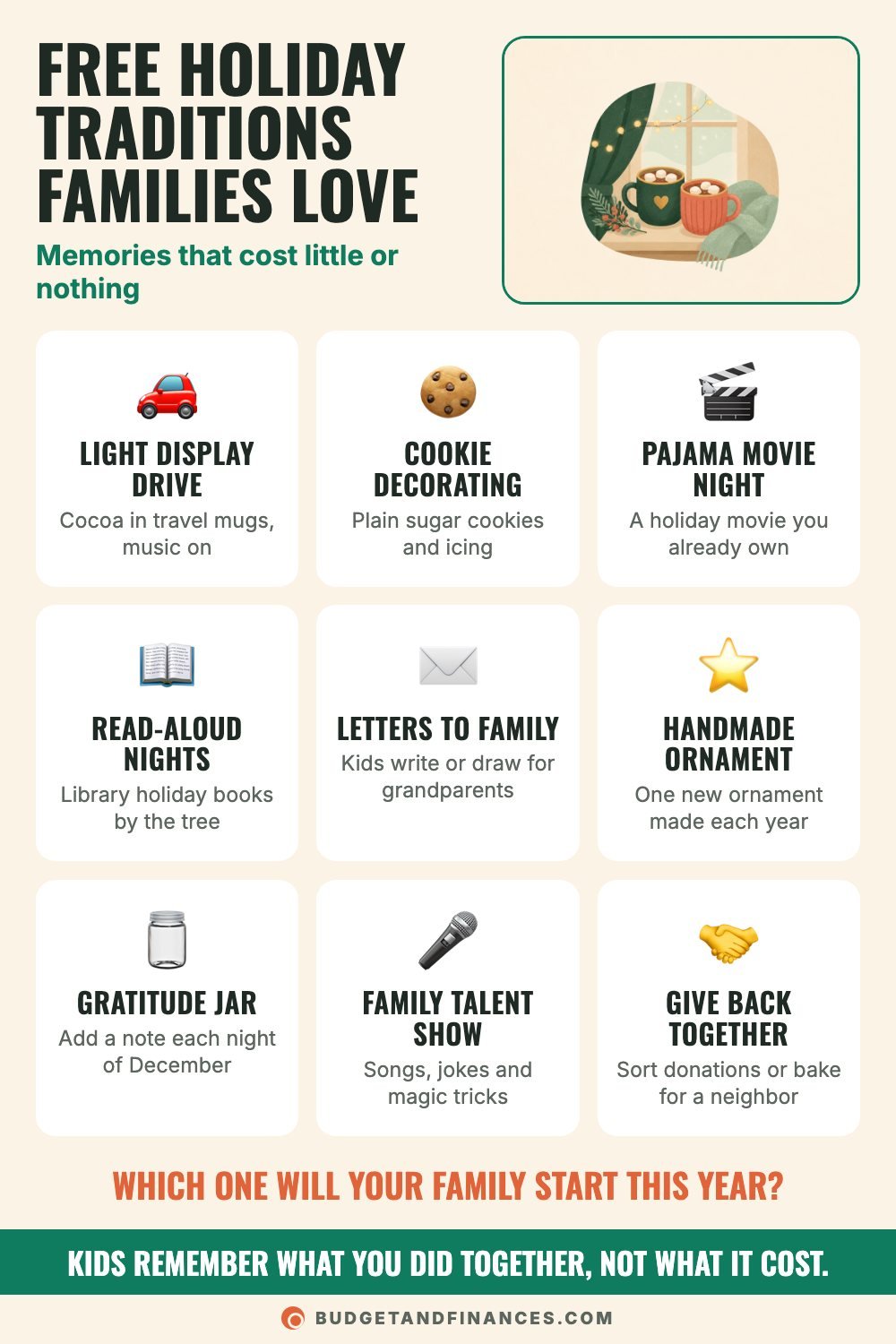
Nine free holiday traditions families love
These cost little or nothing, and most use things you already have.
Light display drive. Pour cocoa into travel mugs, turn on holiday music and drive or walk through the neighborhoods with the best lights.
Cookie decorating. Bake plain sugar cookies and set out icing and sprinkles. The decorating is the fun part, and messy cookies taste the same.
Pajama movie night. Pick a holiday movie you already own or can borrow, make popcorn and let everyone watch in pajamas.
Read-aloud nights. Borrow holiday books from the library and read one by the tree each night.
Letters to family. Kids write or draw something for grandparents, aunts and uncles. It costs a stamp, and it’s often the thing that gets saved.
Handmade ornament. Make one new ornament each year. Salt dough, paper or popsicle sticks all work. Write the year on the back and the collection grows with your kids.
Gratitude jar. Each night of December, everyone adds a note about something they’re thankful for. Read them together on Christmas Eve or New Year’s Eve.
Family talent show. Songs, jokes and magic tricks. Grandparents make a great audience, in person or on a video call.
Give back together. Sort outgrown toys for donation, or bake for a neighbor. Kids learn that the season includes other people.
A holiday bucket list on a budget
A bucket list gives the season shape without a big bill. Check off the fun and keep the money.
At home
- Build a blanket fort and watch a holiday movie.
- Make paper snowflakes for the windows.
- Have a candlelight dinner of breakfast food.
- Make popcorn garland for the tree.
Around town
- Walk a neighborhood with great lights.
- Go to a free community tree lighting.
- Visit the library’s holiday story time.
- Go sledding or take a winter nature walk.
Giving back
- Donate toys the kids have outgrown.
- Bake cookies for a neighbor or first responders.
- Make cards for a nursing home.
Just for fun
- Have a holiday music dance party.
- Take a family photo in matching pajamas.
- Leave a treat for the mail carrier.
Check your town’s website, library calendar and community boards in November. Many free events, like tree lightings and story times, get posted there first.
Pricey traditions vs budget swaps
Your kids want the moment. The price tag isn’t part of it. For most pricey traditions, there’s a budget version that keeps the feeling.
| The pricey version | The budget swap |
|---|---|
| Paid holiday light show tickets | Drive or walk a neighborhood with great lights |
| Store-bought gingerbread kit for everyone | Graham crackers, icing and leftover candy |
| Photos with Santa at a paid event | Family photos by your own tree |
| Big holiday dinner out at a restaurant | A cozy potluck at home |
| Brand-new matching pajamas every year | Matching pajamas passed down or thrifted |
Keep the tradition. Change how you do it.
A graham cracker “gingerbread” house is a good example. The kids still build, frost and decorate. They don’t care that the walls are crackers. One box of crackers and a batch of icing can cover the whole family instead of a kit per child, and the leftover crackers become snacks.
How to start a tradition that lasts
Repeat something once and it’s fun. Repeat it every year and it’s yours. A few things help a cheap tradition feel special.
Keep it simple
The best traditions are easy enough to repeat when life is busy. If it takes a full weekend of prep, it probably won’t survive a hard year.
Tie it to a day
The first snow, Christmas Eve, or the night the tree goes up. A tradition tied to a moment happens on its own, without planning.
Let kids help pick
They’ll look forward to a tradition they had a say in. Offer three or four choices and let them vote.
Save the evidence
Keep the ornaments, photos or gratitude notes in one box you bring out each year. Opening that box becomes its own tradition.
Use what you have
Your kitchen, your street and your library already hold plenty of fun. Start there before buying anything.
Don’t force it
If something feels like a chore, drop it and try something new next year. A tradition should be something your family wants to do again.
Worked example: a 24-day advent plan on a $40 budget
Here’s how one example family plans December 1 to 24 with one small tradition a day and a $40 budget for supplies.
The supply budget:
- Sugar cookie ingredients and icing: $12
- Graham crackers, icing and candy for “gingerbread” houses: $10
- Cocoa and marshmallows for the light drive and movie nights: $8
- Popcorn for garland and movie nights: $6
- Glue, string and craft paper for ornaments and cards: $4
That’s $12 + $10 + $8 + $6 + $4 = $40 for the whole month. Everything else uses things they own, the library or free community events.
The 24 days:
- Put up the tree and start the gratitude jar
- Make paper snowflakes for the windows
- Library trip for holiday books
- Read-aloud night by the tree
- Pajama movie night with popcorn
- Write letters to grandparents
- Winter nature walk
- Make a handmade ornament
- Free community tree lighting
- Holiday music dance party
- Sort outgrown toys to donate
- Blanket fort and a holiday movie
- Library holiday story time
- Bake sugar cookies
- Decorate the cookies
- Deliver cookies to a neighbor
- Make cards for a nursing home
- Popcorn garland for the tree
- Candlelight breakfast-for-dinner
- Light display drive with cocoa
- Build graham cracker houses
- Family talent show
- Family photo by the tree in pajamas
- Leave a treat for the mail carrier and read the gratitude jar
Twenty-four days of family time, and apart from a few stamps for the letters, the only spending is the $40 in supplies.
If 24 days is too much for your family, plan one tradition every few days instead. The calendar works just as well with blank days.
Free printable: advent tradition calendar
The calendar has 24 boxes, one for each day from December 1 to Christmas Eve. Write the month and your family name at the top. Then write one free tradition in each box and check it off together.
One small moment a day adds up to a whole season.
Common mistakes
Trying to do everything. A packed schedule turns fun into a to-do list. Pick the traditions your family enjoys most.
Assuming a tradition has to cost money to feel special. The feeling comes from repetition and time together.
Buying new supplies every year. Store ornaments, cookie cutters and craft supplies in a holiday box so you can reuse them.
Skipping the kids’ input. A tradition they chose is one they’ll ask for next year.
Waiting for the perfect year to start. Start small this year. A tradition only needs to be repeated to become one.
FAQ
What are some free Christmas traditions for families?
Driving or walking to see lights, read-aloud nights with library books, pajama movie nights with a movie you own, a gratitude jar, writing letters to family and making a handmade ornament each year.
How do I make holiday traditions feel special without spending money?
Tie them to a specific day, repeat them every year, and save something from each one, like a photo, ornament or note, in a box you bring out each season.
How do you start a new family tradition?
Pick something simple that you’d enjoy repeating, let the kids help choose, and tie it to a moment like the night the tree goes up. Then do it again next year.
What can we do instead of an expensive holiday outing?
Look for free community events like tree lightings and library story times, walk a neighborhood with great lights, or host a potluck at home instead of eating out.
Can older kids and teens enjoy cheap traditions too?
Yes. Let them pick or lead one, like planning the movie lineup, running the talent show or baking for neighbors. Giving them a role keeps it from feeling like a little-kid activity.