

When money feels tight every month, cutting back sounds simple. Then you try, and it turns into a vague promise to “spend less” that’s gone by the second weekend.
Cutting expenses works better with a list, some math and a plan for where the savings go. Otherwise the money you free up quietly gets spent on something else.
This guide gives you all three. A 30-day plan with one focus per week, the bills you can call and lower, small everyday cuts with the monthly math shown, and a checklist you can print and work through.
Quick cuts vs big cuts
Both help. They just work on different timelines.
Quick cuts: done in an afternoon
– Cancel unused subscriptions
– Set a weekly eating-out limit
– Switch to store brands
– Call to lower insurance or internet
– Smaller savings that start right away
Big cuts: more savings, more effort
– Move somewhere with lower rent
– Sell a car with a high payment
– Get a roommate or rent out a room
– Refinance a high-rate loan
– They take planning, but free up the most room
Start with quick cuts. Look at the big ones if you’re still short. Housing and transportation are usually the biggest lines in a budget, so they’re worth reviewing if quick cuts don’t close the gap.
The 30-day plan to cut monthly expenses
One focus each week, so it never feels like too much.
Week 1: See where it goes (days 1-7)
- Pull last month’s bank and card statements.
- Highlight every recurring charge.
Don’t cancel anything yet. Just find it all. Recurring charges hide on credit cards, in app stores and on accounts you rarely check.
Week 2: Cut the leaks (days 8-14)
- Cancel subscriptions you don’t use.
- Set a weekly limit for eating out.
A good test for subscriptions: if you didn’t use it last month, cancel it. You can always sign up again later.
Week 3: Lower fixed bills (days 15-21)
- Get new car and home insurance quotes.
- Call internet and phone providers for a better rate.
This is the week for phone calls. More on exactly what to ask below.
Week 4: Lock in the savings (days 22-30)
- Add up what you cut each month.
- Set an automatic transfer for that amount to savings.
This step is the one people skip, and it’s the one that matters most. Savings you don’t move on purpose tend to get spent.
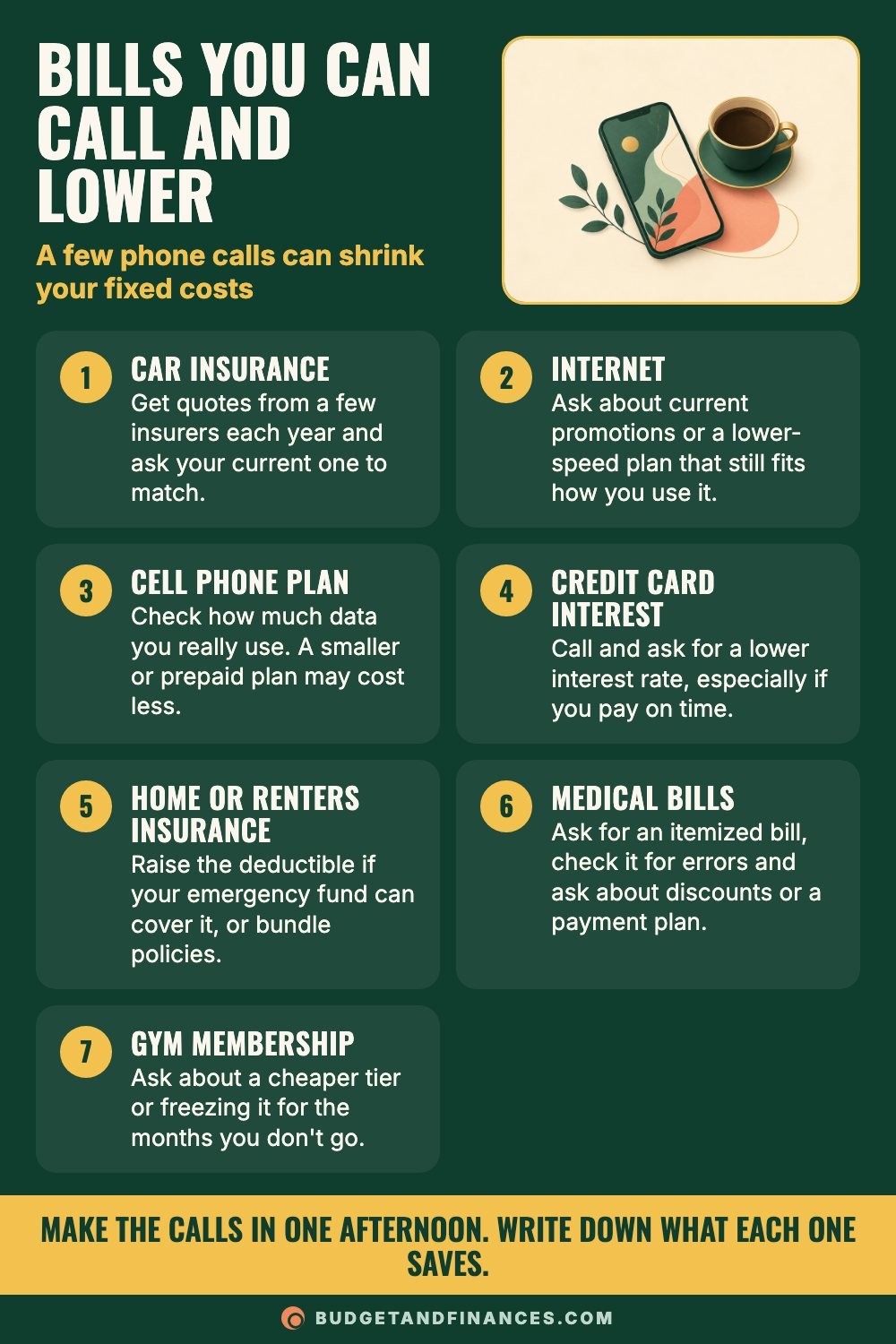
Bills you can call and lower
A few phone calls can shrink your fixed costs. Make the calls in one afternoon and write down what each one saves.
- Car insurance. Get quotes from a few insurers each year and ask your current one to match.
- Internet. Ask about current promotions or a lower-speed plan that still fits how you use it.
- Cell phone plan. Check how much data you really use. A smaller or prepaid plan may cost less.
- Credit card interest. Call and ask for a lower interest rate, especially if you pay on time.
- Home or renters insurance. Raise the deductible if your emergency fund can cover it, or bundle policies.
- Medical bills. Ask for an itemized bill, check it for errors and ask about discounts or a payment plan.
- Gym membership. Ask about a cheaper tier or freezing it for the months you don’t go.
What to say on the call
Keep it short and polite. Something like: “I’m reviewing my bills and I’d like to lower this one. Are there any promotions, cheaper plans or discounts I qualify for?”
If you have a lower quote from another company, mention the number. If the first person can’t help, ask if there’s someone else who handles plan changes or account retention.
Not every call will work. Write down the result either way, including “no change,” so you know which bills you’ve already checked.
Small cuts, real monthly math
Here’s what everyday changes are worth over a month. Each one shows the math, so you can swap in your own prices.
| Change | The math | Per month |
|---|---|---|
| Drop 2 streaming apps | 2 x $15 | $30 |
| Brew coffee at home | 12 fewer $5 coffees | $60 |
| Pack lunch 3x a week | 3 x 4 weeks x $10 | $120 |
| One less takeout night a week | 4 fewer $40 orders | $160 |
| Store brand swaps | $15 less x 4 trips | $60 |
| Smaller phone plan | $25 less x 2 lines | $50 |
| Wash the car at home | 2 x $15 washes | $30 |
| Skip 2 impulse buys | 2 x $25 | $50 |
| Cancel an unused gym | $40 a month | $40 |
Add up the ones you’d actually try. You don’t need all nine.
Worked example: three cuts, moved on payday
Say you pick three changes from the table: brewing coffee at home ($60), packing lunch three times a week ($120) and store brand swaps ($60).
That’s $240 a month. Over 12 months, it’s $2,880.
In week 4 of the plan, you set an automatic transfer of $240 a month to savings. If you’re paid twice a month, that’s $120 each payday.
Now say your week 3 calls also land a smaller phone plan, $25 less on each of 2 lines, which is $50 a month. Your total cut is $290 a month, or $3,480 a year. Raise the transfer to match.
The money only counts as saved once it’s moved. If it stays in checking, it usually finds a new place to go.
Monthly expense cutting checklist
Go through it once and see what you can trim. Work through one section a week if doing it all at once feels like a lot.
How to use the printable: check the box next to each item as you do it. Next to any item that saves money, write the monthly amount in the margin. At the end, add up the margin numbers. That total is your automatic savings transfer.
Subscriptions
– List every subscription on your statements.
– Cancel anything you didn’t use last month.
– Rotate streaming, one service at a time.
Food
– Meal plan before you shop.
– Shop with a list and stick to it.
– Cook double and eat leftovers for lunch.
– Set a weekly eating-out limit.
Home
– Adjust the thermostat a few degrees.
– Unplug electronics you rarely use.
– Wash clothes in cold water.
Car
– Combine errands into one trip.
– Compare car insurance quotes.
– Keep tires properly inflated.
Shopping
– Wait 48 hours before buying non-essentials.
– Unsubscribe from store emails.
– Delete saved cards from shopping sites.
Cut what you won’t miss first. Keep what you truly love.
Common mistakes
Cutting everything at once. A budget with no room for anything enjoyable rarely lasts. Pick the cuts you won’t miss.
Not moving the savings. If the money stays in checking, it tends to disappear. Set the transfer in week 4.
Skipping the phone calls. Calls feel awkward, but fixed bills repeat every month, so a lower rate keeps saving without any effort.
Raising an insurance deductible with no emergency fund. A lower premium doesn’t help if you can’t pay the deductible after a claim.
Ignoring the big lines. If quick cuts still leave you short, housing and transportation are where larger changes are possible.
FAQ
What expenses should I cut first?
Start with the ones you won’t miss: unused subscriptions, forgotten memberships and fees. Then look at bills you can lower with a phone call. Save lifestyle changes for after that.
How much can I save by cutting expenses?
It depends on your spending. Add up the changes you actually make. In the example above, three small cuts came to $240 a month, and adding a cheaper phone plan brought it to $290.
Is it worth calling to negotiate bills?
Often, yes, especially for insurance, internet, phone plans and credit card interest rates. It doesn’t always work, but a lower rate on a monthly bill keeps saving you money every month after.
What should I do with the money I save?
Decide before it arrives. Common choices are building an emergency fund, paying down debt or funding sinking funds for costs you know are coming. Set an automatic transfer so it actually happens.
This is general education, not personal financial advice.