It’s easy to feel behind with money. You scroll past someone’s new car or vacation photos and wonder what you’re doing wrong, even if you’re already financially stable.
But financial stability rarely looks exciting. It looks like bills paid on time, a balance that shrinks a little each month, and a surprise expense that doesn’t send you into a panic.
If you’ve been quietly doing some of those things, you may be further along than you give yourself credit for. Here’s how to tell, and how to find your next step.
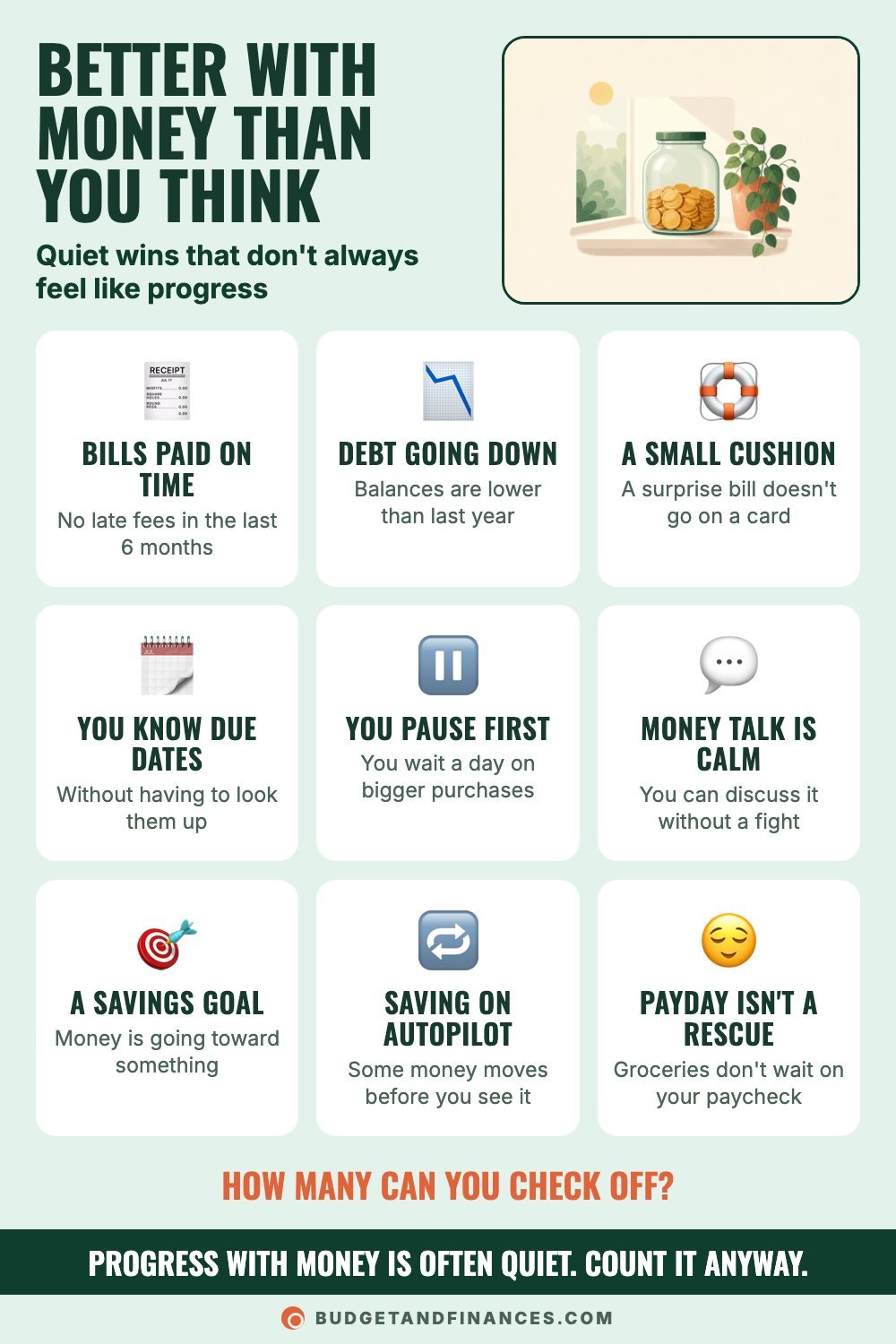
9 signs you’re better with money than you think
Count how many of these apply to you.
- Bills paid on time. No late fees in the last 6 months.
- Debt going down. Balances are lower than last year.
- A small cushion. A surprise bill doesn’t go on a card.
- You know your due dates. Without having to look them up.
- You pause first. You wait a day on bigger purchases.
- Money talk is calm. You can discuss it without a fight.
- A savings goal. Money is going toward something.
- Saving on autopilot. Some money moves before you see it.
- Payday isn’t a rescue. Groceries don’t wait on your paycheck.
Even two or three of these is real progress. Each one is a habit that took effort to build.
Looking well off vs actually stable
A lot of the pressure comes from comparing. And what you can see from the outside is usually spending, not saving.
| Looks well off | Actually stable |
|---|---|
| New car with a big monthly payment | Older car that’s fully paid off |
| Designer items on a credit card | Buys quality, pays in cash |
| Every weekend booked with plans | Some quiet weekends at home |
| Upgrades the phone every year | Emergency fund covers a few months |
| One missed paycheck from trouble | Can handle a surprise bill calmly |
The spending shows. The saving doesn’t. Stability usually looks boring from the outside, and that’s fine. Don’t compare your bank account to someone’s photos.
The five stages of financial stability
Stability doesn’t happen all at once. It’s easier to think of it in stages. Find where you are, then aim for the next one.
Stage 1: Surviving
- Some bills are paid late.
- There’s no money left before payday.
If this is you, the goal is getting current. List every bill with its due date, set autopay for minimums where you can, and see if any due dates can be moved closer to your payday.
Stage 2: Catching up
- All bills are current and paid on time.
- You have a simple budget you mostly follow.
This is a big step, even if it doesn’t feel like one. Next up is a small savings cushion.
Stage 3: Steady
- A $1,000 starter emergency fund is saved.
- You’re paying down high-interest debt.
The starter fund keeps small emergencies from becoming new debt. With that in place, extra money can go toward the highest-cost balances.
Stage 4: Stable
- 3 to 6 months of expenses are saved.
- No credit card balance is carried over month to month.
At this stage, a job loss or a large repair is stressful, but it isn’t a crisis.
Stage 5: Secure
- You’re saving for retirement every month.
- Money is set aside for yearly costs.
Here, your money is working on the long term, and predictable costs like gifts and car registration are planned for.
Every stage counts. Moving up one is a real win.
The financial stability self-check
Answer yes or no to each of these. Be honest, not harsh.
Cash flow
– I spend less than I bring home most months.
– I know roughly what my bills total each month.
– I rarely use a card to cover basics.
Safety net
– I have at least $1,000 set aside for emergencies.
– My emergency money is separate from checking.
– I’m building toward 3 to 6 months of expenses.
Debt
– I pay every bill by its due date.
– My total debt is lower than a year ago.
– I have a plan for paying off each balance.
The future
– I save something for retirement.
– I save ahead for yearly costs like gifts.
– I could say what my net worth is.
Every no just shows you the next step to take.
A worked example: turning the self-check into a plan
Here’s a sample of how someone might use it. The numbers are made up for illustration.
Say your essential expenses (rent, utilities, groceries, insurance, transportation and minimum debt payments) come to $3,000 a month. You answer the self-check and get 8 yeses out of 12.
Your yeses: you spend less than you earn, you know your bill total, you rarely use a card for basics, you have $1,000 set aside, that money is in a separate account, you pay bills on time, your debt is lower than last year, and you save a little for retirement.
Your nos: you aren’t building toward a full emergency fund yet, you don’t have a payoff plan for each balance, you don’t save for yearly costs, and you couldn’t name your net worth.
That puts you in Stage 3: Steady. Here’s how the nos become a to-do list:
- Full emergency fund. 3 months of $3,000 is $9,000. 6 months is $18,000. Your first target is $9,000.
- Debt plan. List each balance with its rate and pick a method: smallest balance first (snowball) or highest rate first (avalanche).
- Yearly costs. If gifts and car registration total $720 a year, that’s $720 / 12 = $60 a month into a sinking fund.
- Net worth. Spend 20 minutes adding up what you own and subtracting what you owe.
Eight out of twelve isn’t a failing grade. It’s a clear picture with four specific next steps.
Money wins people forget to count
Progress is made of small moves. Give yourself credit for these.
- You checked your balance. Looking at your accounts without dread is a skill.
- You said no to a purchase. That money stays available for something you chose.
- You paid a bill early. No late fee, and one less thing on your mind this week.
- You cooked instead of ordering. A home meal usually costs less than delivery, and those gaps add up over a month.
- You asked about a fee. Calling to question a charge or ask for a lower rate is a real money move.
- You saved any amount. $10 in savings is more than $0. The habit matters more than the size at first.
- You made a plan. Writing down a budget or a goal, even a rough one, puts you ahead of guessing.
Common mistakes
Measuring yourself against other people’s spending. You can see their purchases, not their balances. Compare yourself to where you were last year.
Waiting to feel stable before calling it progress. Feelings lag behind numbers. Look at the facts: late fees, balances, savings.
Skipping the starter fund to throw everything at debt. With no cushion, one emergency can add new debt and undo months of work.
Treating a setback as starting over. Using your emergency fund for an emergency means it worked. Rebuild it and keep going.
Being harsh on the self-check. A “no” is information, not a judgment.
FAQ
What does it mean to be financially stable?
A practical definition: your bills are paid on time, you spend less than you earn, you have savings that can absorb a surprise, and your debt is under control and shrinking. It doesn’t require a high income.
How much money do I need to be financially stable?
There’s no single number, since it depends on your expenses. A common target is an emergency fund of 3 to 6 months of essential expenses, no credit card balance carried month to month, and regular retirement saving.
Why don’t I feel stable even though I’m doing okay?
Stability tends to feel like nothing happening, so it’s easy to miss. Comparing yourself to what others spend can also make it feel smaller. Tracking a few numbers, like debt and savings, makes progress visible.
Can I be financially stable with debt?
Yes. Many stable households carry a mortgage or car loan. What matters is that payments are on time, affordable, and part of a plan, and that high-interest card debt isn’t growing.
What should I work on first?
Use the stages. If bills are late, get current. If you’re current, build a $1,000 starter fund. Then high-interest debt, then 3 to 6 months of expenses, then long-term saving.
Progress with money is often quiet. Count it anyway. This is general education, not personal financial advice.