

Saving money for “someday” is hard. There’s no finish line, so every other expense wins without a savings goal tracker to hold the line.
A savings tracker gives the money a name, a number and a date. You write the goal at the top, log every deposit, and watch the total climb while the amount left to go shrinks.
This guide walks through three free printables: a savings goal tracker, a 30-day savings habit calendar and a $1,000 color-in chart. You’ll see how to set each one up, how to do the math, and a filled-in example.
What’s in the savings tracker set
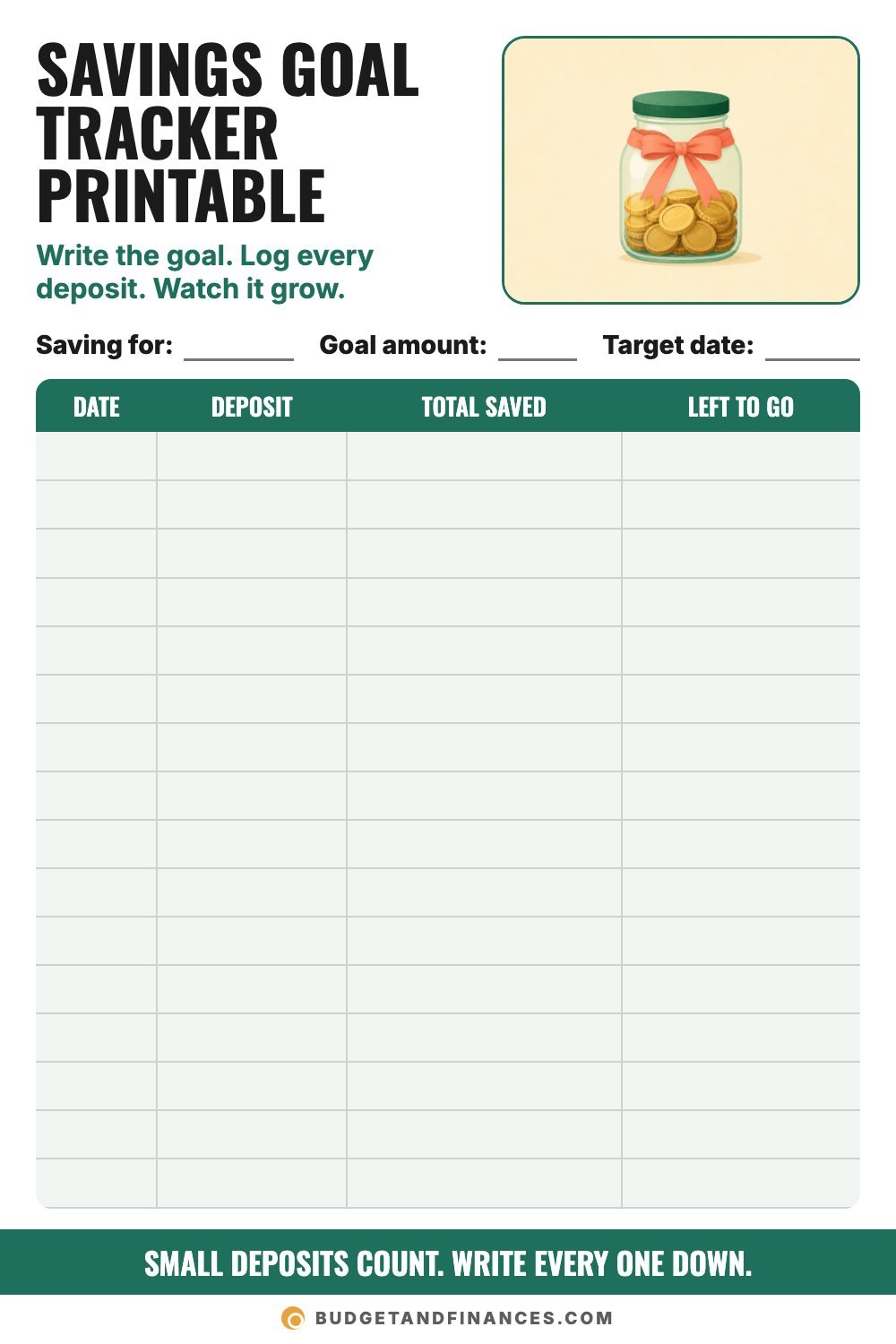
- Savings goal tracker. For one specific goal, like a trip or a car. Log each deposit and your running total.
- 30-day savings habit tracker. A calendar you color in every day you save something. For building the habit.
- $1,000 savings chart. Forty boxes at $25 each. Color one in every time you save $25.
If you’re starting from nothing, the habit calendar is a gentle place to begin. If you already have a goal in mind, start with the goal tracker.
Before your first deposit: set up the tracker
A goal with a number and a date is a plan. Work through this checklist first.
Pick the goal
- Choose one clear goal to start. One goal gets done faster than three at once.
- Write the exact amount you need. Look up real prices instead of guessing.
- Pick a realistic target date.
Do the math
- Divide the amount by the months until the date. That’s your monthly savings number.
- Split it by paycheck if that’s easier.
- Move the date if the amount is too high.
Set it up
- Pick a separate savings account, so goal money isn’t sitting in checking.
- Schedule an automatic transfer on payday.
- Print the tracker and write in the goal.
Keep it going
- Log each deposit the day you make it.
- Check your progress once a month.
- Plan a small reward at milestones, paid in cash, like at the halfway point.
How to fill in the savings goal tracker
The top fields
- Saving for: the goal in a few words. “Beach trip in June” works better than “vacation.”
- Goal amount: the total you need.
- Target date: the date you want to have it saved.
The columns
The tracker has 16 rows and four columns.
- Date: the day you made the deposit.
- Deposit: how much you added this time.
- Total saved: your previous total plus this deposit.
- Left to go: the goal amount minus your total saved.
Check the Total saved column against your savings account balance once a month. If they don’t match, the account balance is the one to trust.
Worked example: a $1,200 goal
Say you’re saving $1,200 for a trip, and your target date is 12 months away.
The math: $1,200 divided by 12 months is $100 a month. If you’re paid twice a month, that’s $50 a paycheck, since 24 paychecks at $50 is also $1,200.
Here are the first few rows of the tracker, with one tax refund added in month 3:
| Date | Deposit | Total saved | Left to go |
|---|---|---|---|
| Month 1 | $100 | $100 | $1,100 |
| Month 2 | $100 | $200 | $1,000 |
| Month 3 | $100 | $300 | $900 |
| Month 3 (refund) | $150 | $450 | $750 |
| Month 4 | $100 | $550 | $650 |
That extra $150 put you a month and a half ahead. At $100 a month, the remaining $650 takes 6 more full deposits and a $50 one, so you’d finish in month 11 instead of month 12.
When the monthly number is too high
Say the goal is $3,000 in 6 months. That’s $500 a month, which may not fit your budget.
You have three choices: lower the cost, move the date, or free up money somewhere else for a while. Moving the date to 12 months cuts the monthly amount to $250.
How to use the 30-day savings habit tracker
Build the habit first. The amount can grow later.
Top fields: Month and Goal. The goal here can be a habit (“save every weekday”) or an amount.
Filling it in: color in every day you move money to savings, even $1. Leave the other days blank.
Small amounts still add up. Saving $1 a day for 30 days is $30. Saving $5 a day for 30 days is $150.
After a month, look at the pattern. If you missed the same days every week, like weekends, plan a transfer for Friday instead.
How to use the $1,000 savings chart
The chart has 40 boxes worth $25 each. 40 boxes x $25 = $1,000.
Every time you save $25, color in one box. You can fill them in any order.
- One box a week gets you to $1,000 in 40 weeks.
- Two boxes a week ($50 a week) gets you there in 20 weeks.
This chart pairs well with the goal tracker. Use the tracker for exact dates and totals, and hang the chart on the fridge where everyone can see it filling up.
How to actually hit your savings goal
Goal, date, monthly amount. Then let the tracker keep score.
- Give the goal a name and date. Saving for a trip in June is easier to stick with than saving for someday.
- Do the math up front. Divide the goal by the months you have. $1,200 over 12 months is $100 a month.
- Save on payday. Move the money when your paycheck lands, before it gets spent on other things.
- Automate the transfer. Set a repeating transfer to savings so it happens even on busy weeks.
- Use a separate account. Keep goal money out of checking so it’s harder to spend by accident.
- Log it the same day. Update your tracker when you deposit. A current total keeps you motivated.
- Add windfalls. Put part of any refund, rebate or bonus toward the goal and write it down.
Common mistakes
Saving for too many goals at once. Each one moves slowly and none feels close. Start with one, or two at most.
Saving whatever is left at the end of the month. There’s usually nothing left. Move the money on payday instead.
Forgetting to log deposits. A tracker that’s two months behind stops being motivating. Update it the same day.
Keeping goal money in checking. It blends in with spending money. A separate account makes the total real.
Giving up after a missed month. Skip the guilt, write a $0 row if you want, and make the next deposit.
FAQ
How much should I save each month for a goal?
Divide the goal amount by the number of months until your target date. A $1,200 goal in 12 months is $100 a month. If that’s too much, move the date or lower the goal.
Should I use a separate savings account for each goal?
It can help, but it isn’t required. One savings account works fine if you track each goal on its own tracker sheet so you know how much belongs to what.
What’s a good first savings goal?
Many people start with a $1,000 starter emergency fund. The $1,000 chart in this set works well for it.
What if I can only save a few dollars at a time?
Start with the 30-day habit tracker. The habit of saving something every day matters more than the amount at first, and you can raise it as your budget allows.