

“How much should a family of four spend on groceries?” sounds like it should have a simple answer. The honest answer is that it depends, and that answer frustrates everyone.
Two families of four can spend very different amounts and both be doing fine. Teenagers eat more than toddlers. Food costs more in some places. A family that packs every lunch buys more groceries than one that eats out.
So instead of handing you a number that might not fit, this guide shows you how to find yours. You’ll get a 4-week method, an example $800 budget split, and tips for feeding a bigger family for less.
What sets your grocery budget
Before you pick a number, look at what pushes yours up or down. Here are nine things that matter more than family size alone.
- Household size. Count everyone who eats most meals at home.
- Kids’ ages. Teens can eat as much as adults. A toddler’s share is much smaller.
- Where you live. Food prices vary by region, and even between stores in the same town.
- Dietary needs. Allergies and special diets often add cost.
- Eating out. Less takeout means more grocery spending. That’s a good trade, but it raises this line.
- Packed lunches. School and work lunches add up at the grocery store.
- Cooking from scratch. Usually cheaper than ready-made meals.
- Where you shop. Discount grocers often cost less for the same basics.
- Storage space. Room for bulk buys lowers unit prices over time.
Which of these push your number up? Write them down. They explain why your budget won’t match a neighbor’s, and that’s fine.
What about official food plan numbers?
The USDA publishes monthly cost estimates for feeding households at a few different spending levels, and it updates them regularly. They can be a useful reference point.
If you use them, look up the current report yourself rather than trusting a number you saw on social media, since the figures change. Then check that number against your own receipts. Your receipts are the better guide for your family.
Find your real grocery budget in 4 weeks
This method works for any family size. It takes one month and very little effort.
Week 1: Save every receipt
Change nothing about how you shop. Keep every food receipt, even the quick trip for milk. Note how many people ate at home that week, since a week with guests or a week away will look different.
Week 2: Keep tracking
Write down last week’s total. Keep saving receipts, and include the things that are easy to forget: snacks, coffee runs, and food from the drugstore or gas station.
Week 3: Spot the leaks
Look back over your receipts. Circle food that got thrown out. Mark impulse buys and anything you bought twice because you didn’t know you had it.
Week 4: Do the math
Add all four weeks together and divide by 4. That’s your average week. Then trim about 10% for your weekly goal. The trim comes from the leaks you found in week 3, not from cutting the food your family needs.
Month 2: Shop with a weekly limit
Use cash or one card for groceries only, so the total is easy to see. Redo the math if your household changes, like a teen who starts eating double or a family member moving in.
Worked example: from receipts to a weekly budget
Here’s how the math looks for an example family of four.
Their four weeks of receipts came to:
- Week 1: $212
- Week 2: $198
- Week 3: $215
- Week 4: $195
That adds up to $820. Divided by 4, the average week is $205.
Trimming 10% gives $184.50. They round it to $185 a week.
Here’s a detail that trips people up. A month is a little longer than four weeks. Over a year, $185 a week is $185 × 52 = $9,620. Divided by 12 months, that’s about $802 a month. So their weekly limit lines up closely with an $800 monthly grocery budget.
These numbers are an example. Your receipts will tell you your own.
Example $800 grocery budget breakdown
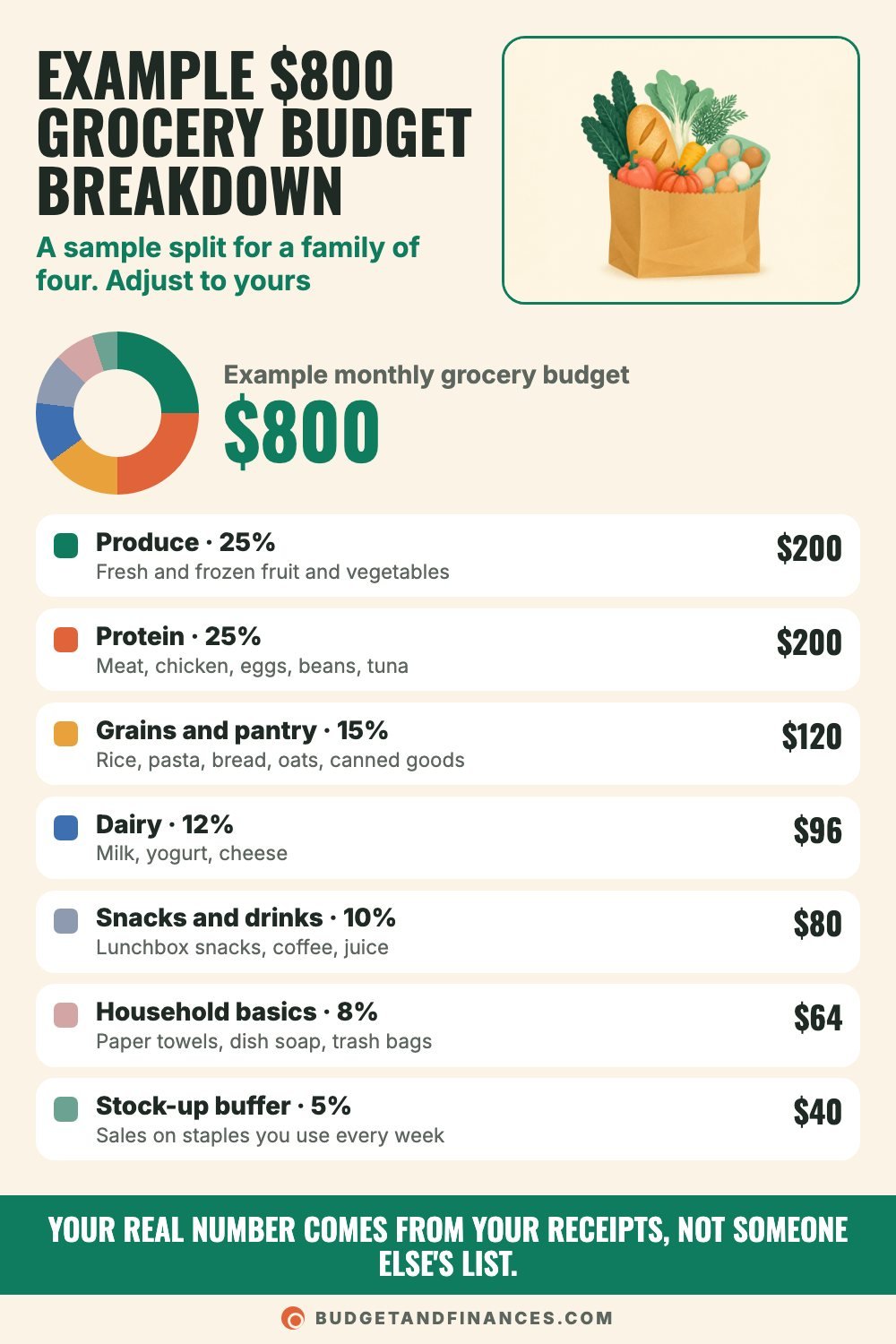
Once you know your monthly number, splitting it into categories shows where the money goes. Here’s one sample split of $800 for a family of four. Adjust it to yours.
| Category | Share | Amount | Examples |
|---|---|---|---|
| Produce | 25% | $200 | Fresh and frozen fruit and vegetables |
| Protein | 25% | $200 | Meat, chicken, eggs, beans, tuna |
| Grains and pantry | 15% | $120 | Rice, pasta, bread, oats, canned goods |
| Dairy | 12% | $96 | Milk, yogurt, cheese |
| Snacks and drinks | 10% | $80 | Lunchbox snacks, coffee, juice |
| Household basics | 8% | $64 | Paper towels, dish soap, trash bags |
| Stock-up buffer | 5% | $40 | Sales on staples you use every week |
| Total | 100% | $800 |
A few notes on this split:
- Household basics are included because they usually land on the same receipt. If you buy them somewhere else, move that $64 out and lower your grocery number.
- The stock-up buffer is for sales on things you already buy weekly. If there’s no good sale, roll it into next month.
- Your percentages will differ. A family with a vegetarian diet might spend less on protein and more on produce.
Your real number comes from your receipts, not someone else’s list.
Tracking each trip during the week
Tracking as you go is what keeps the weekly limit real. Write down every trip and what’s left.
Using the $185 example:
| Date | Store | Spent | Left |
|---|---|---|---|
| Sunday | Main shop | $92.40 | $92.60 |
| Wednesday | Top-up | $61.15 | $31.45 |
| Friday | Milk and bread | $24.80 | $6.65 |
With $6.65 left on Friday, this family knows the weekend is for pantry meals. No guessing, no surprise at the end of the month.
How to feed a bigger family for less
More people at the table means planning pays off even more. These habits work for families of four, five, six, or more.
Cook once, eat twice
Double a recipe and plan the leftovers as lunch or a second dinner that week.
Stretch meat with beans
Swap half the ground meat in tacos or chili for beans or lentils. Most people barely notice.
Check the unit price
Bigger packs are often cheaper per ounce, but not always. The shelf tag tells you.
Serve a filling side
Rice, potatoes, bread, or pasta helps everyone fill up for less.
Portion the snacks
Split snacks into bins for the week so a big box doesn’t vanish in two days.
Shop your pantry first
Plan two meals a week around what’s already in the cupboard and freezer.
Have a leftovers night
One night a week, everyone eats what’s left. No new groceries needed.
Free printable: weekly grocery budget tracker
The tracker has spaces for people at home, your weekly budget, and the month, plus columns for Date, Store, Spent, and Left. Keep it on the fridge and fill it in after every trip.
After a month, you’ll have your real grocery number in your own handwriting.
Common mistakes
Copying another family’s number. Their kids’ ages, location, and eating-out habits aren’t yours.
Forgetting the small trips. The gas station milk and the drive-through coffee count. Leaving them out makes your budget look lower than it is.
Cutting too hard in month one. A 10% trim is realistic. Cutting a third of your spending overnight usually ends with a big catch-up shop.
Treating a month as four weeks. Most months are longer. Multiply your weekly number by 52 and divide by 12 for a monthly figure.
Never redoing the math. Kids grow, prices change, and households shift. Recheck your number every few months.
FAQ
How much should a family of four spend on groceries?
It depends on your area, kids’ ages, diet, and how often you eat out. The most reliable way to find your number is to track four weeks of receipts, average them, and trim about 10%.
Should household items be part of the grocery budget?
If you buy them on the same trip, including them is simpler. The example $800 budget includes 8% for basics like paper towels and dish soap. Just be consistent.
How do I lower my grocery budget quickly?
Start with the leaks: food thrown out, doubles, and impulse buys. Then add a leftovers night and plan two meals a week from the pantry.
Does a bigger family always spend more?
Usually more in total, though the cost per person can drop as you buy larger packs and cook bigger batches. Teens and special diets can push it back up.
What if my grocery budget runs out before the week ends?
Use what’s in the pantry and freezer until the next week starts. Then look at the tracker to see which trip pushed you over, and plan for it next week.