
“Financial freedom” can sound like something for other people. People with big salaries, or people who already have it figured out.
In practice, it’s a series of ordinary steps done in a sensible order. Catch up on bills. Save a little. Pay off the expensive debt. Save more. Invest. Keep going.
The hard part is knowing what to focus on right now. This roadmap breaks it into six levels. You don’t have to see the whole road. Just the next level.
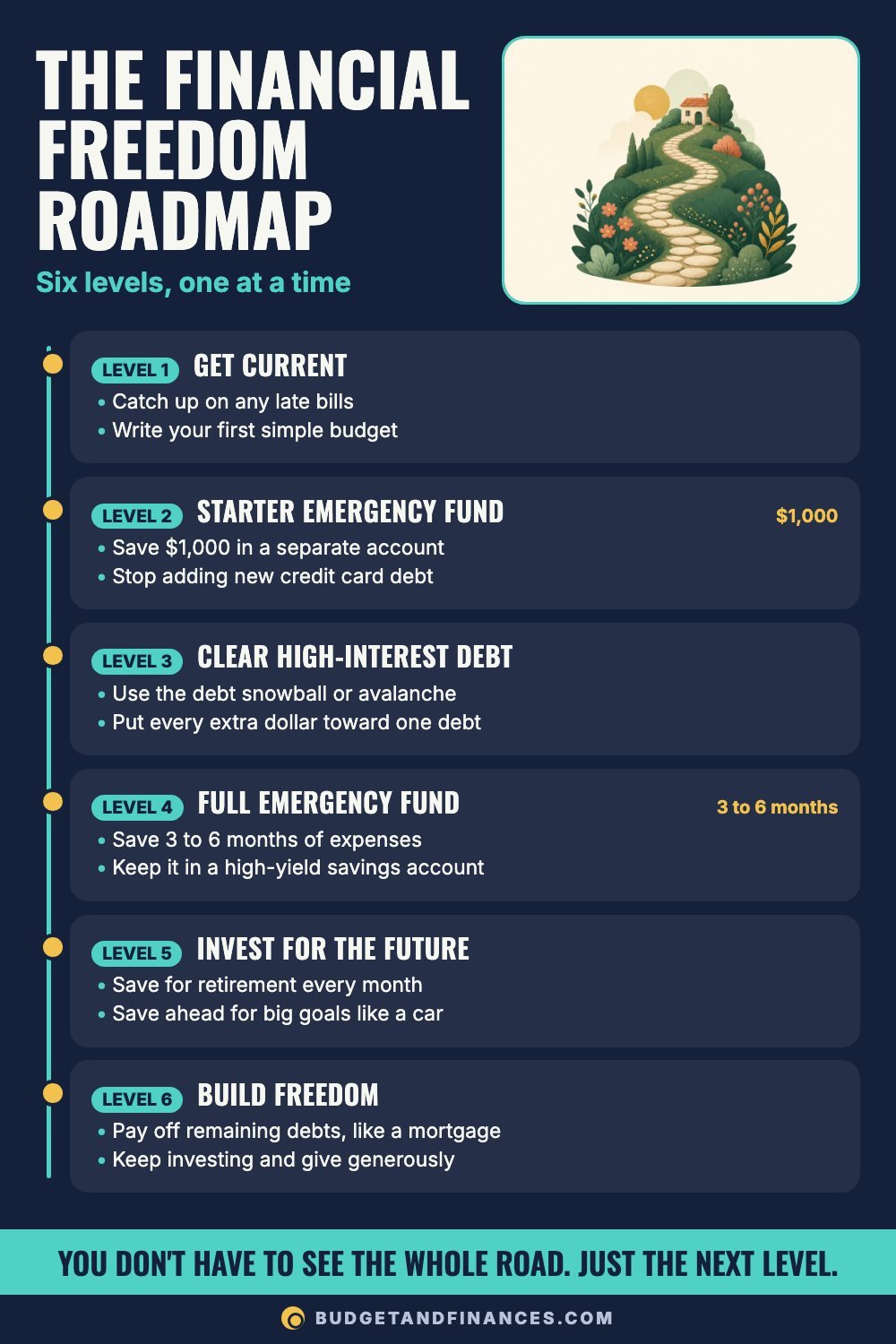
The 6 levels of the financial freedom roadmap
Level 1: Get current
- Catch up on any late bills.
- Write your first simple budget.
Late bills bring fees and stress, so they come first. If you’re behind, call the company and ask about a payment arrangement. Then write a budget for one month: income at the top, bills and spending below, and every dollar assigned somewhere.
You’ve finished this level when: every bill is current and you have a budget that lasted a whole month.
Level 2: Starter emergency fund ($1,000)
- Save $1,000 in a separate account.
- Stop adding new credit card debt.
$1,000 won’t cover every emergency, but it covers a lot of the common ones, and it keeps them off your card. Keep it in a separate savings account so it isn’t mixed with spending money.
You’ve finished this level when: $1,000 is sitting in its own account and your card balances aren’t growing.
Level 3: Clear high-interest debt
- Use the debt snowball or avalanche.
- Put every extra dollar toward one debt.
Two proven methods:
- Debt snowball: pay minimums on everything, and put extra money on the smallest balance first. Quick wins keep you motivated.
- Debt avalanche: pay minimums on everything, and put extra money on the highest interest rate first. This usually costs less in interest.
Pick the one you’ll stick with. When one debt is gone, roll its payment into the next.
You’ve finished this level when: credit cards and other high-interest balances are paid off.
Level 4: Full emergency fund (3 to 6 months)
- Save 3 to 6 months of expenses.
- Keep it in a high-yield savings account.
With high-interest debt gone, the money that went to those payments can build your full safety net. Aim closer to 6 months if your income is irregular or you’re the only earner in your household.
You’ve finished this level when: you have at least 3 months of essential expenses saved.
Level 5: Invest for the future
- Save for retirement every month.
- Save ahead for big goals like a car.
This is where long-term growth starts to do some of the work. Regular retirement saving, plus sinking funds for known big purchases, means the next car doesn’t become a new loan.
Level 6: Build freedom
- Pay off remaining debts, like a mortgage.
- Keep investing and give generously.
At this level, you have choices: an earlier retirement, a career change, more generosity, more time. That’s what financial freedom looks like in practice.
Pay off debt or build savings first?
This is the question that trips people up most. Here are the arguments on both sides.
Build savings first (protects you):
– A $1,000 cushion stops new card debt.
– Surprise bills don’t undo your progress.
– It helps you sleep at night.
– But keep going too long, and debt interest grows.
Pay off debt first (saves you interest):
– It frees up monthly payments faster.
– High-interest debt can cost more than savings earn.
– It’s motivating to see balances hit zero.
– But with no cushion, one emergency adds new debt.
That’s why many roadmaps, including this one, use a middle path: $1,000 saved, then high-interest debt, then more savings. Protect yourself a little, then go after the debt.
A budget built for moving up: $5,000 a month
Here’s one sample way to split $5,000 in monthly take-home pay while working through the levels. Adjust the percentages to fit your life.
| Category | % | Amount | Examples |
|---|---|---|---|
| Housing | 28% | $1,400 | Rent or mortgage, renters or home insurance |
| Transportation | 10% | $500 | Car payment, gas, maintenance, transit |
| Food | 11% | $550 | Groceries plus a little eating out |
| Utilities and phone | 6% | $300 | Electric, water, internet, phone |
| Insurance and health | 7% | $350 | Health premiums, copays, prescriptions |
| Extra debt payoff | 13% | $650 | Payments above the minimum on one debt at a time |
| Saving and investing | 15% | $750 | Emergency fund, retirement, sinking funds |
| Fun and personal | 10% | $500 | Hobbies, clothes, dates, small treats |
| Total | 100% | $5,000 |
Worked example: moving through the levels on this budget
Let’s follow the sample budget above. The numbers are for illustration.
Level 2. The $750 saving line goes to the starter emergency fund first. $750 in month one, and $250 more in month two, reaches $1,000. The rest of month two’s $750, which is $500, can start going toward retirement or sinking funds.
Level 3. The $650 extra debt line goes to one debt at a time. Over a year, that’s $650 x 12 = $7,800 in payments above the minimums.
Level 4. Once the high-interest debt is gone, the $650 that was going to extra payments is free. Add it to the $750 saving line and you have $1,400 a month to work with.
Essential spending in this budget, everything except extra debt payoff and saving, is $5,000 – $650 – $750 = $3,600 a month. So:
- 3 months of expenses: $3,600 x 3 = $10,800
- 6 months of expenses: $3,600 x 6 = $21,600
If all $1,400 a month went to the emergency fund, reaching $10,800 would take $10,800 / $1,400 = about 7.7 months. Since $1,000 is already saved from Level 2, it would be a bit quicker in practice. You might also choose to keep some money flowing to retirement during this level, which would stretch the timeline a little.
The point: once a level is done, its money doesn’t vanish. It rolls forward and speeds up the next one.
Milestones worth celebrating
The levels are big. Milestones break them into moments you can mark along the way:
- Your first real budget, one that lasted a whole month
- Your first $1,000 saved
- Your first debt paid off
- One month of expenses saved
- A card paid in full, with no balance carried to next month
- Automatic retirement investing set up
- Three months of expenses saved
- Consumer debt free: no cards, car or personal loans
- Six months of expenses saved, so most surprises won’t shake you
Celebrate them with something small and cheap. It keeps you going to the next one.
Habits that move you up a level
Motivation comes and goes. These habits keep progress going without it.
Automate the next level. Set the savings or extra debt payment to move on payday, so it happens without a decision.
Raise it when income rises. When you get a raise, send part of it to your current goal before your lifestyle absorbs it.
Keep a sinking fund. Save monthly for car repairs and gifts, so they don’t knock you back a level.
Track one number. Pick the number for your level, like debt left or months saved, and update it monthly.
Use windfalls on purpose. Tax refunds and bonuses can jump you ahead. Decide where they go before they arrive.
Expect setbacks. Dropping back a level after an emergency is normal. The fund did its job. Rebuild it.
Common mistakes
Skipping Level 2. Going straight at debt with no cushion often means the next car repair lands on a card.
Working on four levels at once. Splitting extra money across every goal makes each one move slowly. Focus on the current level.
Letting lifestyle eat every raise. A raise is the easiest time to boost your saving, because you never got used to spending it.
Stopping retirement saving entirely for years. If your employer matches contributions, many people keep contributing at least enough to get the match while working through the earlier levels.
Treating a setback as failure. Emergencies are what the fund is for.
FAQ
How long does it take to reach financial freedom?
It depends on income, expenses and debt. Levels 1 and 2 can take weeks or months. Levels 5 and 6 usually take many years. Focus on how long the current level will take.
Should I invest before paying off debt?
Many roadmaps put high-interest debt ahead of investing, because the interest on card debt is often higher than what investments may earn. Getting any employer retirement match is a common exception.
Where should I keep my emergency fund?
A separate savings account, often a high-yield savings account, so it earns some interest, stays easy to reach in an emergency, and isn’t mixed with spending money.
What counts as high-interest debt?
Credit cards and many personal loans usually do. There’s no official cutoff, but debts with higher rates cost you more each month and are typically paid first in the avalanche method.
What if my income is too low to follow this budget?
Use the order of the levels, not the percentages. Even $25 a month toward a starter fund counts. The steps stay the same; they just take longer.
Slow and steady still reaches the top. This is general education, not personal financial advice.