

Christmas comes every December. Your car needs tires every few years. The registration renewal shows up at about the same time each year.
None of these are surprises, but they often get paid like surprises: on a credit card, or out of the emergency fund, or by skipping something else that month.
Sinking funds fix that. You save a small amount every month for each cost you know is coming, so the money is sitting there when the bill arrives. Here’s the full categories list, the formula for how much to save, and a sample plan.
What is a sinking fund?
A sinking fund is money you set aside, a little at a time, for a specific expense you can predict. You know roughly what it will cost and roughly when you’ll need it.
Each fund has one job. When the time comes, you spend it. That’s the point, and it’s what makes a sinking fund different from an emergency fund.
Sinking funds vs emergency fund
They sound alike, but they cover different costs.
Sinking fund: for costs you can predict
– Saved for a specific, expected expense
– Examples: car tires, Christmas, vacation
– You know roughly when and how much
– Meant to be spent when the time comes
– Many small funds, one for each goal
Emergency fund: for surprises
– Covers true emergencies you can’t plan for
– Examples: job loss, urgent medical bills
– Timing and amount are unknown
– Used only when something goes wrong
– One fund, often 3-6 months of expenses
You need both. Sinking funds protect your emergency fund, because expected costs stop draining it. If it happens every year, give it a fund.
The sinking funds categories list
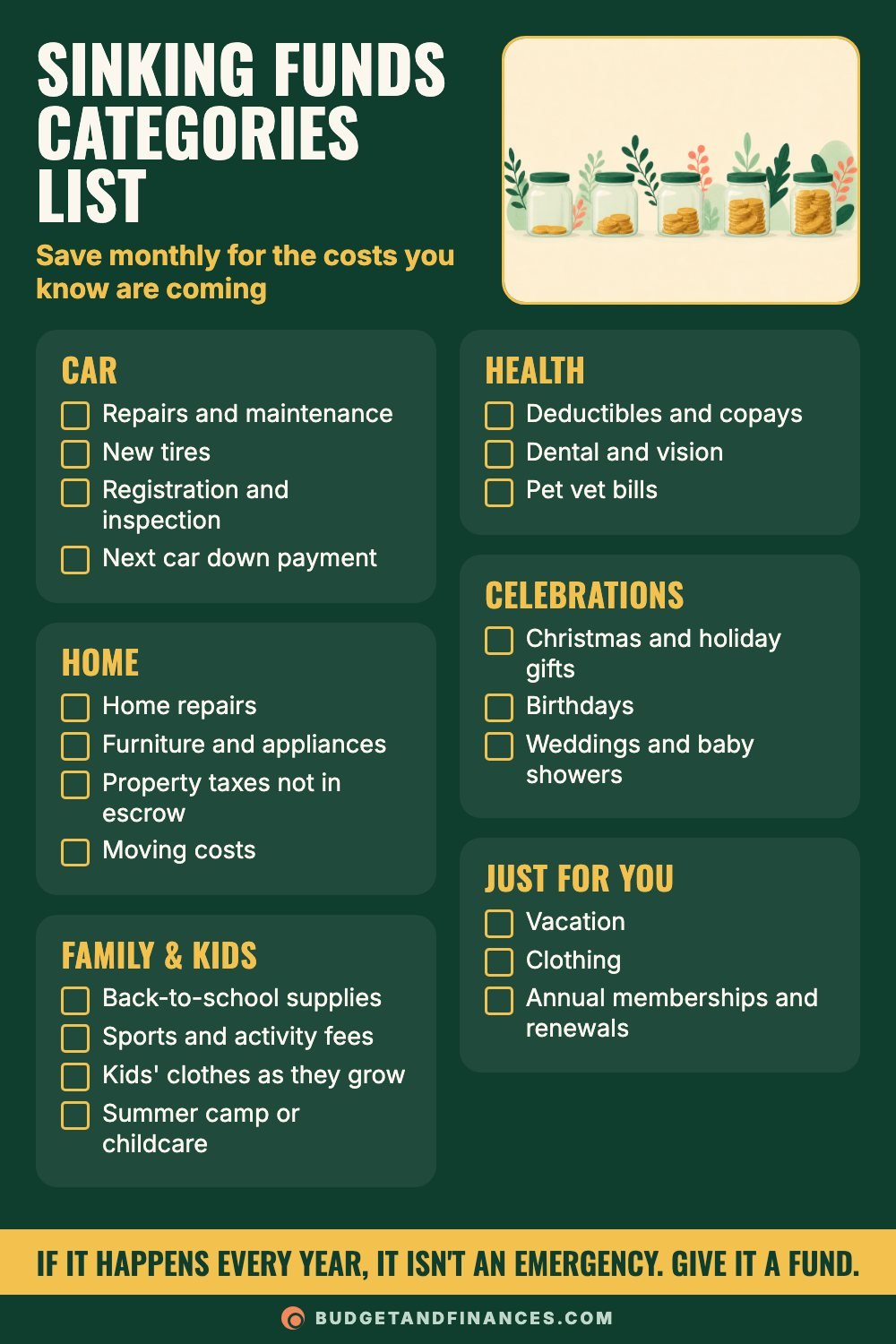
Here are 21 categories to choose from. You won’t need all of them. Pick the ones that fit your life.
Car
- Repairs and maintenance
- New tires
- Registration and inspection
- Next car down payment
Home
- Home repairs
- Furniture and appliances
- Property taxes not in escrow
- Moving costs
Family & kids
- Back-to-school supplies
- Sports and activity fees
- Kids’ clothes as they grow
- Summer camp or childcare
Health
- Deductibles and copays
- Dental and vision
- Pet vet bills
Celebrations
- Christmas and holiday gifts
- Birthdays
- Weddings and baby showers
Just for you
- Vacation
- Clothing
- Annual memberships and renewals
If you’re new to this, start with three or four funds. Car repairs, gifts and one yearly bill are a good first set. Add more once saving for them feels routine.
How to figure your sinking fund amount
Cost divided by months left. That’s the whole formula. Here’s how to use it.
Step 1: Write the total cost
Look at what you spent last year, or get a quote. Round up a little to be safe.
Step 2: Count the months left
Count the months between now and when you’ll need the money.
Step 3: Divide cost by months
A $900 car insurance bill due in 6 months means saving $150 a month.
Step 4: For yearly costs, divide by 12
A $600 Christmas budget works out to $50 a month if you start in January.
If you start late, the same formula still works with fewer months. With only 5 months left before you need that $600, you’d save $120 a month. Starting early keeps the monthly number small.
Step 5: If it’s too much per month
Lower the cost, move the date, or shift money from fun spending for a while.
Step 6: Keep a running balance
Track each fund’s total so you know what’s available when the bill comes.
Sinking fund examples with the monthly math
Here are nine common funds, with yearly costs turned into monthly savings. Swap in your own yearly amounts.
| Fund | Yearly cost | Monthly savings |
|---|---|---|
| Christmas | $720 | $60 |
| Car maintenance | $600 | $50 |
| Car registration | $120 | $10 |
| Back to school | $360 | $30 |
| Birthdays | $300 | $25 |
| Vacation | $1,800 | $150 |
| Pet care | $480 | $40 |
| Home repairs | $1,200 | $100 |
| Dental and vision | $540 | $45 |
If you used all nine, that would be $510 a month, or $6,120 a year. That’s a lot, which is why it makes sense to start with a few funds and grow the list over time.
Worked example: splitting $300 a month
Say you can set aside $300 a month for sinking funds. Here’s one sample plan to adjust for your family:
| Fund | Share | Monthly | What it covers |
|---|---|---|---|
| Car repairs & upkeep | 20% | $60 | Oil changes, tires, brakes, registration |
| Gifts & holidays | 20% | $60 | Christmas, birthdays, teacher gifts |
| Medical & dental | 15% | $45 | Deductibles, copays, dental cleanings, glasses |
| Home repairs | 15% | $45 | Appliance fixes, plumbing, yard and seasonal upkeep |
| Kids & school | 10% | $30 | Supplies, field trips, sports fees |
| Annual bills | 10% | $30 | Memberships, renewals, yearly subscriptions |
| Vacation | 10% | $30 | Travel, lodging, a weekend away |
| Total | 100% | $300 |
$300 a month is $3,600 a year for costs you know are coming.
Using the running balance
Say the car fund has been getting $60 a month for 8 months. The balance is $480. Then you need new tires, and the quote is $520.
The fund covers $480 of it. You’re $40 short, which is a small gap to cover from this month’s budget instead of a $520 charge on a card. Next time, you might raise the car fund a little.
How to use the sinking funds worksheet
The printable has the 21-category checklist on one side and a worksheet on the other.
On the checklist: check off every category that applies to your household this year.
On the worksheet, give each checked category its own row and fill in:
– Fund: the category name.
– Yearly cost: what you expect to spend, rounded up a little.
– Due month: when you’ll need it. Write “ongoing” for costs like car repairs that could come any time.
– Monthly amount: yearly cost divided by 12, or cost divided by months left if the date is close.
– Balance: update it each month when you save and whenever you spend from the fund.
Add up the Monthly amount column. That total is the sinking funds line in your budget. If it’s more than you can save, cut the list down or lower some costs until it fits.
Where to keep sinking fund money
Keep it out of your everyday checking account, so it doesn’t get spent by accident. Some people use one savings account and track each fund’s balance on paper. Others open several savings accounts, one per fund, if their bank allows it without fees.
Either way works as long as you always know how much belongs to each fund.
Common mistakes
Starting with too many funds. Ten funds at $10 each don’t build fast enough to cover anything. Start with the few that hurt most.
Using the emergency fund for predictable costs. Christmas and tires aren’t emergencies. When they come out of the emergency fund, it may be empty when a real emergency hits.
Not tracking balances. If you keep funds in one account, you need a running balance for each, or you’ll spend the gift money on car repairs.
Guessing the cost too low. Look at last year’s statements and round up.
Stopping the deposits after you spend. When you use a fund, keep saving into it for next time.
FAQ
How many sinking funds should I have?
There’s no set number. Many people start with three or four and add more as their budget allows. The right number is however many you can fund steadily each month.
Should sinking funds be in separate accounts?
It’s a matter of preference. One savings account with a written balance for each fund works fine. Separate accounts make the balances easier to see.
What if I need the money before the fund is full?
Use what’s there and cover the gap from your regular budget that month. It’s still much smaller than paying the whole cost at once.
Are sinking funds part of my budget?
Yes. Add the monthly total as a budget line, just like rent or groceries, and move the money on payday.