

Your budget tells you what happened this month. Your net worth tells you where all those months are adding up to.
It’s one number: everything you own minus everything you owe. It can be negative, positive, big or small. What matters is which way it moves over time.
If you’ve never calculated it, it can feel intimidating. It’s really just two lists and one subtraction. Here’s how to do it, what to count, and how to track it so you can see your progress.
What is net worth?
Net worth = total assets minus total debts.
- Assets are what you own that has value.
- Debts (also called liabilities) are what you owe.
That’s the whole formula. The only real work is making sure your lists are complete and your values are realistic.
Assets vs debts: what to count
Assets (what you own)
- Checking and savings balances
- Retirement and investment accounts
- Your home’s realistic sale value
- Your car’s current resale value
- Cash on hand
Debts (what you owe)
- Mortgage balance
- Car loan balance
- Student loan balances
- Credit card balances
- Personal loans and medical bills
Count what things are worth today, not what you paid. A car you bought years ago is worth its resale value now, not its sticker price. For a home, use a realistic sale estimate, not the highest number you’ve seen.
Many people leave out everyday belongings like furniture, clothes and electronics. They rarely sell for anywhere near what they cost, and leaving them out keeps your number honest.
How to calculate your net worth, step by step
Here’s a sample worked out, using made-up numbers.
Step 1: List what you have
- Checking: $1,200
- Savings: $3,500
- Retirement: $14,800
- Car value: $8,000
Step 2: Add up your assets
$1,200 + $3,500 + $14,800 + $8,000 = $27,500 in total assets.
Step 3: List what you owe
- Car loan: $6,500
- Student loan: $18,000
- Credit card: $2,100
Step 4: Add up your debts
$6,500 + $18,000 + $2,100 = $26,600 in total debts.
Step 5: Subtract
$27,500 – $26,600 = $900. That’s this sample net worth.
Step 6: Repeat on the same day
Update it monthly or quarterly, on the same day each time, like the first of the month. The trend over time tells you more than one number.
Worked example: tracking the trend for three months
Let’s keep going with the same sample person to see how tracking works.
Month 1: assets $27,500, debts $26,600, net worth $900.
Month 2: They keep paying down debt and adding to savings.
- Assets: checking $1,150, savings $3,800, retirement $15,100, car $7,850. Total: $27,900.
- Debts: car loan $6,250, student loan $17,850, credit card $1,700. Total: $25,800.
- Net worth: $27,900 – $25,800 = $2,100.
- Change: $2,100 – $900 = +$1,200.
Month 3:
- Assets: checking $900, savings $4,100, retirement $15,400, car $7,700. Total: $28,100.
- Debts: car loan $6,000, student loan $17,700, credit card $1,350. Total: $25,050.
- Net worth: $28,100 – $25,050 = $3,050.
- Change: $3,050 – $2,100 = +$950.
Notice a few things. Checking went down in month 3, and the car lost value every month. Net worth still rose, because debts dropped and savings grew. That’s why the total matters more than any one account.
Some months will go the other way. A big repair or a dip in a retirement account can pull the number down. One month is noise. Several months in a row is a trend.
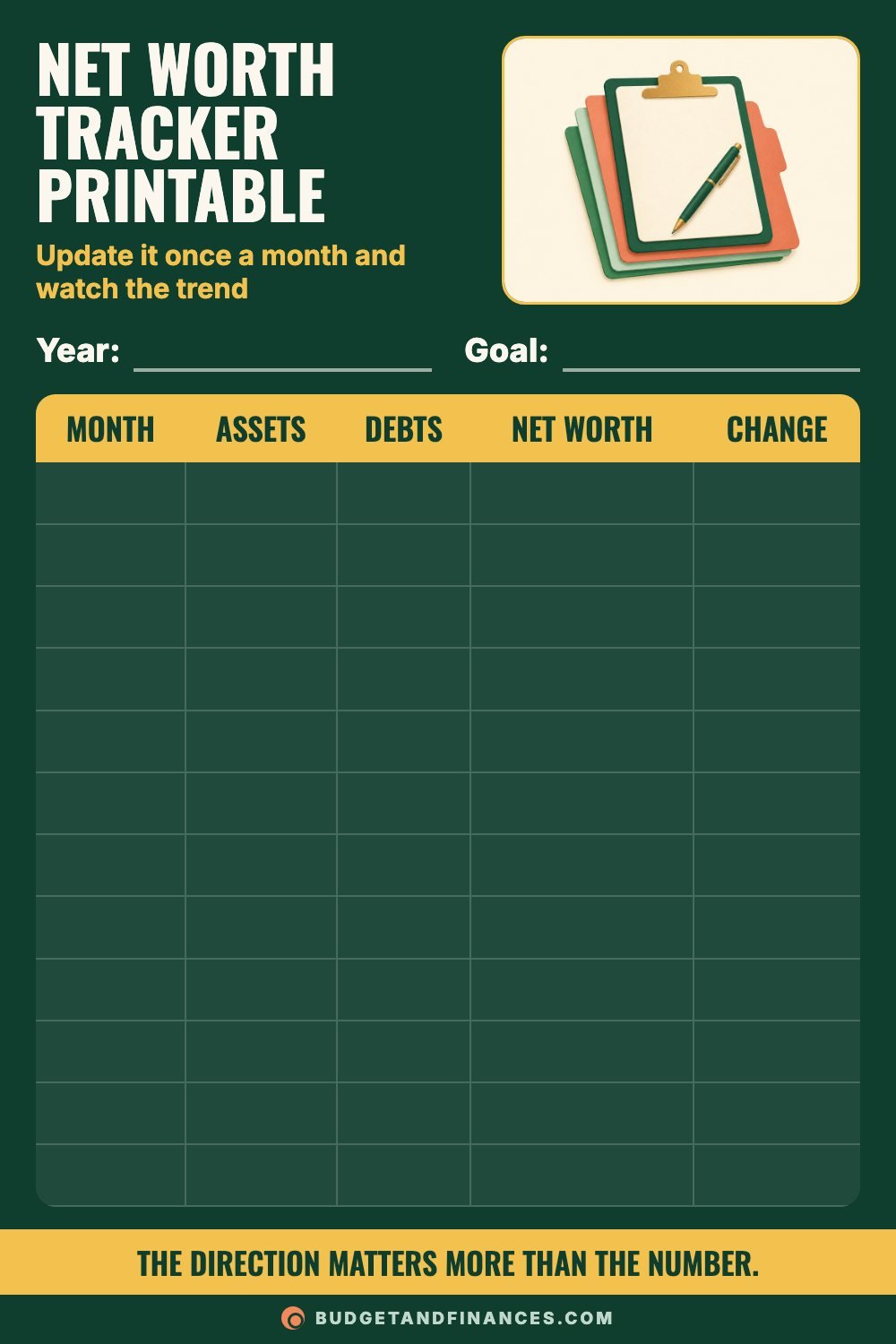
Get the free net worth tracker
The printable has space for a full year. For each month, write your total assets, total debts, net worth, and the change from last month. There’s room at the top for the year and your goal.
Why your net worth might be negative
If your number came out below zero, you’re in good company. Common reasons, and none of them mean you failed:
- Student loans. Common early in a career.
- A new mortgage. Little equity in the first years.
- A newer car loan. A car’s value can drop faster than the loan balance.
- Medical bills. Health costs you didn’t choose.
- Just starting out. Savings haven’t had time to grow.
- Starting over. After a divorce, a move or a job loss.
A negative net worth just means your debts are larger than your assets right now. Watch the trend, not today’s number. Negative today can be positive later.
Net worth milestones to aim for
Milestones give you something closer than “wealthy someday” to work toward.
Milestone 1: Know your number
- List every asset and every debt.
- Write down today’s net worth, even if it’s negative.
Milestone 2: Reach zero
- Pay down debts, especially high-interest ones.
- Stop adding new consumer debt.
Milestone 3: Get positive
- Build savings while debts shrink.
- Update your tracker every month.
Milestone 4: Your first $10,000
- Keep saving and investing on autopilot.
- Protect it with an emergency fund.
Milestone 5: Your first $100,000
- Stay consistent over many years.
- Growth tends to speed up as it builds, because investment returns and interest start adding more on top of what you put in.
Every milestone starts with writing the number down.
Common mistakes
Using purchase prices. Your car and home are worth what they’d sell for today. Using what you paid makes your net worth look higher than it is.
Forgetting smaller debts. Medical bills, a store card, money owed to a family member. If you owe it, count it.
Checking too often. Daily or weekly checks mostly show market swings. Monthly or quarterly is enough.
Comparing your number to other people’s. Age, income, location and student loans make comparisons unfair. Compare yourself to your own last update.
Counting retirement accounts at face value without thinking. It’s fine to include the balance, but remember some of it may go to taxes or fees when you eventually withdraw it. Just be consistent from month to month.
FAQ
How often should I calculate my net worth?
Monthly or quarterly works well. Pick one and use the same day each time so the numbers are comparable.
Should I include my home in my net worth?
Yes, as a realistic sale value, with the mortgage balance on the debt side. Some people also track a second version without the home to see their savings and investments more clearly.
Is a negative net worth bad?
It’s common, especially with student loans or a new mortgage. It shows where you’re starting. What matters is whether the number rises over time.
Do I count my 401(k) or retirement account?
Yes. Use the current balance shown on your statement. Just remember that balance can go up and down with the market.
What’s a good net worth for my age?
There isn’t one right answer, since income, debt and cost of living vary so much. A better goal is a net worth that’s higher this year than last.
The direction matters more than the number. This is general education, not personal financial advice.